
Mining the "Why": Detecting Hidden Outliers in Social Media Fan Marketing
Mining implict outlier purchasing behaviors from fan group marketing data
This paper introduces an enhanced data mining framework for identifying outlier purchasing behaviors in social media fan groups. Using a revised Outlier Degree (OD) calculation and association rule mining, the method identifies "implicit outliers" where expected items are missing and uncovers the specific products causing these deviations.
TL;DR
In the world of social media marketing, "fans" usually follow predictable purchasing patterns. But what happens when they don't? This paper presents a framework to detect implicit outlier behaviors—instances where a fan should have bought something but didn't. By filtering "noise" from rare items and using association rules, the researchers can pinpoint exactly which rare products are disrupting standard buying habits.
Background: The Social Recommender Paradox
Virtual communities and fan pages (like those on Facebook or X) are built on the principle of homophily: users have similar tastes. Businesses rely on this to build recommender systems. However, most research focuses on finding new fans. This paper argues that the real goldmine lies in studying the exceptions—the existing fans who deviate from the group norm. Identifying these outliers helps businesses understand community evolution and prevent fan "drift."
The Core Problem: The Dilution of Abnormality
Existing outlier detection tools for transactions, such as the Outlier Degree (OD), measure how much a transaction violates "standard" association rules. For instance, if everyone who buys Milk also buys Bread, a "Milk-only" transaction is an outlier.
However, previous models had a flaw: if a user bought "Milk" but also bought a very "Rare Item" (like a specialized battery), the model would often treat the transaction as more "unique" and thus less of an outlier regarding the Milk-Bread rule. Infrequent items were masking the missing frequent items.
Methodology: Redefining "Associative Closure"
The authors solve this by introducing a "clean-before-calculate" step.
1. The Filtered Outlier Degree
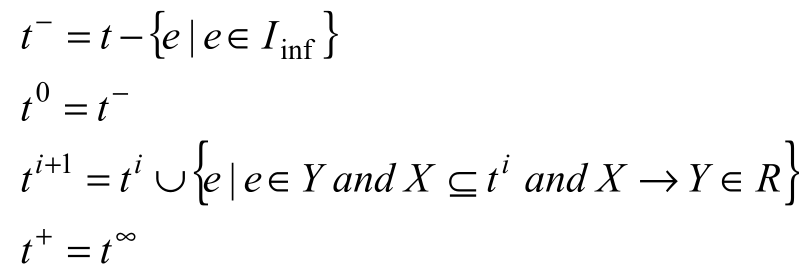
The framework removes infrequent items () before calculating the Associative Closure. This ensures that the outlier score is based purely on how well the fan adheres to established, frequent patterns.
2. Transaction Transformation
To find out why a behavior is abnormal, the authors transform the data. They create a new dataset where each row contains:
- Unobserved Frequent Itemsets: Items that should have been there based on high-confidence rules but were missing (marked with an asterisk, e.g.,
Bread*). - Infrequent Itemsets: The rare items actually present in the transaction.
By running the Apriori algorithm on this transformed data, they can find rules like:
{Rare Item A} → {Missing Item F}*
This suggests that Item A might be the reason fans are skipping Item F.
Experimental Insights
Using a synthetic dataset mimicking 16 fan group transactions and 9 products (labeled to ), the authors demonstrated the framework's utility.
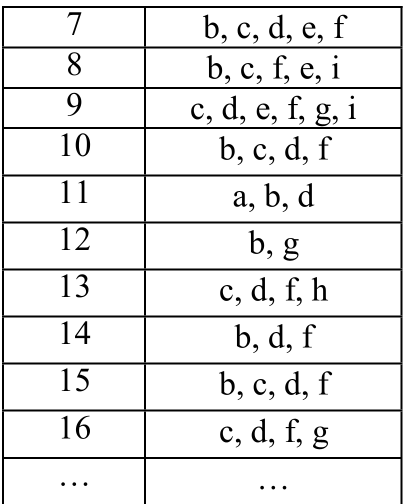
In the experiment, they identified that while Item and Item usually appear together, specific outliers were missing . Through their transformation, they discovered that Item was frequently present when was missing. For a marketing manager, this is a clear signal: fans who buy Item are losing interest in the standard Item bundle—perhaps Item is a competitor’s product or a substitute that requires a change in marketing strategy.
Deep Insight & Conclusion
This paper shifts the focus from Global Outliers (objects that are different from everyone) to Pattern-Violating Outliers (objects that specifically break "trust" rules).
Takeaway: The real value of data mining in marketing isn't just predicting what a user will do next, but understanding why they stopped doing what they usually do. By isolating infrequent "noise" from frequent "expectations," businesses can diagnose friction in their sales funnel before it leads to total fan loss.
Limitations: The study currently relies on synthetic data and a simplified assumption that items are the primary cause of deviation. Future work must incorporate external factors like time and sentiment to fully capture "Community Evolution."