
Digital Socratic Circles: Mining In-Class Social Networks via Multimedia
Mining in-class social networks for large-scale pedagogical analysis
The paper introduces an automated framework for mining in-class social networks through multimedia technology, specifically image stitching and face recognition. By recognizing student identities and their physical sitting arrangements over time, the authors construct student-to-student and student-to-teacher social networks to facilitate large-scale pedagogical analysis of academic performance.
TL;DR
Researchers from Sichuan University have bridged the gap between computer vision and pedagogy. By using image stitching and a novel "Social Inference" face recognition algorithm, they've automated the mapping of student seat-sharing patterns. Their findings prove that who you sit with (social centrality) is often a better predictor of your grades than where you sit (proximity to the teacher).
Background: The Scalability Wall in Education Research
For decades, education researchers have known that social learning matters. However, they were stuck in a "qualitative trap." To understand student dynamics, researchers had to hand-out surveys or conduct interviews, limiting studies to tiny sample sizes. While online social networks (like Facebook) offered big data, they didn't reflect the "natural" behavior of a physical classroom. This paper seeks to turn the physical classroom into a data-rich environment using only a standard camera.
Methodology: High-Stakes Face Recognition
Recognizing 60+ faces in a single, distorted, stitched panoramic image is a nightmare for standard algorithms. The students might be looking away, partially occluded, or blurred.
The Insight: Identity by Association
The authors' core technical contribution is the Social Inference scheme. Instead of looking at a face in isolation, the system asks: "Who is this person likely to be, given that they are sitting next to Student A and Student B?"

The process uses an iterative formula: Where the identity of student is updated by combining local visual evidence with the "social signals" of their neighbors. Over several classes, the model learns who frequently sits together (potential teammates), and this "social prior" drastically improves recognition accuracy in tough visual conditions.
Localization via Linear Regression
To map "who sits where," the authors used image alignment and RANSAC-optimized linear regression to define "row" and "column" lines across stitched images, allowing the system to handle the perspective distortion inherent in wide-angle classroom photography.
Experiments & Results: Debunking Classroom Myths
The study followed 379 students across six courses. The technical results were impressive: adding "Social Network (SN)" data to standard baselines like Sparse Coding or Eigenfaces boosted recognition rates by ~30%.
Pedagogical Insights: Interaction vs. Location
The most fascinating part of the study is the pedagogical analysis.
- Student-to-Student: High Betweenness Centrality (being a bridge between different groups) and Closeness (having short paths to all other students) were strongly correlated with higher grades. Successful students are "social hubs."
- Student-to-Teacher: Unlike the "common sense" belief that sitting in the front row guarantees success, the authors found a much noisier correlation. Using RANSAC to find a "Majority Model," they discovered that while most successful students do sit near the front, there is a significant group of "self-starters" who sit in the back but engage with teachers after class, skewing smaller, traditional studies.
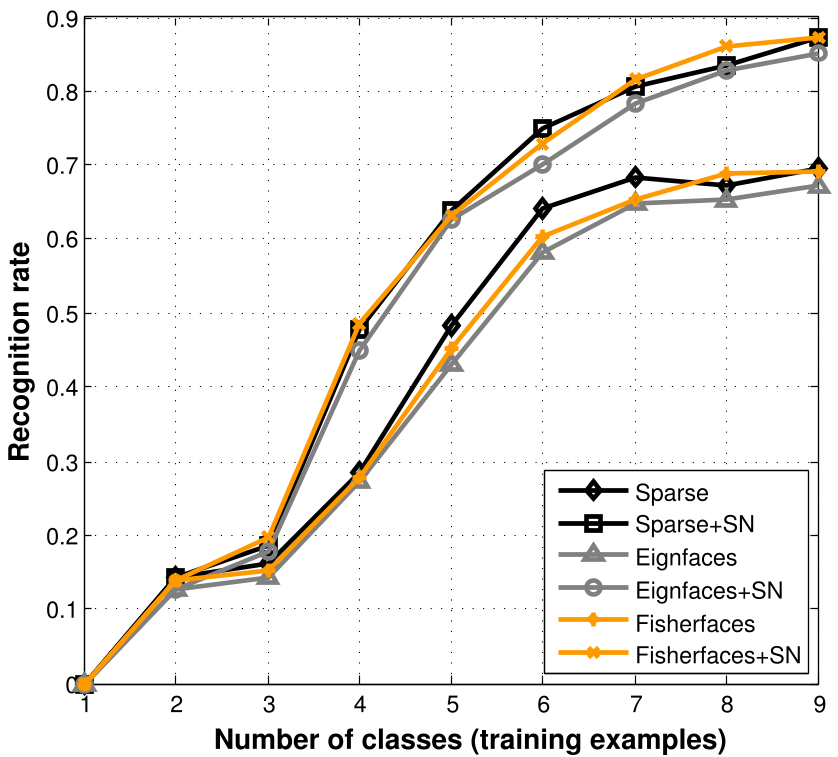 Fig: The accuracy jump when adding Social Network (SN) context to standard face recognition baselines.
Critical Analysis & Conclusion
Takeaway
This paper is a pioneer in "Computational Pedagogy." It proves that we don't need invasive sensors to track social capital; we can infer it from the physical "traces" of where people choose to sit.
Limitations
The study assumes that physical proximity equals social interaction. While true for "co-learning" groups, it might miss digital interactions (texting/messaging) occurring in the classroom. Additionally, the face recognition rate of 65%, while a massive improvement, still requires some manual "self-labeling" by students to maintain a perfect ground truth.
Future Outlook
As we move toward "Smart Campuses," this methodology could be scaled to identify at-risk students who are socially isolated early in the semester, allowing for pedagogical interventions before their grades suffer.