
Efficient Link Prediction: Balancing Accuracy and Speed in LBSNs
Mining Individual Features to Enhance Link Prediction Efficiency in Location Based Social Networks
This paper presents a strategy to enhance link prediction efficiency in Location-Based Social Networks (LBSNs) by mining individual feature costs and performances. By identifying a subset of "Only Successful Low Cost Features" (OSLCF), the authors achieve a 20x speedup in prediction tasks using Naive Bayes, Bayesian Network, and Random Forest classifiers on the Gowalla dataset.
TL;DR
In the world of Location-Based Social Networks (LBSNs) like Foursquare or Gowalla, predicting who will become friends is vital for growth. However, accuracy often comes at the price of speed. This paper explores how to slash prediction time by 20x while maintaining over 99% of original accuracy by identifying and removing "computational bottlenecks"—features that are expensive to calculate but offer redundant information.
The Hidden Cost of Accuracy
Most research in Link Prediction (LP) focuses on the "What"—what features (like Common Friends or Jaccard Coefficient) make a prediction more accurate? But for an industry professional, the "How Fast" is just as critical.
The authors observed that as they added more semantically rich features (e.g., common check-ins, location entropy), the time required to extract these features for billions of potential user pairs skyrocketed. Some graph-based features, like Shortest Path Distance (SPD), require traversing massive graphs, making them impractical for real-time recommendation engines.
Methodology: The Efficiency Frontier
The core insight is simple yet powerful: Not all features are created equal. Some are "Cheap and Smart," while others are "Expensive and Redundant."
1. Feature Categories
The study utilizes 25 features categorized into:
- Topological Features: Derived from the friendship graph (e.g., Common Friend Count).
- Interaction Features: Derived from check-in data (e.g., Common Place Count, Location Entropy).
2. The OSLCF Selection Strategy
To find the most efficient subset, the authors followed a two-step heuristic:
- Thresholding by Performance: Only keep features whose individual ROC-AUC is higher than the median.
- Filtering by Cost: Remove the "Top 3" most expensive features in terms of extraction time (milliseconds per pair).
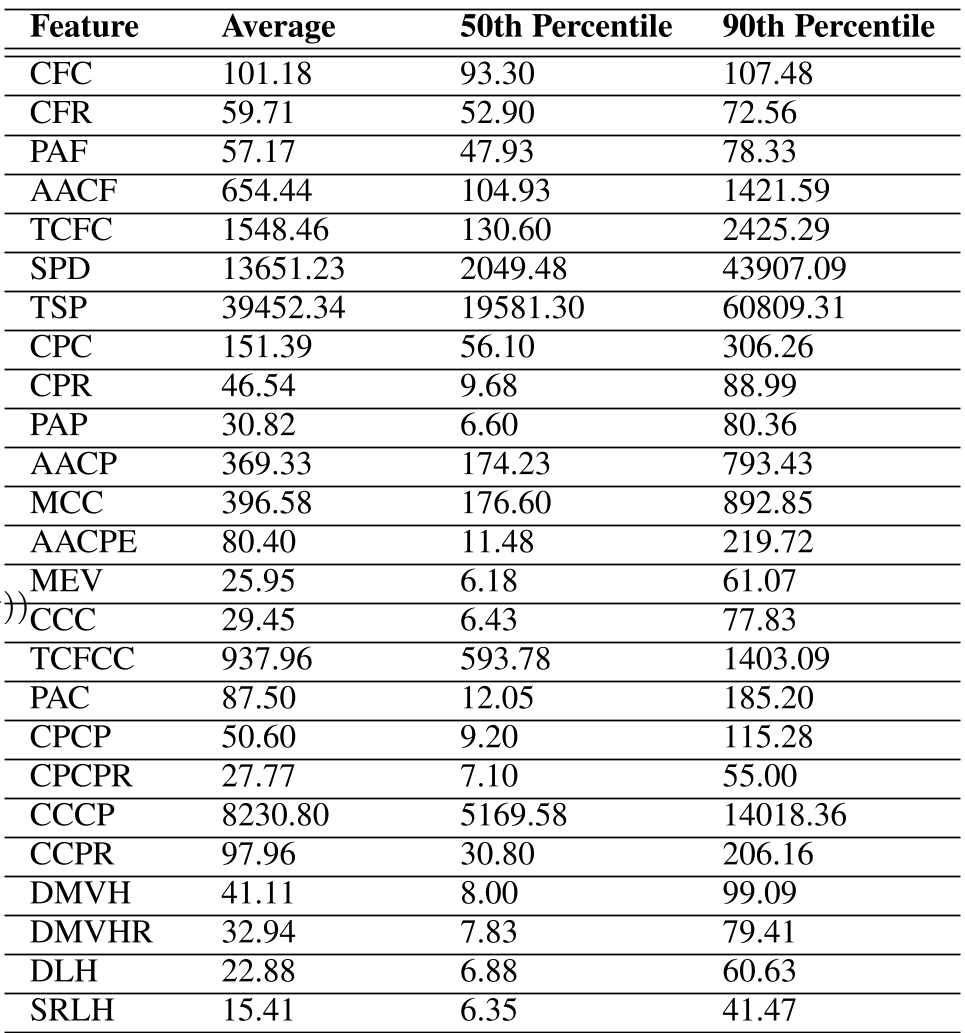 Table: Individual feature extraction costs (Average, 50th, and 90th percentile).
Experimental Insights: 20x Faster, Same Results
The authors tested their approach using the Gowalla dataset with three classifiers: Naive Bayes (NBC), Bayesian Network (BN), and Random Forest (RF).
Key Findings:
- The "Heavy" Culprits: Features like
SPD(Shortest Path Distance) andTSP(Total Shortest Paths) took an average of 13,651ms and 39,452ms respectively. - The "Efficient" Winners: Location-based features like
Common Place Count (CPC)andRadius Length from Home (SRLH)were significantly faster (under 160ms/20ms) and provided high information gain. - Performance Stability: For Bayesian Networks, removing high-cost features actually maintained a high ROC-AUC (~0.95), suggesting that cheaper interaction features can effectively "proxy" for expensive topological ones.
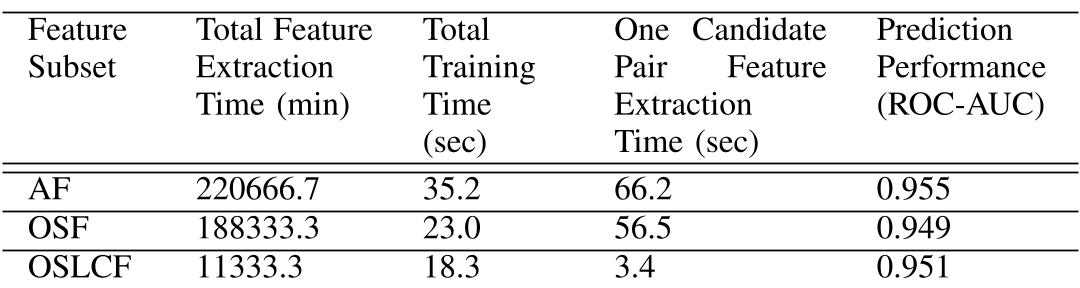 Table: Comparison of Performance (ROC-AUC) vs. Extraction Time for Bayesian Networks.
Deep Insight: Redundancy is the Enemy
Why didn't accuracy drop when we removed the "best" topological features? The paper suggests a redundancy effect. In LBSNs, if two people share many common friends (expensive to calculate), they likely also share many common check-in locations (cheaper to calculate). By leaning on "Interaction Features," we capture the same social proximity at a fraction of the computational cost.
Critical Analysis & Conclusion
Takeaway
For developers building recommendation systems, the lesson is clear: Measure your feature extraction latency. Moving from "All Features" to "Only Successful Low Cost Features" (OSLCF) can reduce processing time from months to days without hurting user experience.
Limitations
- Dataset Specificity: The findings are based on the Gowalla dataset from 2010; modern social graphs are even denser, which might change the cost-benefit ratio of certain features.
- Greedy Selection: The two-step selection is a heuristic. A more robust approach might involve a multi-objective optimization (Pareto frontier) to find the absolute best accuracy-speed trade-off.
Future Outlook
The next step for this research involves exploring online learning, where the model could dynamically decide which features to extract based on the initial "cheap" signals it receives from a user pair.