
PMPM: Unveiling the Hidden Rhythms of Personal Life via GPS Traces
Mining Individual Mobility Patterns Based on Location History
This paper introduces PMPM (Periodic Mobility Pattern Mining), a comprehensive framework designed to adaptively detect periodic parameters and mine individual mobility patterns from raw GPS trajectories. The framework achieves state-of-the-art efficiency in stay-point detection and reference spot clustering, significantly outperforming traditional baseline methods.
TL;DR
Trajectory data is more than just coordinates; it’s a signature of human habit. The PMPM (Periodic Mobility Pattern Mining) framework automates the discovery of these habits. By moving away from fixed manual parameters and utilizing a clever probabilistic model for periodicity, PMPM identifies where you go and how often you return with significantly higher computational efficiency than previous SOTA methods.
The Problem: The "Fuzziness" of Human Movement
Most trajectory mining algorithms suffer from three fatal flaws:
- Manual Periodicity: They assume a user follows a 24-hour cycle. But what if the cycle is weekly, or bi-weekly?
- The High-Dimensional Trap: Treating every GPS point as a feature leads to a combinatorial explosion.
- Spatial Noise: GPS drifts (especially indoors) create "clusters" that aren't actually stay points.
Research intuition suggests that human behavior is inherently periodic. The authors' insight was to treat spatial locations as binary signals (Present/Absent), allowing them to use signal processing techniques to "detect" the rhythm of a person's life rather than guessing it.
Methodology: The PMPM Pipeline
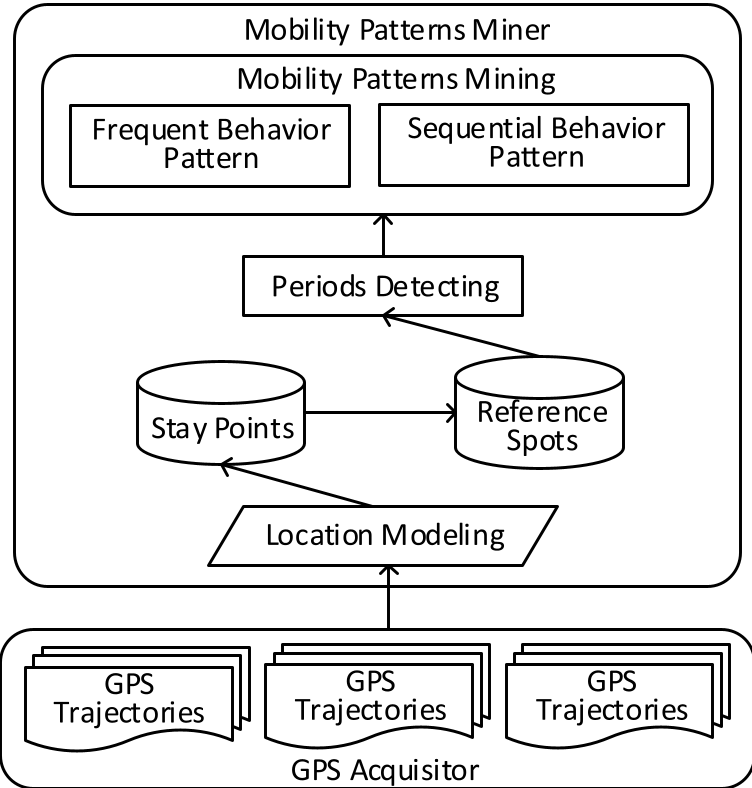
The framework is divided into three logical phases:
1. Location Modeling (Precision Cleaning)
First, raw data is pruned via VDTPruning (Velocity, Distance, Time). Then, the system identifies Stay Points—areas where a user lingers. To bridge the gap between "nearby points" and "semantic locations" (like 'Home' or 'Office'), the authors use the CFS Clustering Algorithm. Unlike K-Means, CFS doesn't ask you for the number of clusters; it finds them based on density peaks.
2. Probabilistic Period Detection
This is the "secret sauce." The trajectory is converted into a 0-1 binary sequence.
- 1: User is at the Reference Spot.
- 0: User is elsewhere. Using a probabilistic distribution vector, the system calculates the likelihood of various periods (). It picks the that maximizes the difference between domestic and external distributions, effectively "learning" if a spot is a daily office or a weekend getaway.
3. Pattern Mining
Once the period is known, the system applies:
- Apriori: For Frequent Behavior (e.g., "This user is at Spot A 60% of the time").
- PrefixSpan: For Sequential Behavior (e.g., "Office -> Gym -> Home").
Experiments: Speed and Accuracy
Testing on the Geolife 1.2 dataset (178 users over 4 years), the results were striking. PMPM demonstrated a significant speed advantage over the baseline established by Zheng et al.
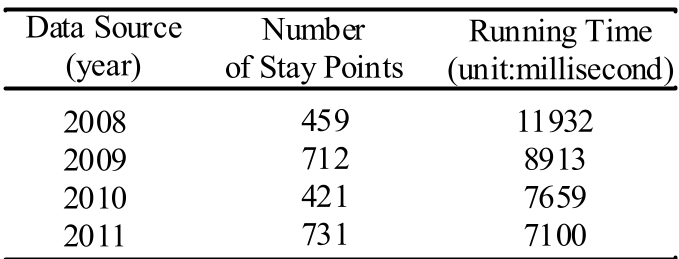 Stay Point Detection efficiency: PMPM processed 2010 data in 3,319ms, nearly 2.3x faster than the baseline's 7,659ms.
The model accurately successfully identified that different locations have different "breathable" periods. For instance, Reference Spot 1 (likely a workplace) showed a 23-24 hour period, whereas others showed a 168-hour (weekly) period, confirming the model's ability to distinguish between workdays and weekends.
Critical Insight & Future Outlook
The brilliance of PMPM lies in its data reduction. By converting millions of GPS points into a handful of "Reference Spots" and then into "Binary Sequences," the "Combinatorial Explosion" problem is bypassed entirely.
Limitations: The current framework is purely individual. The next frontier, as the authors suggest, is Group Mobility Patterns. Imagine a system that doesn't just know your schedule, but identifies "Social Clusters"—groups of people who share the same rhythms, potentially revolutionizing urban planning and social networking.
Takeaway: If you are building LBS applications, stop pre-setting your time windows. Let the data's own probability distribution tell you when the user is likely to return.