
InFlowMine: Beyond Edge Probabilities to Real-Time Content Flows
Mining Influencers Using Information Flows in Social Streams
The paper introduces InFlowMine and NDIF, a data-driven framework for mining information flow patterns and influencers in social streams. Traditionally focused on static edge-based transmission, this method shifts to a content-centered approach, achieving an order of magnitude speedup in flow discovery and significantly higher influence scores compared to SOTA baselines like PMIA.
TL;DR
Social influence research has long been stuck in "probability-land," where experts guess the likelihood of one person influencing another based on static graph edges. In the paper Mining Influencers Using Information Flows in Social Streams, the authors flip the script. Instead of predicting potential influence, they mine actual content transmissions to find "Information Flows"—the literal path a hashtag or idea takes through a network. The result? A system called InFlowMine that is 10x faster and far more accurate at identifying the "epicenters" of social trends.
Contextual Positioning: Data-Driven vs. Model-Driven
In the academic coordinate system, this work sits at the intersection of Sequential Pattern Mining and Social Influence Maximization. While classics like Kempe et al. (2003) defined the theoretical bounds of influence using Independent Cascade (IC) models, they relied on pre-defined edge weights. This paper argues that influence is highly contextual; someone might be a "god" in the #DataMining category but a "ghost" in #GlobalPolitics. By analyzing the social stream (the actual content), the authors create a purely data-driven model.
The Problem: The "Static Edge" Trap
Most SOTA (State Of The Art) methods assume:
- Static Probabilities: If you follow me, I have a fixed chance of influencing you.
- Generic Influence: Influence is treated the same regardless of what is being shared.
The authors point out that real life is dynamic. Influencer behavior depends on the time, the topic, and the velocity of the stream. Static models fail to separate coincidental activity from true causal influence.
Methodology: How InFlowMine Works
The core of the methodology is a two-pronged attack: Pattern Mining and Greedy Selection.
1. InFlowMine (Pattern Extraction)
The authors use a "level-wise" approach. Instead of checking every possible sequence (which grows exponentially), they only look at sequences that:
- Follow valid edges in the graph (Valid Flow Path).
- Appear frequently across different content tokens (Frequent Flow Path).
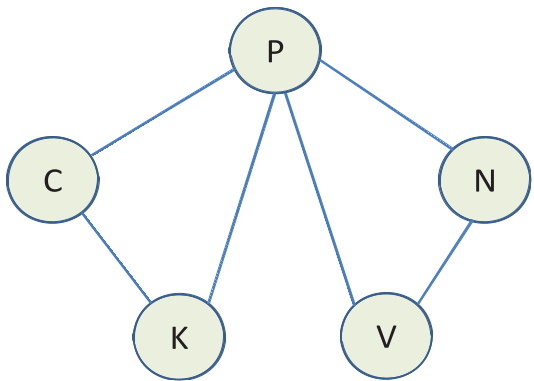 Fig 1: The relationship network acts as a constraint filter for content propagation.
2. NDIF (Influence Maximization)
Once the "highways" of information are mapped, the NDIF algorithm calculates which nodes sit at the start of the most frequent and longest flows. Crucially, they prove that their influence function is sub-modular, allowing them to use a greedy selection process that guarantees results within 63% of the absolute mathematical optimum.
Experiments & Results: Speed and Precision
The researchers tested their system on 1.9 million tweets and the DBLP publication database.
- Efficiency: On the Twitter dataset, InFlowMine handled nearly 2 billion edges and 120 million nodes effortlessly. Compared to the baseline (PrefixSpan), InFlowMine stayed linear in runtime while others spiked exponentially as support levels dropped.
- Effectiveness: When measuring "Influence Score" (how many people an influencer actually reaches), NDIF crushed heuristics like DegreeDiscountIC.
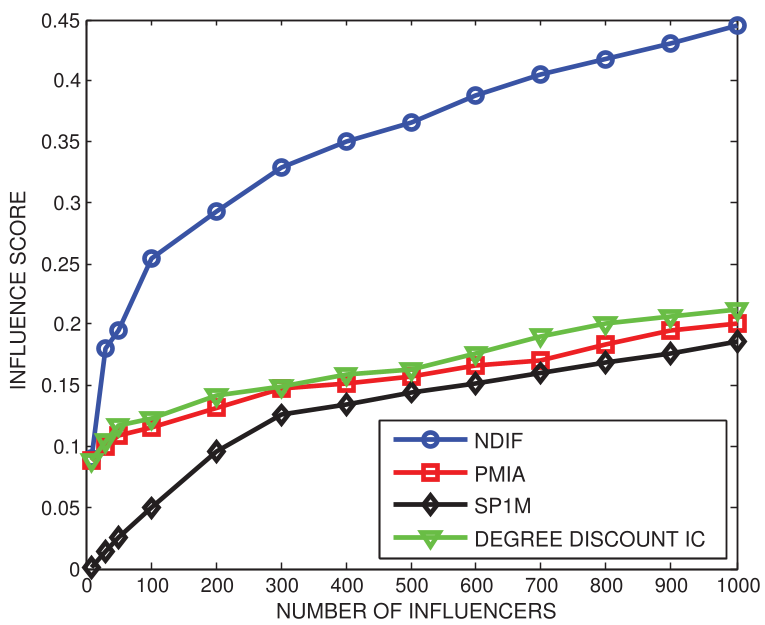 Fig 2: Influence Score comparison on different datasets. NDIF (our) consistently outperforms baselines.
A Novel Application: Flow-Based Egonets
One of the most striking parts of this research is the Flow-Based Egonet. Unlike a standard ego network (a person and their friends), a flow-based egonet shows a person and their "Propagandists"—the specific people who actually carry their voice further into the network.
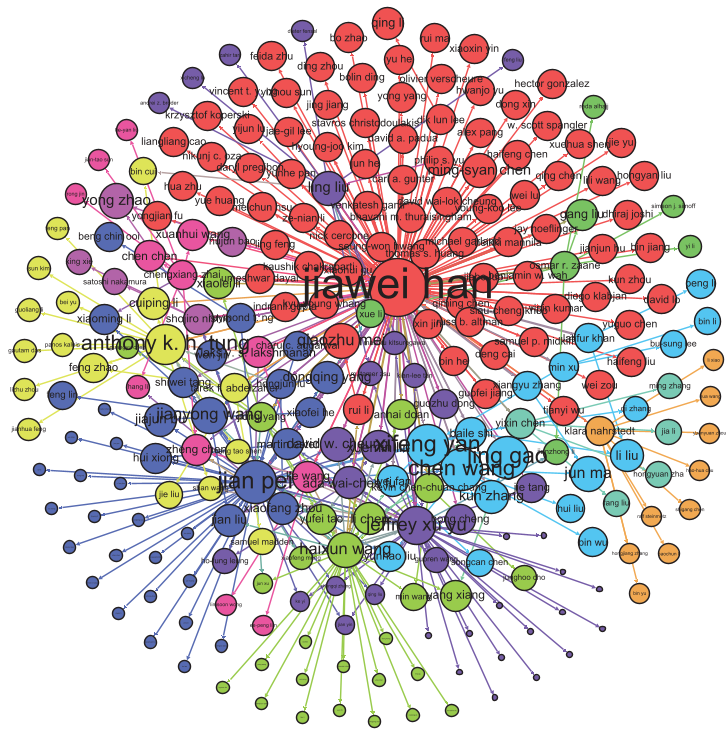 Fig 3: Flow-based Ego networks for researchers like Jiawei Han, showing specialized "propagandist" nodes.
Critical Analysis & Takeaways
Key Contributions:
- Integration: It merges content, time, and structure into a single unified framework.
- Scalability: The use of online hashing for content tracking makes it viable for production-level social streams.
Limitations:
- The model relies on the first time a user posts content to build a flow. While this avoids spam, it might miss "re-engagement" influence.
- It assumes an undirected graph for simplicity in some calculations, which might lose nuance in platforms like Twitter where follow/follower relationships are strictly directed.
Future Outlook: This work paves the way for "Just-in-time Recommendations." By understanding the literal channels (flows) through which information travels, platforms can recommend content not just to users, but to active flow channels, accelerating the "viral" potential of information.