
Beyond Connectivity: Harvesting Social Influence through Behavior and Sentiment Analysis
Mining Initial Nodes with BSIS Model and BS-G Algorithm on Social Networks for Influence Maximization
This paper introduces the BSIS (Behavior and Sentiment Influence Spread) model and the BS-G greedy algorithm to address the Influence Maximization (IM) problem in social networks. By integrating user behavior tendencies, time-delay factors, and expanded sentiment analysis, the approach achieves superior seed node selection compared to traditional IC and LT models.
TL;DR
The Influence Maximization (IM) problem has long been dominated by structural models like Independent Cascade (IC). This paper argues that who we follow is less important than how we interact. By introducing the BSIS (Behavior and Sentiment Influence Spread) model and the BS-G algorithm, the authors incorporate sentiment polarity and behavioral latency into the IM equation, significantly outperforming traditional benchmarks on large-scale platforms like Flickr and Microblog.
The Missing Link: Why Graph Structure Isn't Enough
Most IM research focuses on the "plumbing" of a social network—the edges and nodes. However, true viral marketing depends on human psychology. Two primary gaps exist in current SOTA methods:
- Sentiment Neglect: Traditional models treat all interactions as equal, ignoring whether a comment is positive, negative, or neutral.
- Temporal & Behavioral Blindness: The time it takes for a user to react (latency) and the frequency of their interactions are vital indicators of "intimacy" and "influence," yet they are often absent from the propagation probability.
Methodology: The BSIS Model
The core innovation lies in defining "Comprehensive Influence" as a sum of two sophisticated components.
1. Behavior and Time-Delay (BTInf)
Influence isn't just about presence; it's about response. The authors define behavior influence by calculating the ratio of interaction behaviors (likes, reposts) relative to total activity. Crucially, they introduce an exponential decay factor based on average delay-time. If User V responds to User U faster than their personal average, the influence weight increases.
2. Expanded Sentiment Analysis (SInf)
Social media language evolves rapidly. The authors didn't just use static dictionaries like NTUSD; they built a training model to expand them.
- Algorithm: Using marked-comment datasets (e.g., Joybuy), they calculate sentiment weights based on the probability of a word appearing in positive vs. negative contexts.
- Contextual Awareness: The model accounts for degree adverbs. A "not good" comment is mathematically flipped to ensure the sentiment score reflects reality.
3. The BS-G Algorithm
To select the initial "seed" nodes, the authors utilize a Greedy approach optimized for the BSIS model. They calculate the Marginal Gain—the additional influence a new node brings to an existing set—ensuring that the chosen seeds provide the maximum possible spread across the network.
 The final sentiment weighting formula, balancing frequency and probability.
Experimental Evidence: Real-World Impact
The researchers tested their model on distributed Hadoop/Spark clusters using data from Flickr (40k nodes) and Microblog (412k nodes).
SOTA Comparison
When compared against traditional IC (Independent Cascade), LT (Linear Threshold), and the more recent CDNF (Credit Distribution with Node Features), BSIS consistently picked seeds that generated a higher "Total Influence."
Real Action Validation
The most compelling result is the "Action Number" metric (the sum of actual clicks, comments, and reposts). The seeds identified by BS-G didn't just "mathematically" influence the network; they triggered more real-world engagement.
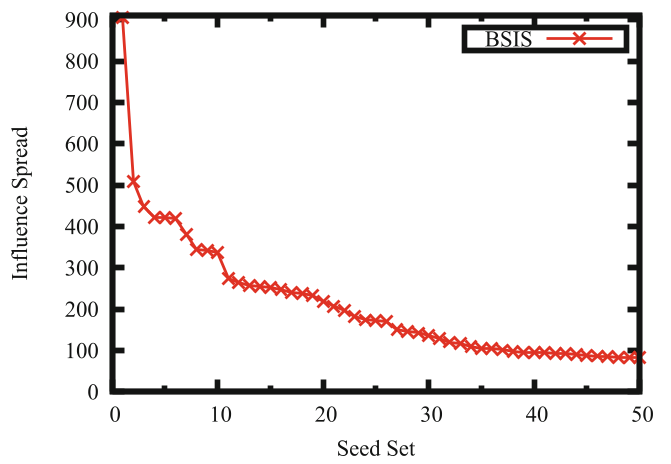 Figure 1: Comparison of total influence spread on the Flickr dataset.
Critical Insight & Conclusion
The BSIS model proves that Influence = Behavior + Sentiment. By moving away from purely topological metrics and toward "Behavioral Intimacy," the authors provide a more robust framework for viral marketing and opinion monitoring.
Limitations: While powerful, the model relies heavily on the availability of comment text and timestamp data. In privacy-restricted environments where only "follow" relationships are visible, the BSIS model's performance would likely degrade.
Future Outlook: The next step in this evolution will likely involve integrating Graph Neural Networks (GNNs) to automatically learn these behavioral patterns, potentially removing the need for hand-crafted sentiment dictionaries.