
Mining the Invisible Influencers: Scaling Telecom Marketing via Social Leaders
Mining of Leaders in Mobile Telecom Social Networks
This paper introduces a precision marketing strategy for telecom operators by identifying influential "leaders" within mobile social networks using the PageRank algorithm on Apache Spark. By leveraging peer influence, the method aims to boost mobile data consumption and user engagement, validated through a large-scale real-world deployment with China Mobile.
TL;DR
In the hyper-competitive telecom landscape, "spray and pray" advertising is dead. This paper demonstrates a highly effective alternative: treating the telecom network as a social graph. By identifying "Leaders"—users with high social capital—using PageRank on an Apache Spark cluster, authors achieved a staggering 150% increase in mobile traffic growth for China Mobile.
Background: The Social Physics of Data Usage
Why do you upgrade your data plan? Is it because of a billboard, or because your friends are all using a new data-hungry video app? Sociology suggests the latter. Modern telecom operators sit on a goldmine of Big Data, specifically interaction records (calls and SMS). This paper shifts the focus from the individual to the Communication Circle, positing that the key to marketing efficiency lies in the "physics" of peer influence.
Methodology: From Big Data to Actionable Circles
The authors propose a multi-stage pipeline designed to handle the scale of 4 million users and 3.6GB of relational data.
1. Community Extraction (Snowball Sampling)
Processing a national-level network is computationally prohibitive. Instead, the authors use Snowball Sampling to capture a seed user's two-layer contacts. This preserves the local social structure necessary to identify influence without needing to process the entire global graph at once.
2. Identifying Leaders via PageRank
While PageRank is famous for ranking websites, the authors apply it here to rank human influence. A leader's importance is defined not just by how many people they call (out-degree), but by the importance of the people they interact with.
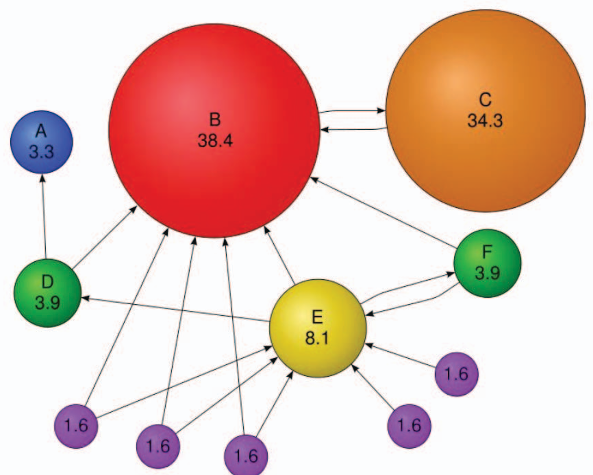
Fig: The logic of influence—the importance of node 'j' is derived from the weighted importance of its neighbors 'i' and 'k'.
3. Distributed Computing with Spark GraphX
To handle 220,000 root users and their expansive networks, the team utilized Apache Spark. By leveraging GraphX, they could perform 100 iterations of PageRank over millions of edges, a task that would be impossible on traditional relational databases.
Experimental Results: The Viral Effect
The strategy was put to the test at China Wuxi Mobile. The experiment targeted users with low data usage (50MB-100MB) and incentivized the identified "Leaders" with "Commune Credits."
The results were dramatic:
- Traffic Volume: The growth rate jumped from 36% (Sept) to 150% (Oct).
- User Acquisition: Registered users in the target community grew by 87.8%.
- Sustained Engagement: While growth slowed slightly in November, it remained significantly higher than the pre-strategy baseline.
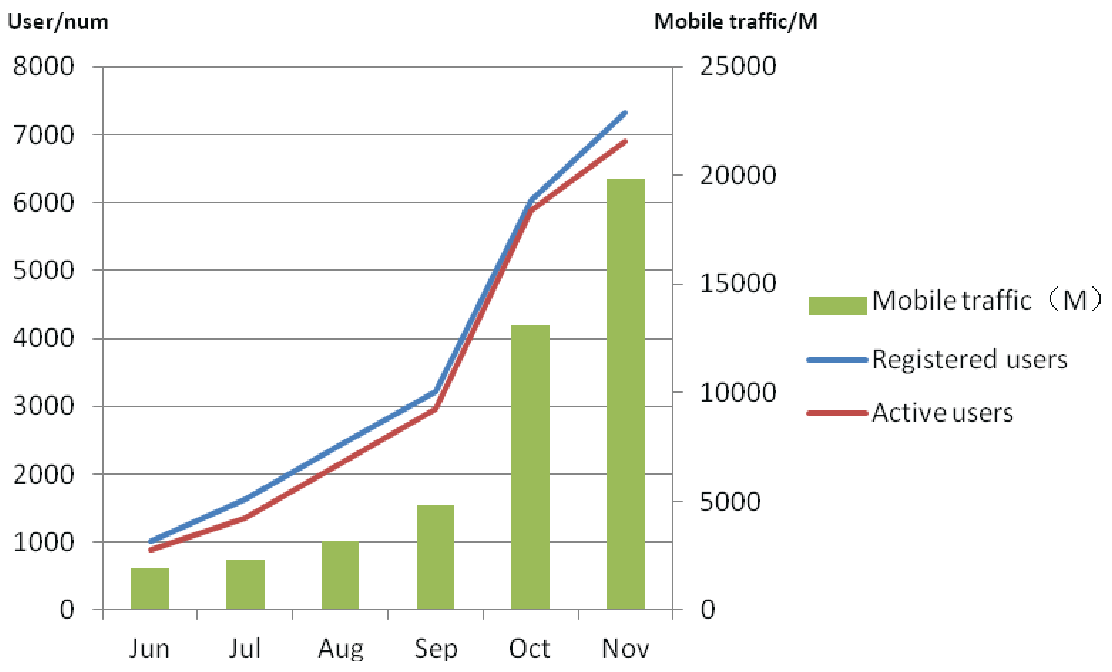
Fig: Comparison of user growth and traffic consumption before and after leader-based marketing.
Critical Analysis & Professional Insights
The true brilliance of this work isn't just the algorithm—PageRank is well-understood—it's the application of complex network theory to industrial Big Data architecture.
- The Power of Pruning: The authors wisely deleted communities with fewer than 50 nodes. This "pruning phase" ensures marketing resources are spent where the network density is high enough to support viral diffusion.
- Incentive Alignment: By allowing leaders to share credits, the authors didn't just find influencers; they converted them into "unpaid sales agents."
- Limitations: The paper primarily uses call frequency as the link weight. Future work could improve accuracy by incorporating "duration of calls" or "data usage similarity" as edge weights to better capture the quality of the relationship.
Conclusion
This study proves that for telecom companies, whom you know is just as important as what you use. By shifting from individual-centric models to community-centric models, operators can achieve massive ROI with surgical precision. For data scientists, it’s a masterclass in using PageRank and Spark to solve a classic business problem.