
Strategic Synergies: Mining Marketing Maps for Data-Driven Business Alliances
Mining marketing maps for business alliances
This paper introduces a data mining framework using the Apriori association rule algorithm to extract "marketing maps" from customer behavior data. By analyzing brand perceptions and purchase patterns of 1,020 participants in Taiwan, the study identifies strategic opportunities for business alliances, achieving high-confidence (90%+) rules for cross-industry cooperation.
TL;DR
In the hyper-competitive landscape of modern commerce, forming the right alliance can be the difference between market dominance and obsolescence. This classic research by Liao et al. moves partner selection from "gut feeling" to "data-driven" by using the Apriori algorithm to mine customer knowledge. By generating Marketing Maps, the paper visualizes how brands and products are linked in the minds of consumers, providing a blueprint for successful co-branding and cross-selling.
The Problem: The Blind Spot in Alliance Strategy
Most businesses form alliances reactively—either to cut costs in the supply chain or to follow a competitor’s lead. However, the most valuable data—customer perception and consumption logic—often remains locked in databases.
The challenge is twofold:
- Complexity: Partner selection involves multi-dimensional variables (reputation, culture, product quality).
- Accessibility: Market knowledge is "concealed" within customer habits and is not easily extracted into actionable strategy.
Methodology: From Association Rules to Marketing Maps
The core of this research is a systematic flow that pipelines raw questionnaire data into strategic visualization.
1. The Apriori Engine
The researchers utilized the Apriori algorithm to identify "Association Rules." An association rule (e.g., ) implies that a customer who interacts with Brand X is highly likely to interact with Brand Y.
- Support: The statistical importance of the rule.
- Confidence: The reliability or strength of the implication.
- Lift: A measure of how much more likely Y is purchased when X is purchased, compared to Y's normal purchase rate.
2. The Visual Insight: Marketing Maps
Instead of hand-reading tables, the study introduces Marketing Maps. These maps visualize the consumption path. For example, if a path moves from Family Mart to SOGO to Shin Kong Mitsukoshi, it signals a high-affinity cluster for a specific customer segment.
 Figure 1: The proposed system framework for mining alliance knowledge.
Key Findings: The Power of Proximity
The study analyzed 129 brands across 10 industries in Taiwan. The results revealed striking "Co-branding" opportunities:
- Brand Alliances: Strong interrelations were found between 7-Eleven and department stores like SOGO. The data suggests that if 7-Eleven wants to capture "Family Mart" customers, it should focus promotions on SOGO and Shin Kong Mitsukoshi channels.
- Product Alliances: "Root" products like Food & Beverage and ATM services serve as central nodes. Businesses can extend their product lines by identifying which "peripheral" products (e.g., Clothing, Shoes) show high association with their core offerings.
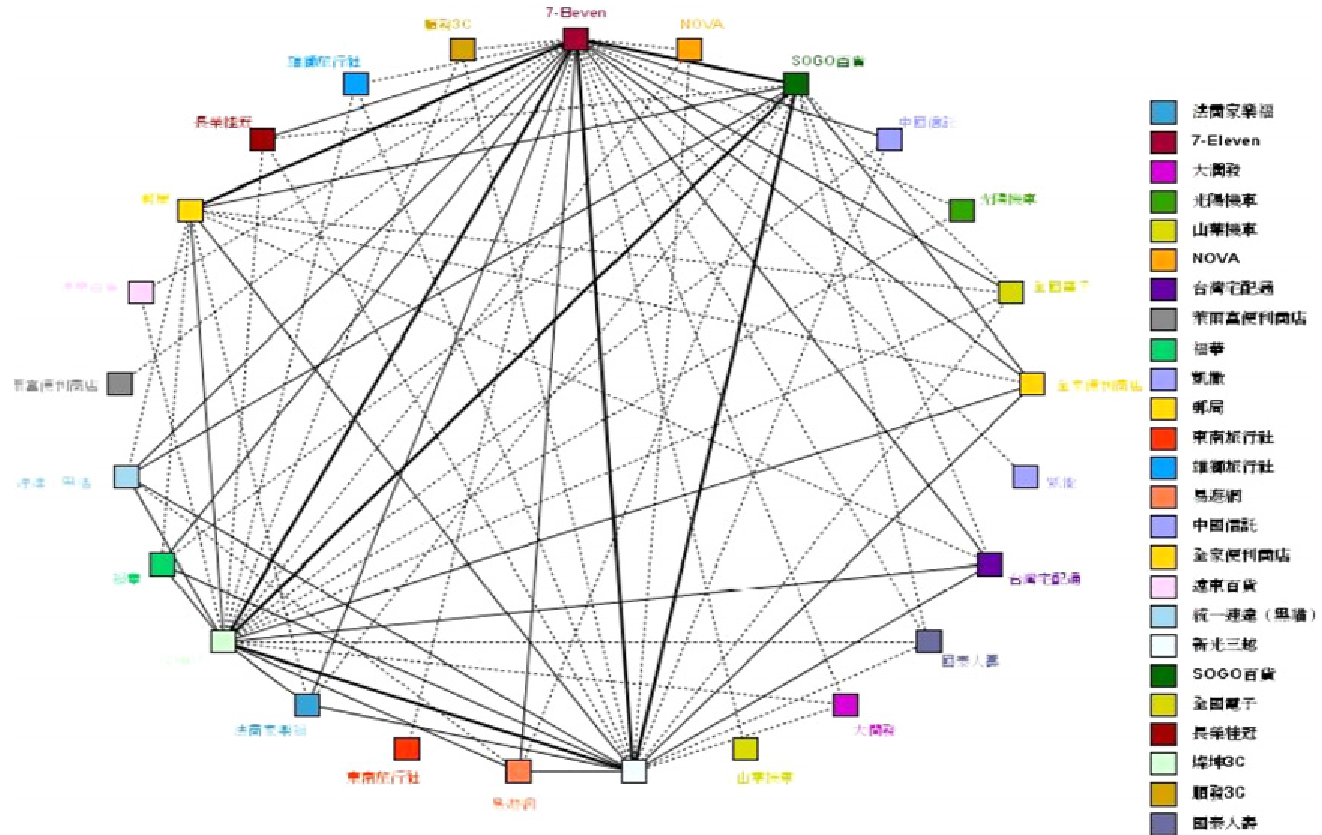 Figure 2: Web diagram visualizing the strength of brand associations.
Critical Analysis & Future Outlook
Why this works
The beauty of this approach is its objectivity. It doesn't rely on what managers think their brand represents, but on where the customers actually spend their money. By focusing on Lift and Confidence, the framework filtered out noise to find 23 highly actionable alliance rules.
Limitations
As the authors admit, the study reflects a "snapshot" in time (2004). In today’s world, association rules must be calculated in real-time to account for shifting digital trends. Furthermore, the model does not account for the "quality" of the alliance—two brands might be associated in the customer's mind for negative reasons (e.g., shared poor service).
Conclusion
Liao et al. demonstrate that data mining is not just an IT tool, but a strategic asset. For businesses looking to expand through alliances, the message is clear: Look at your customers' maps before you choose your partners.
Takeaway for the Industry: In the age of Big Data, the most effective "Strategic Consultant" is your own transaction database.