
Decoding the Digital Trail: Mining Web Trajectories from Passive Network Traces
Mining and modeling web trajectories from passive traces
This paper introduces a systematic framework for mining user web trajectories from passive network logs. By combining a machine learning-based "Core domain" classifier with the TribeFlow latent modeling methodology, the authors successfully map raw TCP/DNS traces to high-level "latent environments" representing specific user interests.
TL;DR
Researchers have developed a way to reconstruct and model user browsing habits ("trajectories") solely by looking at encrypted network metadata. By filtering out the "noise" of background CDN and tracking connections and applying a latent environment model called TribeFlow, they can identify specific interest groups—like identifying that architecture students frequent travel sites while electronics students haunt computer science forums—without ever seeing the actual content of the web pages.
Background: The Challenge of the Opaque Web
Understanding web navigation is vital for everything from content recommendation to cybersecurity. However, two major hurdles remain:
- Encryption: Most traffic is TLS-encrypted, hiding specific URLs.
- The "Noise" Problem: A single click on a news site might trigger 50 background connections to ad servers and analytics engines.
This paper treats the user's journey not as a series of packets, but as a sequence of Core domains—the actual destinations intended by the human behind the screen.
Methodology: From Raw Logs to Latent Environments
1. Identifying the "Core"
The authors propose a clever preprocessing step. Since encrypted traffic hides the page content, they use a machine learning classifier to distinguish between Core domains (the site you wanted) and Support domains (the images/scripts loaded in the background).
- The Insight: Core domains typically have larger HTML payloads and rarely redirect immediately to other domains.
- The Result: A simplified decision tree with >96% accuracy that cleans the trajectory.
 Fig 1: The end-to-end workflow from passive logging to interest extraction.
2. The TribeFlow Model
Once trajectories are cleaned, they are fed into TribeFlow. This model views each user as a "random surfer." Instead of a single massive transition matrix, TribeFlow assumes there are latent environments (e.g., "Online Shopping," "Academic Research," "Social Media").
The transition probability is defined mathematically as a mixture of these environments: Where represents the inter-arrival time, capturing the temporal dynamics of how fast people click through information.
Experimental Insights: Community Behavior
The authors applied this to a massive dataset of 113 TB of traffic from a university campus.
Environmental Clustering
By inspecting the probability distributions within the 30 learned environments, the model automatically clustered related domains. Word clouds generated from these environments (Fig 4) clearly show topical coherence—one environment might be dominated by engineering journals, while another is filled with travel booking sites.
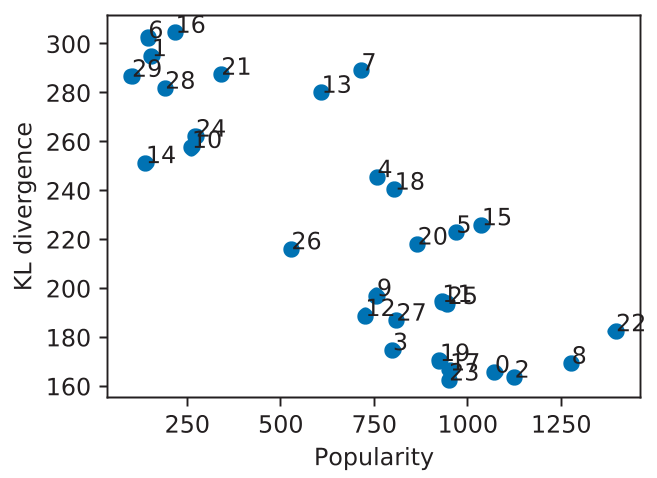 Fig 2: Word-clouds representing the top domains in specific environments for different departments.
Popularity vs. Diversity
Using Kullback-Leibler (KL) Divergence, the authors found a fascinating trend: the most "popular" environments (those visited by everyone) are the least diverse. They are the "utility" zones of the web (search engines, social media). The "peculiar" interests—the ones that define a community—reside in the long tail of less popular but highly specific environments.
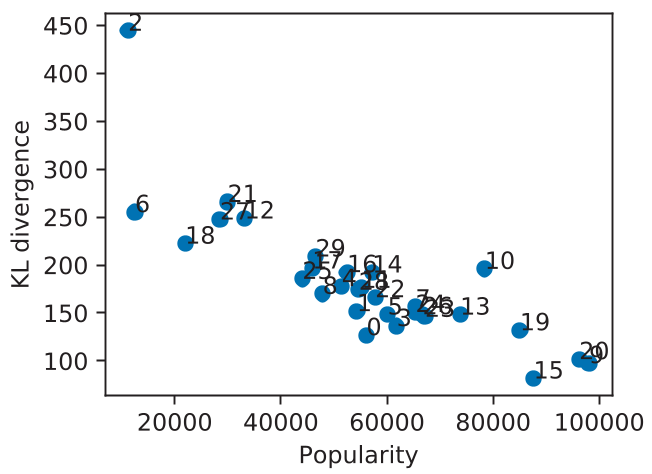 Fig 3: KL Divergence vs. Popularity. Generic environments cluster at the bottom right, while specialized interests appear in the top left.
Critical Perspective
The Takeaway: This work proves that we don't need to break encryption to understand user communities. By focusing on the rhythm and sequence of domain names (FQDNs), we can build highly accurate behavioral models.
Limitations:
- The "Core domain" logic relies on active crawling of home-pages, which might change over time or be blocked by servers.
- The model assumes a first-order Markov chain; however, human browsing often has "long-term memory" (returning to a site after 10 other steps) which might require higher-order modeling or RNNs/Transformers in future iterations.
Future Outlook
This methodology opens the door for Privacy-Preserving Personalization. ISPs or network admins could offer better services or recommendations without ever needing to inspect private data packets, relying instead on the structural "shape" of the web trajectory.
Written by the Senior Academic Tech Editor. Source: Vassio et al., "Mining and Modeling Web Trajectories from Passive Traces."