
OLMiner: Breaking the "Influence Overlap" in Social Network Analytics
Mining Opinion Leaders in Big Social Network
The paper introduces OLMiner, a novel two-stage clustering framework designed to efficiently identify domain-specific opinion leaders in large-scale social networks. It achieves superior influence spread compared to attribute-only methods by integrating network structural analysis with leadership quality metrics.
Executive Summary
TL;DR: OLMiner is a sophisticated algorithm designed to find the most influential figures in massive social networks without redundant coverage. By combining community detection with behavioral k-means clustering, it identifies "opinion leaders" who are not only authoritative but also strategically positioned to reach unique audiences.
Positioning: This work moves beyond simple "PageRank" variants or flat attribute-based clustering (like number of followers). It sits at the intersection of Community-based Influence Maximization and Domain-Sensitive Sentiment Analysis, offering a practical solution for large-scale social graphs where traditional graph processing fails.
The Core Problem: The Overlap Trap
In social network marketing, targeting the five most popular users often leads to wasted resources. Why? Because the most popular users usually follow each other and have overlapping audiences. If Leader A and Leader B both influence the same 1,000 people, your total reach is stagnant.
Furthermore, processing a "Big Social Network" with millions of nodes makes traditional structural analysis too slow. We need a way to shrink the search space without losing the most critical nodes.
Methodology: The Two-Stage Approach
The authors propose a multi-component framework that shifts from "macro" network structure to "micro" user behavior.
1. Structural Gravity: Network Construction
Unlike simple graphs, OLMiner considers the temporal behavior of users. If two users post during the same time segments (e.g., 9:00 AM - 3:00 PM), their connection weight is strengthened. This adds a "real-world" dimension to digital relationships.
2. Stage 1: Community Detection (Macro-Filtering)
To solve the overlap problem, OLMiner first partitions the network into communities.
- Heuristic: It groups nodes where the edge weight is mutually the strongest among neighbors.
- Termination: It uses Modularity Gain (). If merging two communities doesn't improve the network's structural density, it stops.
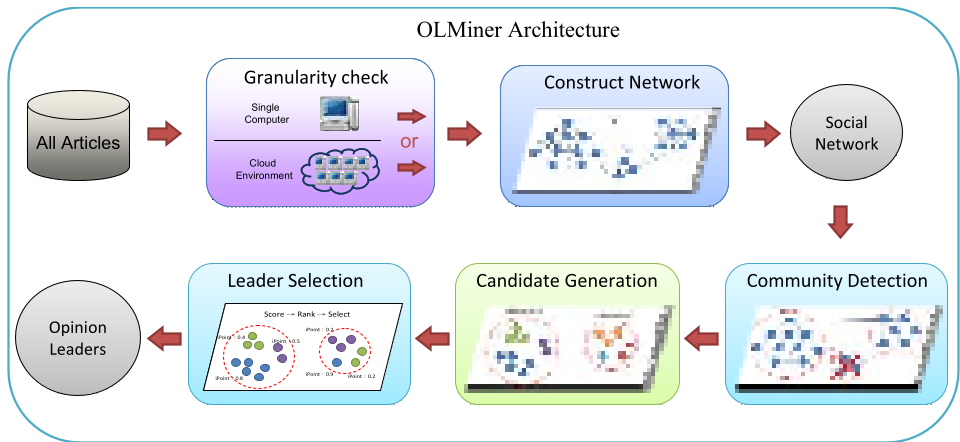
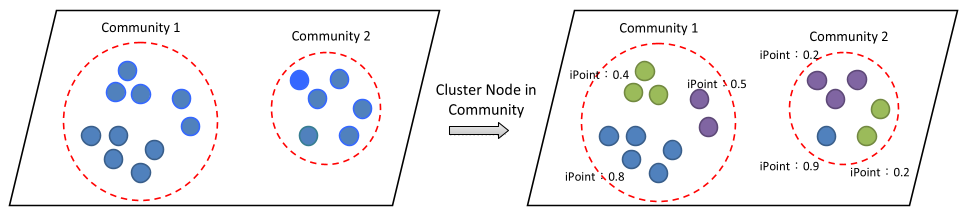
3. Stage 2: Quality Analysis (Micro-Filtering)
Within each community, the algorithm performs k-means clustering based on four key attributes:
- article_num: Total activity.
- replied_by_prob: How much do others care?
- expert_deg: Is this user a domain specialist?
- reply_prob: How engaged is this user with the community?
Experimental Validation
The researchers tested OLMiner using real data from the Mobile01 Forum (LEXUS and AUDI sub-forums).
Influence Spread Comparison
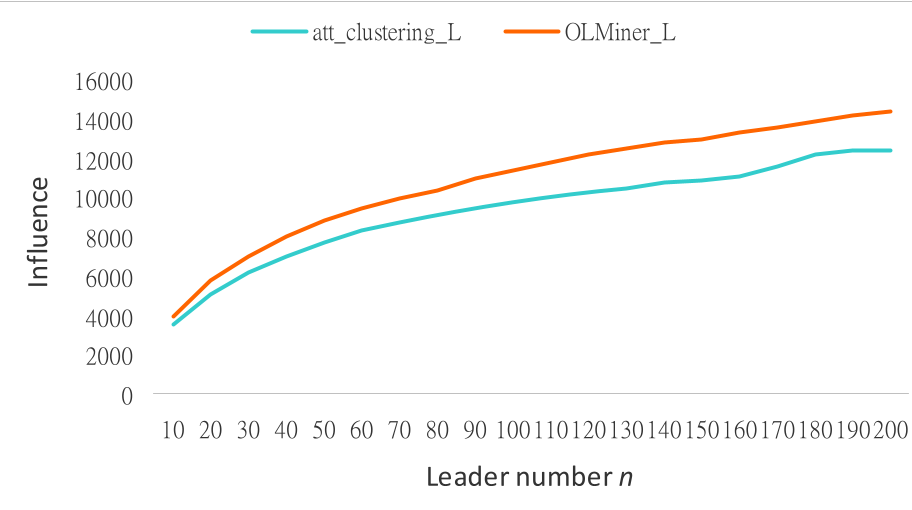
The primary metric was "Influence Spread"—how many unique users are reached by the selected leaders.
- Observation: As the number of leaders increases, the competitor (
att_clustering) plateaus because it keeps picking leaders from the same "popular" clusters. - Outcome: OLMiner’s influence spread grows steadily because its community-first approach forces the selection of leaders from diverse parts of the network.
Critical Insight & Perspectives
Why does it work? The brilliance of OLMiner lies in its Inductive Bias: it assumes that a true set of global leaders must be composed of local heroes from different communities. By partitioning the graph first, it effectively "parallelizes" the search for leadership and ensures diversity.
Limitations: While highly efficient, the current model relies on a static snapshot of the network. Social influence is notoriously dynamic—a user who was an expert last year might be inactive today. Integrating a "Decay Function" for historical activity could further sharpen the results.
Future Outlook: As we move toward Web 3.0 and decentralized social layers, algorithms like OLMiner will be essential for "Sybil Defense" and understanding the organic formation of public opinion in the face of bot-driven manipulation.