
Mining Academic Synergy: From Social Graphs to Opportunity Discovery
Mining Potential Partnership through Opportunity Discovery in Research Networks
The paper formalizes "opportunity discovery" in social networks as a graph transformation problem and develops a methodology for mining potential research partnerships. By integrating co-authorship links with semantic interest similarity, it identifies untapped collaborations in academic communities like INTEROP and MIUA.
TL;DR
This paper introduces a formal framework for Opportunity Discovery within research networks. By modeling academic relations as a multi-graph—combining who has worked together with who should work together based on semantic research interests—the authors successfully predict future collaborations with up to 75% accuracy. It transforms the subjective "intuition" of networking into a rigorous graph transformation task.
The Motivation: Beyond the "Old Boys' Club"
In the academic world, collaboration is the engine of innovation. However, most partnerships are formed through existing social circles or "Strong Ties." According to social capital theory, the most valuable opportunities often lie in "Weak Ties" or "Structural Holes"—connections between researchers who don't know each other but share complementary expertise.
The authors argue that we can systematically bridge these gaps by analyzing the latent similarity in research output. The problem is that research interests are fluid and often hidden in specialized terminology, making them hard to map manually at scale.
Methodology: The Opportunity Network Model
The core of the paper is the definition of an Opportunity Network, a tuple that treats the discovery process as a graph evolution.
1. The Multi-Graph Representation
The network consists of:
- Nodes: Research units or individual scientists.
- Co-authorship Edges: Explicit past collaborations (the "What is").
- Similarity Edges: Weighted links calculated via cosine similarity of "Interest Vectors" (the "What could be").
2. Semantic Profiling and Ontological Expansion
To build accurate interest vectors, the authors didn't just look at keywords. They used:
- TermExtractor: To pull domain-specific terms from a corpus of 1,500+ papers.
- Ontology Expansion: Leveraging the INTEROP and MESH ontologies to add parent concepts. For example, if a paper mentions "SVM," the system expands it to "Machine Learning," ensuring that researchers using different but related sub-terms are still linked.
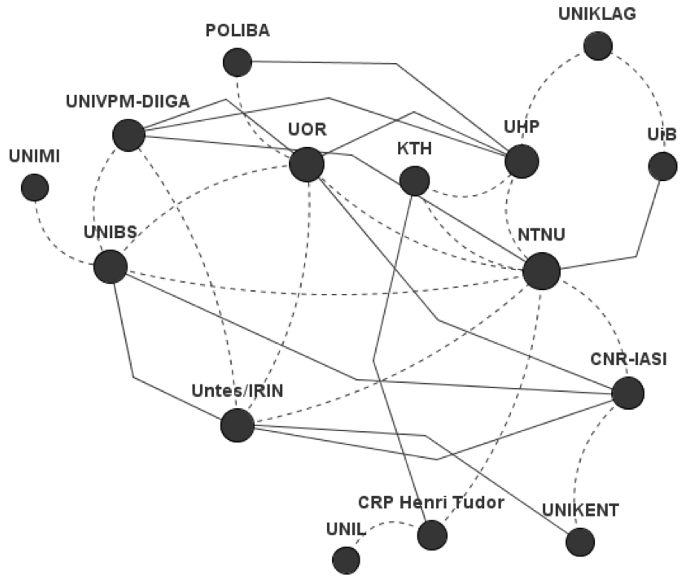 Figure 1: Visualization of the INTEROP network where dashed lines represent potential opportunities (high similarity, no current co-authorship).
Experiments: Validating the "Crystal Ball"
The authors validated their model through two lenses: Extraction Quality and Predictive Power.
Semantic Accuracy
By comparing the automatically generated profiles against "Ground Truth" (self-declared interests by researchers), the model showed high Recall. While Precision was initially lower, the authors insightfully noted that papers typically contain more specific technical terms than the general descriptions people write in their bios—suggesting the model might actually understand a researcher's work better than their own summary.
Predicting the Future
The most impressive result comes from the temporal analysis. By taking data from 2004 and identifying "Opportunities," the authors checked if those people actually collaborated by 2005 or later.
| Network Source | Exploited Opportunities (Predicted vs. Actual) |
|---|---|
| G-before-2004 | 57% (by end of project) |
| G-2004 | 75% (by end of project) |
The data suggests that the more recent the publication data used to build the model, the higher its accuracy in predicting forthcoming partnerships.
Deep Insights & Limitations
Why it works
The success of this methodology lies in its Inductive Bias: the assumption that similarity of research interests is a primary driver for successful collaboration. By formalizing this as a graph pattern, the system can rank "high-value" opportunities that a human might miss in a network of thousands of actors.
Critical Reflection
- The "Cold Start" Problem: The model relies on a corpus of existing papers. New researchers with few publications might remain "islands" in the graph.
- The Social Dimension: As the authors admit, partnership isn't just about "Topics." It’s about trust, politics, and funding. The model currently treats scientists as rational agents optimized solely for "Research Interest Match."
- Ontology Dependency: The performance boost from ontological expansion shows the model is only as good as the underlying Knowledge Graph (INTEROP/MESH).
Conclusion
This research provides a robust template for the next generation of Research Information Systems. By moving from a static database of "who is who" to a dynamic engine of "who should meet," this methodology offers a data-driven way to foster interdisciplinary innovation and optimize the growth of scientific communities.