
Mining Peopleware: Decoding the DNA of IT Recruitment via StackOverflow
Mining People Analytics from StackOverflow Job Advertisements
This paper proposes a framework for People Analytics (PA) by mining IT job advertisements from StackOverflow. It leverages text mining and multivariate statistical analysis to extract and correlate explicit hard skills, implicit hard skills, and soft skills (competences) using the ESCO taxonomy.
Executive Summary
TL;DR: This research establishes a data-mining framework to transform raw StackOverflow job advertisements into actionable People Analytics. By categorizing skills into three distinct layers—Explicit Hard Skills (tools), Implicit Hard Skills (domains), and Soft Skills (competences)—the authors reveal how the IT industry clusters its requirements and where the "soft skill gap" in job descriptions currently lies.
Positioning: This work serves as a foundational bridge between Software Repository Mining and Human Resources Management (HRM), shifting the focus from "what developers do" to "what the industry demands."
The "Layers" of Expertise: Identifying the Motivation
Recruitment in the IT sector has long faced a terminology gap. Recruiters and candidates often speak different languages; a candidate might list "Python," while a job ad asks for "Data Science."
The authors' core insight is that skills are not monolithic. They propose a tri-partite taxonomy:
- Explicit Hard Skills: The specific tools (e.g., Java, React, AWS).
- Implicit Hard Skills: The abstract application of tools (e.g., Architecture, Data Analysis).
- Soft Skills (Competences): The transversal abilities defined by the European ESCO framework (e.g., Problem Solving, Critical Thinking).
Methodology: From Raw Text to Latent Factors
The framework utilizes a custom scrapper for StackOverflow Jobs, followed by a rigorous NLP pipeline including stemming and stop-word removal.
The Analytical Core: Exploratory Factor Analysis (EFA)
Rather than just counting words, the authors use Principal Component Analysis (PCA) to find "Factors"—groups of skills that naturally appear together. This reveals the "latent" structure of the job market.
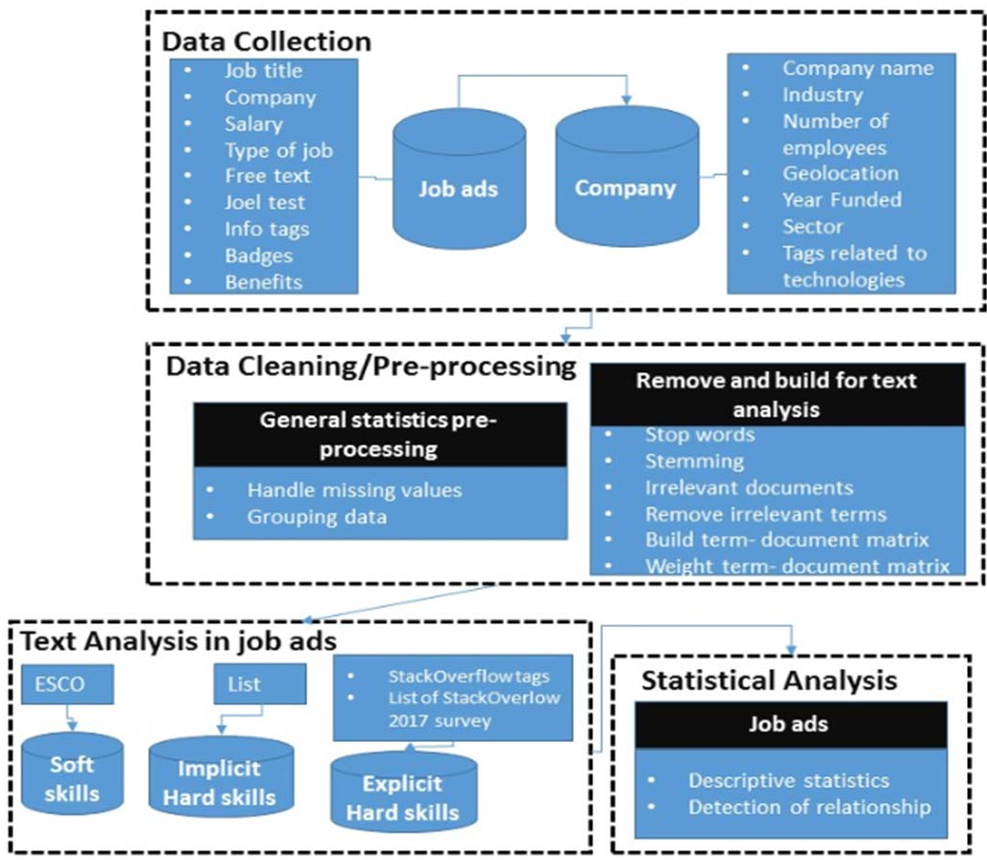 Figure 1: The Proposed Framework for People Analytics from Job Advertisements.
Key Insights: What the Data Tells Us
The statistical analysis produced several "Eureka" moments for tech recruiters:
- The Big Data Cluster: A strong correlation (rho=0.180) exists between the tools Hadoop/Spark and the implicit domain of Data Mining/Big Data.
- Mobile Synergy: UI/UX requirements are significantly correlated with Android and iOS explicit skills.
- The Soft Skill "Dark Matter": Surprisingly, soft skills showed almost no correlation with hard skills. This suggests that either IT companies view soft skills as "universal defaults" not worth mentioning specifically, or they lack the vocabulary to describe them in technical ads.
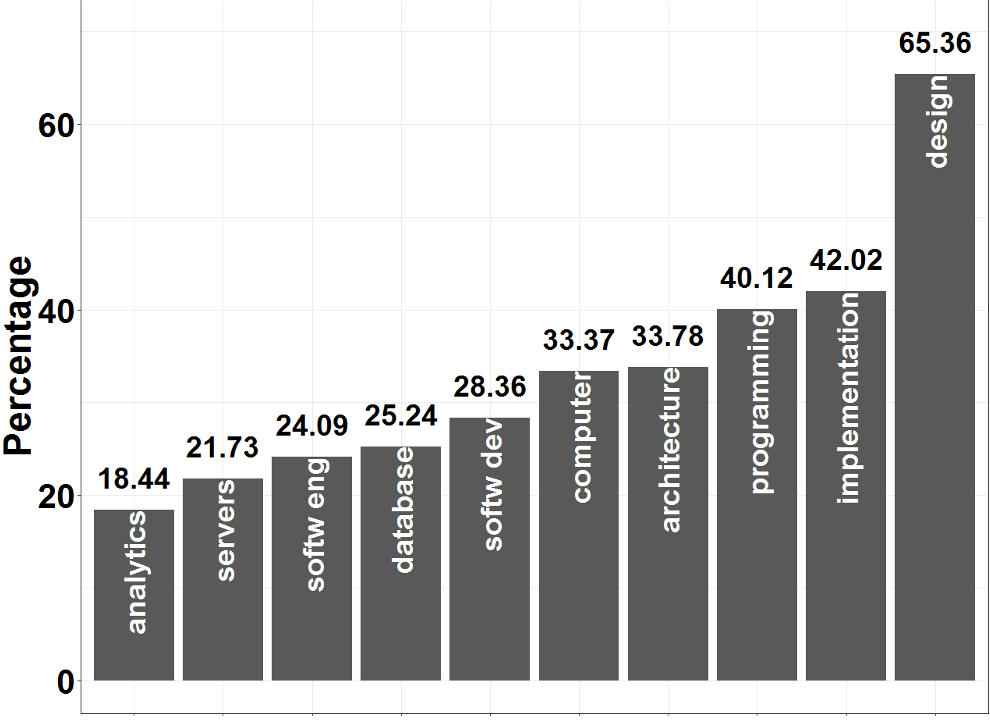 Figure 2: Distribution of Top 10 Implicit Hard Skills showing the dominance of 'Design' and 'Programming'.
Critical Analysis & Future Outlook
Strengths
The use of the ESCO taxonomy provides an academic and legal rigor often missing from "keyword-matching" recruitment startups. By identifying that "leading others" often negatively correlates with "planning own work," the paper offers a sophisticated view of role-based tensions.
Limitations
- Language Bias: The study is restricted to English-only advertisements.
- The "Keyword" Ceiling: Because it relies on term frequency, it may miss nuanced expressions of soft skills that don't use "textbook" terminology.
The Future of Peopleware
This research paves the way for automated career pathing. By understanding which skills are "neighbors" in the factor analysis, educational institutions can design curricula that prepare students for the clusters of skills the industry actually buys, rather than isolated tools. As we move toward 2026, the integration of LLMs into this framework will likely solve the "Soft Skill" detection problem that this 2017 paper identifies as its primary hurdle.
Conclusion
The study proves that StackOverflow is more than a debugging forum; it is a real-time pulse of the global IT economy. For the HR professional, it provides the "hard data" to justify team-building strategies. For the developer, it provides a roadmap of the "hidden" skills required to move from a coder to an architect.