
Mining Social Capital: Do Strong and Weak Ties Behave Differently on OSNs?
Mining Social Capital on Online Social Networks with Strong and Weak Ties
This paper presents a large-scale empirical study investigating social capital on Facebook, Twitter, YouTube, and Slashdot using triadic analysis. By splitting networks into strong and weak ties based on reciprocity and mutual friendship, the authors identify the prevalence of brokerage (bridging) and closure (bonding) social capital.
TL;DR
Is your Facebook friend circle a tight-knit "closure" group or a bridge to new information? This paper investigates social capital across Facebook, Twitter, YouTube, and Slashdot. By analyzing millions of "triads" (groups of three users), the researchers discovered that while weak ties almost always act as information brokers, strong ties in the digital world are surprisingly versatile—performing both bonding and brokerage roles simultaneously.
Problem & Motivation
Sociologists have long argued that social capital comes in two flavors:
- Bonding (Closure): Found in tight-knit groups (strong ties) providing emotional support.
- Bridging (Brokerage): Found in loose acquaintances (weak ties) providing new information.
While these theories worked for offline neighborhood studies, do they apply to a global network of a billion users? Existing research often relies on small-scale surveys. This paper moves beyond "self-reporting" to structural analysis, using the math of graph theory to see if the architecture of our online relationships matches classical sociological predictions.
Methodology: The Anatomy of a Triad
The authors use a Triad Census—a method of categorizing every possible relationship pattern between three people.
1. Defining Tie Strength
To test their hypotheses, they split each OSN into two sub-networks:
- Strong Ties: Pairs with reciprocal interactions (back-and-forth) AND/OR a high number of mutual friends.
- Weak Ties: Pairs with sporadic interaction and few to no mutual friends.
2. The Triad Classification
They categorized 13 specific triad types into two functional groups:
- Closure Triads: "A knows B, B knows C, and A knows C." These are the building blocks of bonding capital.
- Brokerage Triads: "A knows B and C, but B and C don't know each other." Here, A acts as a "broker."
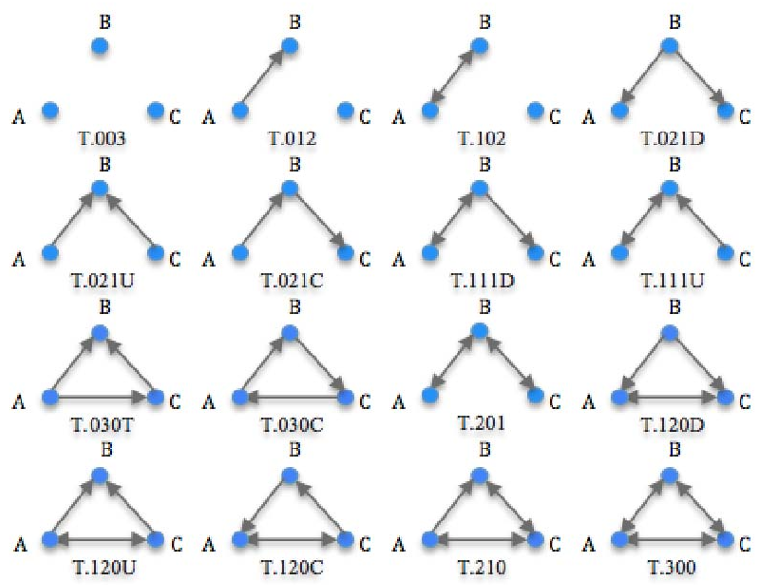 Fig 1: The MAN notation describing the 16 possible states of a triad.
Experiments & Results
The researchers calculated the Z-score for these triads—a statistical measure showing how much more (or less) a pattern appears compared to a random network.
Hypothesis 1: Strong Ties = Closure (REJECTED)
Surprisingly, in all four networks, "Strong Ties" didn't just form closed circles. They also formed a significant number of brokerage triads.
- Insight: On Facebook or Twitter, even if you are "strong friends" with someone (e.g., colleagues), you might still act as a broker between different departments or social circles. Digital strong ties are not just for "family-like" bonding; they are also functional bridges.
Hypothesis 2: Weak Ties = Brokerage (ACCEPTED)
With the exception of Slashdot, weak ties networks were significantly rich in brokerage triads and poor in closure triads.
- Insight: This confirms Granovetter’s "Strength of Weak Ties"—online, your acquaintances are your primary source for non-redundant information and "bridging" to new communities.
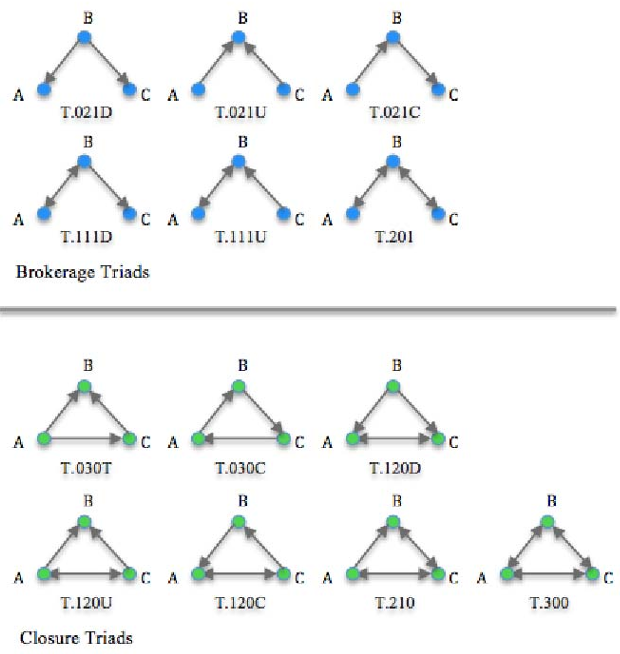 Fig 2: Defining closure (bonding) and brokerage (bridging) via triads.
The Slashdot Anomaly
Slashdot was the outlier. Its weak ties network showed high levels of both brokerage and closure. The authors attribute this to Slashdot's unique "Friend/Foe" system. Because users can tag others as "Foes," the network forms tight-knit "closure" groups of enemies (e.g., "The enemy of my enemy is my friend"), which doesn't happen on "Like-only" platforms like Facebook.
Critical Analysis & Conclusion
Takeaway
The digital environment changes how "Strong Ties" function. In the physical world, a strong tie usually leads to a closed group. Online, we maintain strong ties with people across various organizational and geographical boundaries, allowing these ties to serve as brokers.
Limitations
- Sampling Bias: For YouTube and Twitter, the authors used "Forest Fire Sampling" due to computational limits. While standard, this might slightly skew the triad census compared to the full graph.
- Temporal Dynamics: The study uses a snapshot in time. Social capital is dynamic—weak ties often evolve into strong ties, a process not captured here.
Value to the Field
This work provides a scalable localized metric (triads) to measure the "health" of a social network's capital. For product designers, it suggests that if you want to foster information flow, you must protect the "brokerage" triads within weak ties, but realize that your power users (strong ties) are also your most effective bridges.