
Detecting the Unseen: Mining Social Graphs to Defeat Random Link Attacks
Mining (Social) Network Graphs to Detect Random Link Attacks
This paper introduces the Random Link Attack (RLA), a unified graph-theoretic abstraction for various communication network abuses such as spam, telemarketing, and viral marketing. The authors propose the first formal framework to detect these attacks by mining the structural properties of social network graphs, achieving detection through suspect pruning and subgraph mining.
TL;DR
Researchers from Bell Labs have formulated the Random Link Attack (RLA), a generic model for network abuse (spam, telemarketing, viral marketing). By focusing on who users interact with rather than what they say, they developed algorithms that can identify collaborative attackers in massive social graphs (4.4M nodes) by exploiting the structural "triangle" deficit left by random victim selection.
Problem & Motivation: The Content-Agnostic Challenge
Most anti-spam measures are content-based; they read your emails or listen for keywords. However, this fails in encrypted environments or voice-based networks. Furthermore, modern attackers are "collaborative"—they form dense connections among themselves to mimic the high clustering coefficient of real human communities, effectively "camouflaging" their profiles.
The core insight of this paper is that while attackers can fake their own community structure, they cannot control how their victims interact. Because victims are chosen randomly or from lists, they rarely communicate with each other, creating a structural signature that is strikingly different from legitimate social circles.
Methodology: The RLA Framework
An RLA is defined by a small set of attackers () connecting to a massive set of victims (). The authors prove that finding the optimal RLA subgraph is NP-complete, necessitating efficient heuristics.
1. Catching Suspects
The system first prunes the graph using two tests:
- Clustering Property: Checks if a node's neighbors are also neighbors of each other.
- Neighborhood Independence: Measures the size of the independent set in a node's neighborhood. Legitimate users have many triangles; attackers targeting random victims have massive "independent" neighborhoods.
2. Subgraph Mining Algorithms
Once suspects are identified, the paper proposes two ways to grow the attack cluster:
- GREEDY: Iteratively adds nodes from the neighborhood into a potential attack set based on their connectivity support.
- TRWALK (Triangle Random Walk): A randomized traversal that "walks" across triangles sharing an edge. Since attack triangles (attacker-attacker-victim) rarely share edges with legitimate triangles, the walk stays trapped within the malicious subgraph.
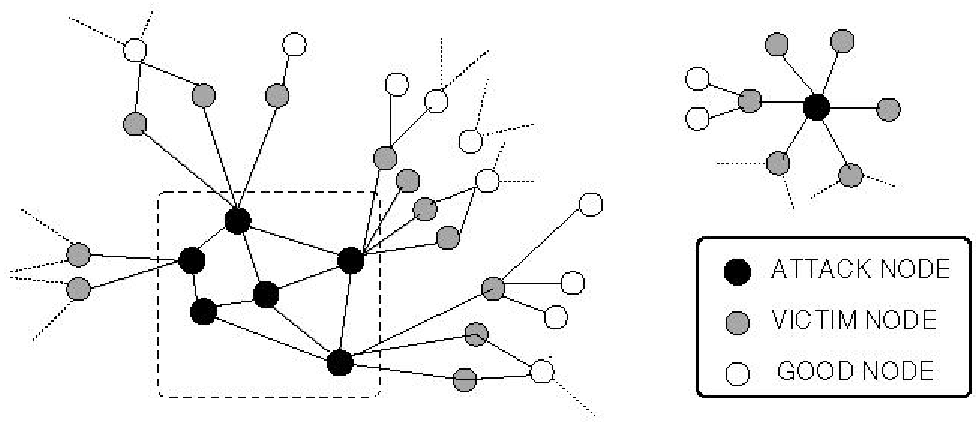 Fig 1: The structural difference between a collaborative attack group () and the sparsely connected victim set ().
Experimental Results
The authors validated their approach using the LiveJournal dataset. The key finding was the trade-off between speed and accuracy:
- Precision: Both algorithms achieved nearly 100% accuracy in detecting injected attacks when the internal connectivity of the attackers was sufficiently high.
- Performance: TRWALK proved significantly faster, making it suitable for real-time monitoring of large-scale networks.
- Robustness: The "Neighborhood Independence" test reduced false positives from good nodes with high degrees (celebrities, etc.) by analyzing the ratio of the independent set to the total degree.
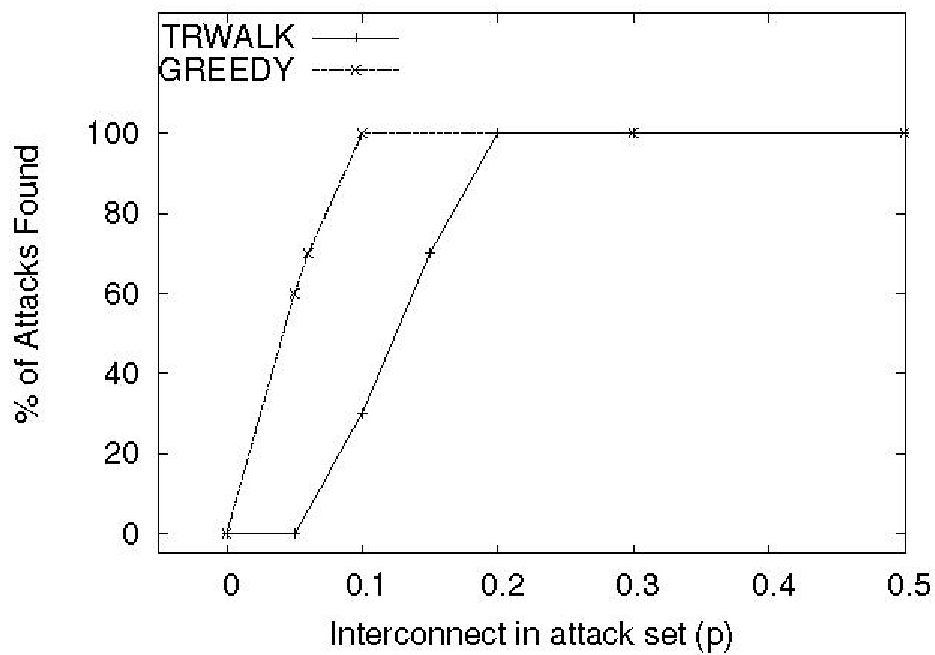 Fig 2: Graph showing the high accuracy of detection across different levels of attacker interconnectivity.
Critical Analysis & Conclusion
Takeaway
The RLA model proves that the "Social Graph" is its own best defense. By abstracting away content and focusing on the topology of trust, we can detect malicious actors who are otherwise invisible to content filters.
Limitations & Future Work
- Computational Hardness: While heuristics work, the NP-complete nature of the problem means highly sophisticated, sparse attacks might still evade detection.
- Static vs. Dynamic: The current model assumes a static snapshot of the graph. Real-world attacks are temporal; attackers slowly build links over months.
- Evolution: Future research should focus on how these algorithms perform as social networks evolve and become more "noisy" with automated bots that may not behave purely randomly.
This work lays the groundwork for a new generation of structural security tools that protect communication platforms by looking at the "shape" of our interactions.