
Beyond Simple Connections: Mining Significant Friend Groups via SF-Trees
Mining Social Networks for Significant Friend Groups
This paper introduces the Significant Friend-tree (SF-tree) and a corresponding pattern-growth algorithm for mining "significant friend groups" in social networks. By integrating interaction frequency (weight) and user reputation (confidence), the method identifies subgroups that hold the highest social value for a specific individual.
TL;DR
Not all friends are created equal. In the era of massive social networks like LinkedIn and Facebook, finding the "inner circle" or influential subgroups is a data mining challenge. This paper proposes the SF-tree, a tree-based architecture that identifies highly significant friend groups by combining interaction frequency and user reputation, outperforming traditional utility mining algorithms in speed and scalability.
The Problem: The "Significance" Bottleneck
In a social network, a user might have 500+ connections, but only a handful are truly impactful. Identifying these groups is difficult because:
- Asymmetric Value: Your interaction with a mentor is more significant than with a casual acquaintance.
- Lack of Downward Closure: In standard data mining, if a group is frequent, its subsets must be frequent. In social "significance," this isn't always true. A group might be significant because of the synergy of its members, even if an individual member isn't "significant" on their own. This mathematical hurdle makes typical mining algorithms (like Apriori) exceptionally slow.
Motivation & Insight
The authors suggest that significance should be a product of Weight (e.g., how many times Don posted on Gail's wall) and Confidence (Don's rank or expertise).
To solve the computational efficiency problem, they introduced climp (containing list importance). By calculating significance based on the total importance of the lists a group appears in, they "forced" the downward closure property back into the equation. If a group is significant, its subset is now guaranteed to be significant under the climp metric, allowing for massive pruning of the search space.
Methodology: The SF-Tree Architecture
The core of the solution is the Significant Friend-tree (SF-tree). It functions through a two-scan process:
- First Scan: Calculate individual significance and prune users who don't meet the threshold.
- Second Scan: Build a prefix tree where nodes store the cumulative "climp" values.
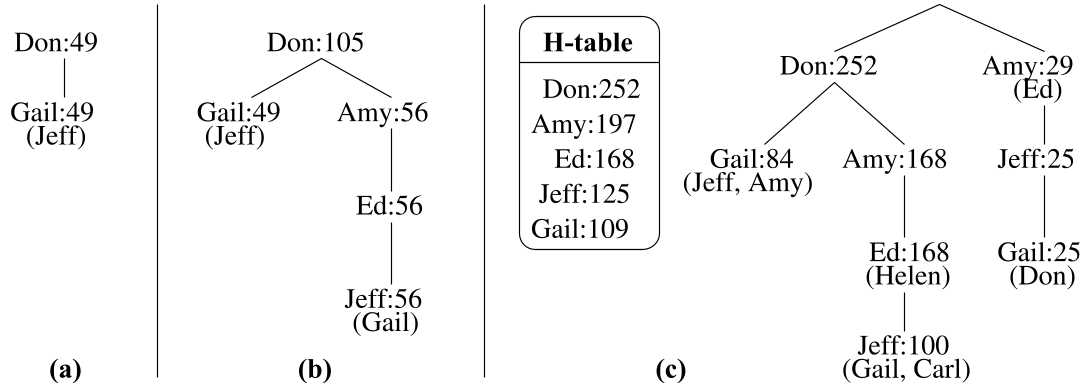 Fig 1: The evolution of an SF-tree as friend lists (L1, L2, etc.) are processed.
The tree structure allows the algorithm to explore "potential" groups using a pattern-growth approach. Instead of generating every possible combination of friends (which would lead to a combinatorial explosion), it only looks at paths that actually exist in the tree.
Experimental Results
The researchers compared the SF-tree against existing high-utility pattern mining algorithms like Two-Phase and FUM.
1. Pruning Efficiency
The SF-tree generated significantly fewer "false positive" candidates. In dense datasets (like Mushroom), where many users are interconnected, traditional algorithms were overwhelmed by candidate generation, while SF-tree remained lean.
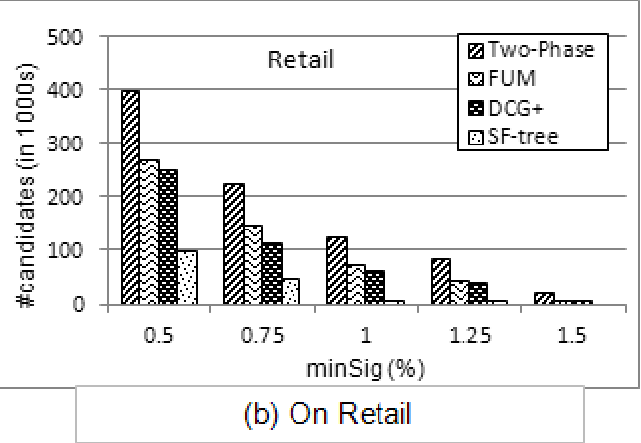 Fig 2: SF-tree (bottom line) produces far fewer candidates than competitors as the threshold decreases.
2. Linear Scalability
On the Kosarak dataset (nearly 1 million records), the SF-tree showed linear scalability. While competitors crashed or took an unreasonable amount of time at low significance thresholds, the SF-tree completed the task efficiently.
Critical Analysis & Conclusion
Takeaway
The SF-tree is a powerful tool for social platform developers. It moves beyond "who you know" to "who matters to you," providing a mathematical framework to rank subgroups efficiently.
Limitations
- Post-processing: Because the climp metric is an upper-bound estimate to maintain downward closure, the algorithm still requires a final scan to prune "false positive" groups that don't meet the actual significance criteria.
- Static Nature: The current model assumes a static snapshot of a database. In real-world social media, weights and confidence scores fluctuate daily.
Future Outlook
This work lays the foundation for more personalized social features, such as automated "Close Friends" list generation or targeted professional networking suggestions in platforms like LinkedIn. Integrating this with Graph Neural Networks could further refine how "Confidence" values are calculated.