
Mining the Social Pulse: An Integrated Graph Approach to Micro-blogging Influence
Mining Social Relationships in Micro-blogging Systems
This paper proposes an integrated framework for mining social relationships in micro-blogging systems using Graph Theory. It introduces a multi-stage approach featuring Maximal Strongly Connected Components (MSCC) for grouping, topological sorting for group influence ranking, and a novel "QIndex" algorithm to quantify individual user influence.
TL;DR
As social media scales to millions of users, traditional structural analysis buckles under the weight of "Big Data." This paper introduces a robust, graph-theoretic framework to partition micro-blogging users into highly interactive groups using Maximal Strongly Connected Components (MSCC) and ranks individual influence using a new metric called QIndex, which accounts for both the distance and the reliability of information flow.
Problem & Motivation: Beyond Simple Centrality
In the early days of Social Network Analysis (SNA), researchers focused on small-scale, often undirected networks. However, micro-blogging systems (like Twitter or Digu) introduce two major challenges:
- Scale: Millions of nodes and edges make O(N^2) or O(N^3) algorithms computationally prohibitive.
- Directionality: In micro-blogging, "Following" is a directed act. Information flows from the followee to the follower, creating complex, asymmetric diffusion patterns that simple centrality measures often overlook.
The authors' insight is that influence isn't just about how many followers you have, but about your position within a "condensed" hierarchy of information flow.
Methodology: The Three-Step Influence Pipeline
The proposed method operates as a funnel, moving from macroscopic structure to microscopic influence.
1. Grouping via MSCC
The authors define a user group as a Maximal Strongly Connected Component (MSCC). In this context, an MSCC is a subset of users where every user can reach every other user through a bidirectional path of information flow. This effectively partitions the massive graph into "communication kernels."
2. Group Ranking: The View from 30,000 Feet
Once groups are identified, the entire social network is "condensed." Each MSCC becomes a single node in a new, simplified graph. By definition, this condensed graph is a Directed Acyclic Graph (DAG). The authors then apply a modified topological sort to rank these groups. Groups that have high information outflow but no inflow are positioned at the top of the influence hierarchy.
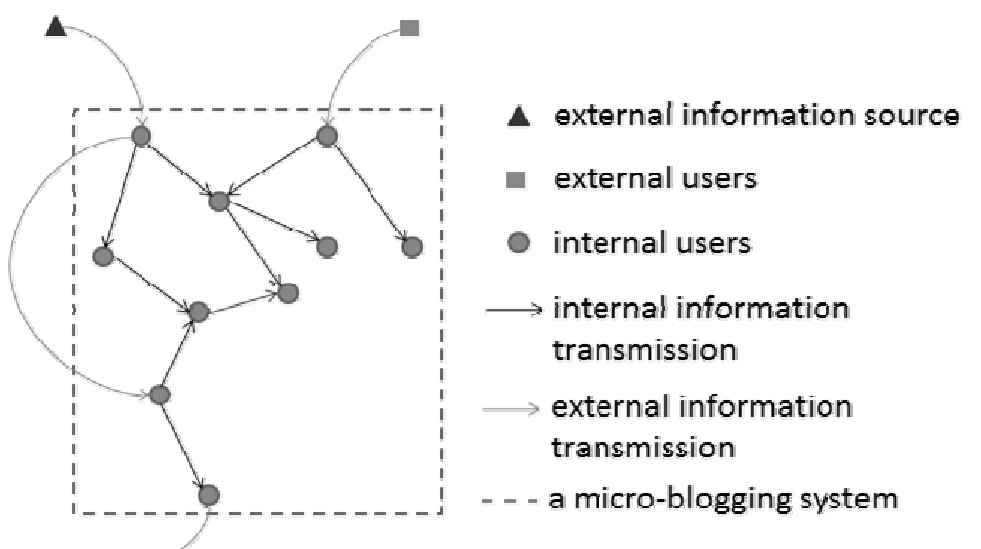 Note: The condensation of MSCCs creates a DAG, allowing for linear ordering of group influence.
3. Individual Influence: The QIndex
To analyze specific users within a group, the authors introduce the QIndex. Inspired by Dijkstra’s algorithm, it considers:
- Distance: How many hops it takes for information to reach a target.
- Width: How many distinct paths exist between the source and target.
The formula is elegantly simple:
A lower QIndex indicates a stronger influence, as it implies information travels through frequent (high width) and short (low distance) paths.
Experiments & Validation
The authors tested their framework on Digu.com, a Chinese micro-blogging site. Using a snowball sampling method, they captured a snapshot of the network's skeletal structure.
Key Findings:
- Community Structure: They identified a core group of 1,426 users acting as the primary engine of information exchange.
- Hidden Influencers: The QIndex successfully identified users who were highly influential even without direct "Follow" links, simply because they sat at the intersection of multiple short transmission paths (high width).
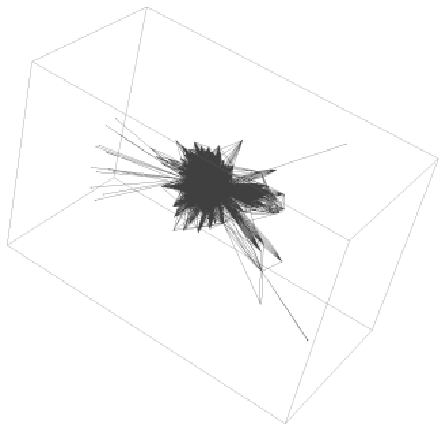 Fig 1: Visualization of the largest MSCC found in the Digu dataset.
| Users | Distance | Width | QIndex |
|---|---|---|---|
| classyuan | 1 | 1 | 1.0 |
| liuxinwu | 2 | 2 | 1.0 |
| xujun99663 | 3 | 2 | 1.5 |
As shown in the table above, user 'liuxinwu' has the same influence (QIndex 1.0) as a direct follower, despite being two hops away, due to the high path width (redundancy).
Critical Analysis & Conclusion
This paper provides a pragmatic bridge between abstract Graph Theory and practical Social Data Mining. By shifting the focus from "node degree" (follower count) to "path reliability" (QIndex), it offers a more nuanced view of how ideas actually spread.
Limitations: The study relies on a "snapshot," whereas social networks are highly temporal. Furthermore, the QIndex assumes a fixed probability of retweeting, which in reality varies wildly based on content quality and user sentiment.
Future Outlook: Integrating this structural analysis with NLP (to weigh edges based on content relevance) would likely create a "Gold Standard" for viral marketing and public opinion monitoring.