
TFAM: Unmasking the Architecture of Transnational Telecom Fraud via SNA
Mining the Networks of Telecommunication Fraud Groups using Social Network Analysis
This paper introduces the Telecom Fraud Analysis Model (TFAM), a specialized framework for uncovering the organizational structures of transnational telecommunication fraud groups. By applying Social Network Analysis (SNA) to real-world flight and co-offending data, the authors successfully identify key roles (chiefs/bosses) within a dataset of 113 fraudsters across four countries.
TL;DR
Telecommunication fraud is no longer a solo act; it is a sophisticated, "corporate" criminal enterprise. This paper proposes the Telecom Fraud Analysis Model (TFAM), which transforms flight travel patterns and co-offending records into a social graph. By applying Centrality measures, investigators can pinpoint the "Bosses" and "Chiefs" hidden within the noise of low-level operatives.
Problem & Motivation: The Resilience of Organized Fraud
Modern telecom fraud groups operate like multinational corporations. They split operations across borders—placing "call centers" in Southeast Asia while victimizing individuals in other countries.
The authors identify a critical gap: Traditional investigation is too reactive. Arresting a "Money Mule" (the person withdrawing cash) does little to damage the organization because these roles are easily replaceable. To truly dismantle the network, police must find the brokers and orchestrators who hold the structure together. The challenge is that these leaders rarely get their hands dirty, making them invisible in standard case files unless their social connections are mapped analytically.
Methodology: Mapping the "Corporate" Structure of Crime
The researchers categorize a typical fraud organization into three distinct silos:
- Telecom Department: Technical experts handling VoIP and Caller ID spoofing.
- Operation Department: Divided into the "Call Center" (the voice) and "Money Mules" (the hands).
- Financial Department: The "Accountants" managing money laundering and profit sharing.
Data Fusion and Graph Construction
TFAM builds links between suspects using two primary data sources:
- Flight Information: High-level members and callers often travel together or stay abroad for synchronized periods.
- Co-offending Records: Historical criminal data showing who has been arrested together previously.
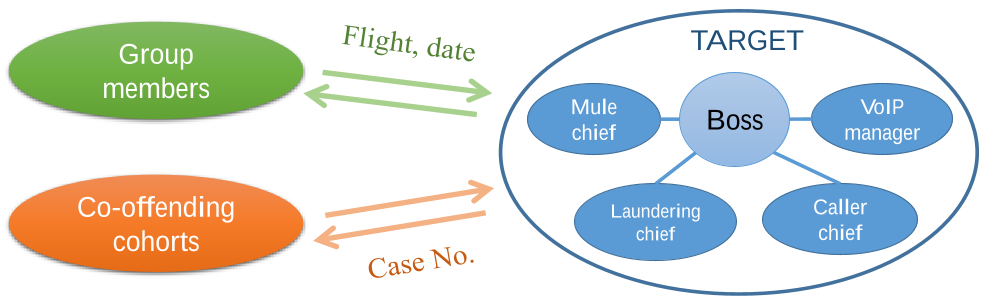
Once the network is built, the paper evaluates five mathematical measures of Centrality to rank individuals. The intuition is that a "Boss" may not have the most connections (Degree), but they often have the most influential connections (Eigenvector) or act as a bridge between specialized subgroups (Betweenness/Structural Holes).
Experiments & Results: Who are the Key Players?
The study utilized a real-world dataset from the Criminal Investigation Bureau (CIB) in Taiwan, covering 113 fraudsters across two major groups (Group A and Group B).
Key Findings:
- Eigenvector Centrality is King: In both groups, Eigenvector centrality—which considers not just how many people you know, but how important those people are—outperformed other measures in identifying "Chiefs" and "Bosses."
- Degraded Performance of Closeness/Betweenness: Interestingly, these measures performed poorly. This suggests that in criminal networks, information doesn't necessarily flow through a single central broker, or perhaps the network is too fragmented for simple path-based metrics to work.
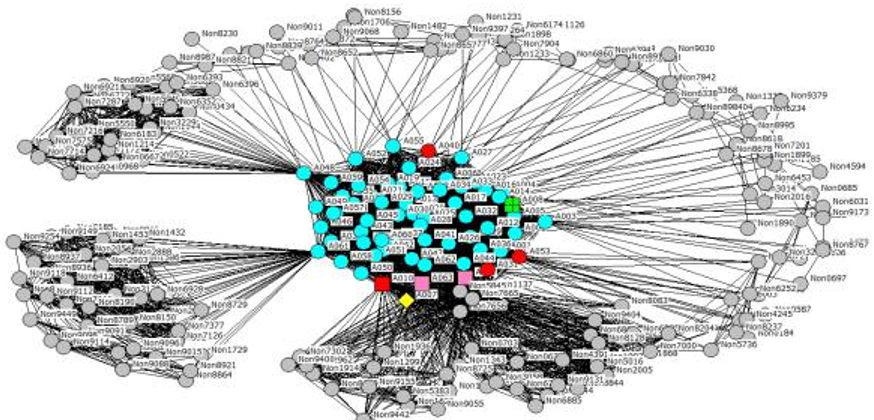
The results shown in the tables highlight that while identifying a "Mule Chief" was relatively straightforward with Degree centrality, identifying the specialized "Caller Chiefs" required more nuanced metrics like Eigenvector.
Critical Analysis & Conclusion
The TFAM model represents a significant step towards the "third generation" of crime analysis—moving away from manual charting towards algorithmic discovery.
Takeaways for Law Enforcement:
- Focus on the Core: High Degree/Eigenvector nodes should be the primary targets for surveillance.
- Data Integration: The success of the model relied heavily on combining travel data with criminal records, proving that siloed data is the enemy of effective investigation.
Limitations: While effective, the model's Average Precision (~0.3) indicates there is still significant noise. The paper focuses on static snapshots of networks; however, criminal organizations are dynamic and adapt quickly when a member is arrested.
Future Work: The authors suggest that future iterations should incorporate Influence Propagation models—simulating how the removal of one node affects the functionality of the rest of the network—and Community Detection to find hidden subgroups within even larger datasets.