
Mining Human Rhythms: Why Your Saturday Routine is More Predictable Than Your Next Move
Mining user behaviours: a study of check-in patterns in location based social networks
The paper investigates human mobility patterns using a novel dataset of 10,000 frequent Foursquare users. It introduces a method to analyze semantic venue categories (e.g., Food, Residence) across various temporal scales and applies these insights to user behavioral clustering and future movement prediction.
TL;DR
Human movement isn't just a series of random coordinates; it's a rhythmic story told through the places we visit. This paper analyzes 10,000 frequent Foursquare users to prove that our weekly habits—like going to the gym every Tuesday or a bar every Friday—are better predictors of where we'll go next than our most recent check-in. By using venue categories (Food, Work, Shops) as semantic anchors, the researchers outperformed traditional sequence models in predicting future user behavior.
Context: Moving Beyond Raw GPS
Before the rise of Location-Based Social Networks (LBSNs), mobility research was "semantically blind." We knew someone moved from Point A to Point B via cell tower pings, but we didn't know if Point A was a workplace or a late-night diner. This paper shifts the focus from coordinates to categories, identifying the "social heartbeat" of urban environments.
The "Workaholic" and the "Student": Unsupervised Persona Discovery
One of the most compelling insights involves clustering users based on their transition matrices. By looking at the probability of moving from one category to another (e.g., "Arts & Entertainment" "Food"), the researchers used K-means clustering to identify distinct behavioral archetypes:
- Cluster 3 (The Businessmen): High frequency of check-ins at "Professional" venues with minimal deviation.
- Cluster 5 (Stay-at-Home): Dominant transitions between "Residence," "Food," and "Shops."
- Cluster 8 (Students): Centered almost exclusively around "College & University" transitions.
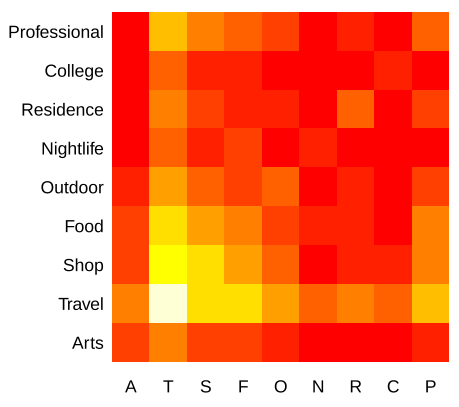 Figure: Centroids of different user clusters showing distinct transition patterns.
Methodology: The Power of Periodicity
The authors compared traditional Order-K Markov Models (which predict the next location based on the last 1 or 2 steps) against Temporal Frequency Models.
The Intuition
Markov models assume your next move depends on where you are now. However, human life is governed by a clock and a calendar. If it is 12:00 PM on a Wednesday, you are likely going to "Food," regardless of whether you were just at "Work" or "Travel."
The paper proves this by showing that:
- Interevent Times vary by category: People spend very little time at "Transport" hubs but hours at "Residences."
- Weekly Return Ratios: You are more likely to return to a specific venue at the same time next week than you are to return the next day.
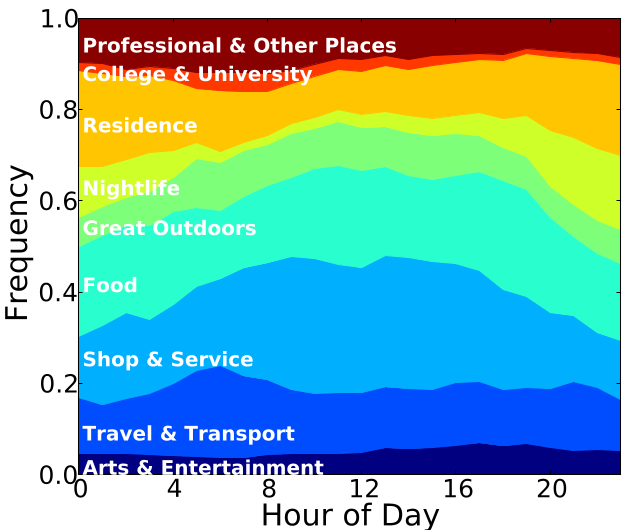 Figure: The stark difference in venue category distribution between Weekdays and Saturdays.
Results: Rhythms Beat Sequences
In the prediction task, the results were definitive. The Most Frequent Day of Week and Hour model achieved the highest accuracy (40.65%), significantly outperforming the Order-2 Markov model (34.21%).
| Method | Accuracy |
|---|---|
| Markov-1 (Sequence-based) | 36.13% |
| Most Frequent Day & Hour (Time-based) | 40.65% |
This suggests that our internal "weekly schedule" is a stronger force than the simple physical transition between adjacent locations.
Critical Insight & Limitations
While this work successfully captures the "rhythm" of the masses, predicting individual movement remains a "hard" problem (macro-accuracy remains under 50%). The study highlights that sparsity is still an issue—even frequent users don't check in everywhere they go.
From a modern perspective, this research laid the groundwork for current AI-driven city planning and hyper-local advertising. It teaches us that to understand where someone is going, don't just look at where they are—look at the time and the "type" of life they lead.
Conclusion
By bridging the gap between temporal cycles and semantic venue data, Preoţiuc-Pietro and Cohn demonstrated that human mobility is highly structured. For future developers in the LBSN space, the takeaway is clear: Context (Time + Venue Type) is King.