
Mining the Long Tail of User Experience: Turning Tweets into Real Estate Insights
Mining User Experience through Crowdsourcing: A Property Search Behavior Corpus Derived from Microblogging Timelines
This paper introduces a specialized property search behavior corpus built by annotating microblogging (Twitter) timelines using microtask-based crowdsourcing. The authors successfully mapped user journeys across four distinct stages—from initial needs to final decision-making—capturing 67 detailed user search processes.
Executive Summary
TL;DR: This research develops a method to reconstruct the long-term journey of home seekers by mining Twitter timelines. By using a clever hierarchical crowdsourcing approach, the authors created a structured corpus that tracks users through weeks of house hunting—capturing raw sentiments and offline behaviors that traditional web logs completely miss.
Positioning: This work transitions microblogging analysis from "event detection" (like earthquakes or stock fluctuations) to "individual experience mining." It fills a critical gap in understanding consumer behavior for high-stakes, long-term decisions where "big data" logs often lose the human context.
The Problem: The Blind Spots of Digital Logs
When a person searches for a new home, their journey isn't just a series of clicks on a real estate portal. It involves late-night discussions, physical property visits, frustrations with agents, and compromise on budget.
- Web Logs only see when the user is on the site.
- Questionnaires miss the subconscious emotions and immediate reactions.
- Behavior Observation is too expensive to perform over the 3–12 months a typical search takes.
The authors realized that Twitter timelines are an untapped gold mine of these "missing links."
Methodology: High-Precision Crowdsourcing
Extracting property search data from Twitter is like finding a needle in a haystack. Most tweets are about lunch or pop culture. To solve this, the authors designed a three-tier system:
1. Targeted Filtering
They started with 40,000 followers of a major Japanese property portal and used keyword filtering (terms like "key money" or "property preview") to isolate 157 highly relevant accounts.
2. The Microtask Workflow
Instead of asking workers to read an entire year of tweets, they broke timelines into fragments of five tweets. To ensure quality, they used Majority Rules (3 workers per task) and Embedded Test Questions to filter out "frivolous" workers.
3. Hierarchical Tagging
Rather than asking workers to pick from four complex stages immediately, they used a binary decision tree. This "simple question" approach reduces cognitive load and increases accuracy.
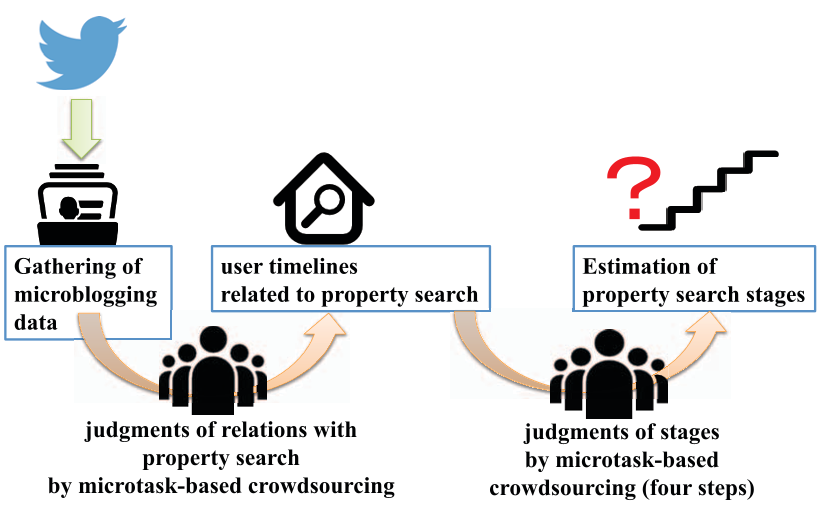 Figure 1: Example of a user timeline showing the transition from general thoughts to specific property search actions.
Understanding the Search Stages
The research successfully categorized behaviors into four phases (S1-S4):
- S1 (Potential Needs): "My rent is too high," or "I want to move."
- S2 (Gathering Information): Discussing specific areas, rent prices, and commute times.
- S3 (Previewing Properties): Reactions to physical visits, security of the neighborhood, and agents.
- S4 (Decision & Contracting): The final paperwork and frustrations with the closing process.
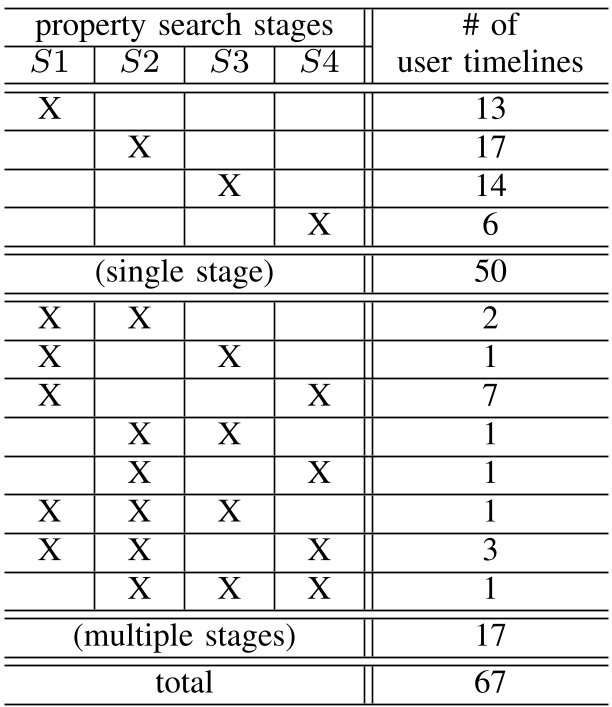 Table 1: Distribution of users across single and multiple stages, showing the ability to track the "flow" of search behavior.
Key Insights and Results
The experiment found that users are most vocal during S2 (Information Gathering) and S3 (Previewing). A particularly interesting finding was the prevalence of "dissatisfaction with agents" in stages S3 and S4. For a real estate company, this is actionable intelligence: it suggests that the "human touchpoint" (the agent) is a major pain point in the user journey that digital services currently haven't solved.
- Efficiency: The entire annotation for 2,400 fragments was completed in less than 3 hours.
- Data Density: 17 of the 67 users were captured transitioning through multiple stages, providing a rare "longitudinal" view of user experience.
Critical Analysis & Conclusion
Takeaway
The corpus demonstrates that social media is more than a broadcast tool; it is a longitudinal record of human decision-making. By structuring this data, companies can move from reactive marketing to "empathic design," addressing user needs before they even visit a property site.
Limitations & Future Work
The sample size (67 users) is relatively small. Furthermore, the study relies on manual crowdsourcing, which is faster than traditional methods but still has costs. The next logical step—as the authors hint—is applying this to other high-priced markets like cars or insurance, and potentially using the resulting corpus to train machine learning models for automated behavior detection.
Bottom Line: If you want to know what your customers are really thinking during their months-long journey, stop looking at your server logs and start looking at their timelines.