
Mining the Political Pulse: What Our Search Queries Reveal About Partisanship
Mining web query logs to analyze political issues
This paper introduces a novel framework for analyzing political issues by mining anonymized web search query logs. By linking queries to partisan-labeled blogs, Wikipedia entities, and fact-checked statements from PolitiFact, the authors quantify "political leaning" and visualize the dynamics of public attention during the 2012 U.S. election cycle.
TL;DR
Researchers from Yahoo! and the University of Amsterdam have unlocked a method to quantify political bias using web search logs. By tracking which partisan blogs users click after a search, they’ve mapped the "leaning" of queries. Their findings are a reality check for the digital age: we are obsessed with "the other side," misinformation drives massive traffic, and political friction breeds negative sentiment in search results.
Background: Beyond Simple Search Volumes
In the world of computational social science, we’ve long known that search volume acts as a proxy for public attention. However, knowing that people are searching for "Health Care" isn't the same as knowing what they think about it. This paper moves the needle by "charging" queries with political energy—specifically, a numerical leaning score ranging from 0.0 (Right) to 1.0 (Left).
The Methodology: Multi-Faceted Political Intelligence
The authors didn't just look at keywords; they built a rich, relational dataset by triangulating four distinct sources:
- Clickstream Data: 1,099 partisan-labeled blogs used to ground truth the "leaning" of a query.
- Wikipedia Entities: Mapping queries to articles to identify the core subject (e.g., mapping "obamacare" to the Patient Protection and Affordable Care Act).
- Fact-Checking (PolitiFact): Linking searches to verified true or false statements.
- Sentiment Analysis: Using SentiStrength to judge the "emotional temperature" of the top search results.
The Leaning Equation
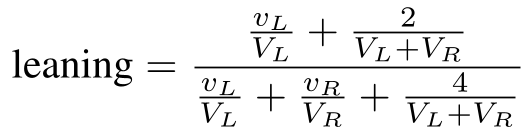
The core of the methodology is an elegant smoothing formula that calculates leaning based on the volume of clicks to Left () vs. Right () blogs, adjusted for the total volume of clicks across the entire ecosystem.
Insights: The Dark Side of Digital Democracy
The results from the 27-week study period (2011-2012) offer three stinging "Deep Insights":
1. The "Opposition Interest" Paradox
Contrary to the "echo chamber" theory where users only read what they agree with, search logs show an intense interest in "the other side." Queries about Democrat politicians (like Obama) often had a right-leaning click profile, while queries about Republicans (like Gingrich) had a left-leaning profile. This suggests that search is a primary tool for opposition research and criticism.
2. Lies are Catchy
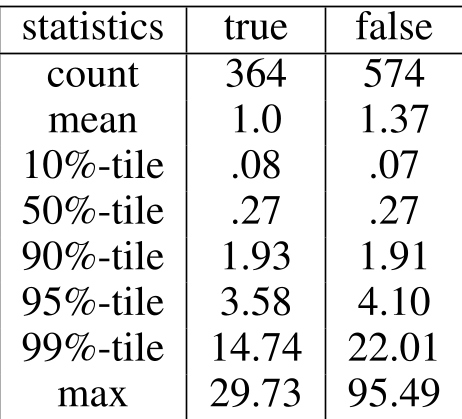
One of the most sobering findings is the correlation between truth and volume. The researchers found that queries corresponding to "False" or "Pants on Fire" statements on PolitiFact were significantly more likely to reach massive search volumes compared to true statements.
3. Visualizing the Controversy
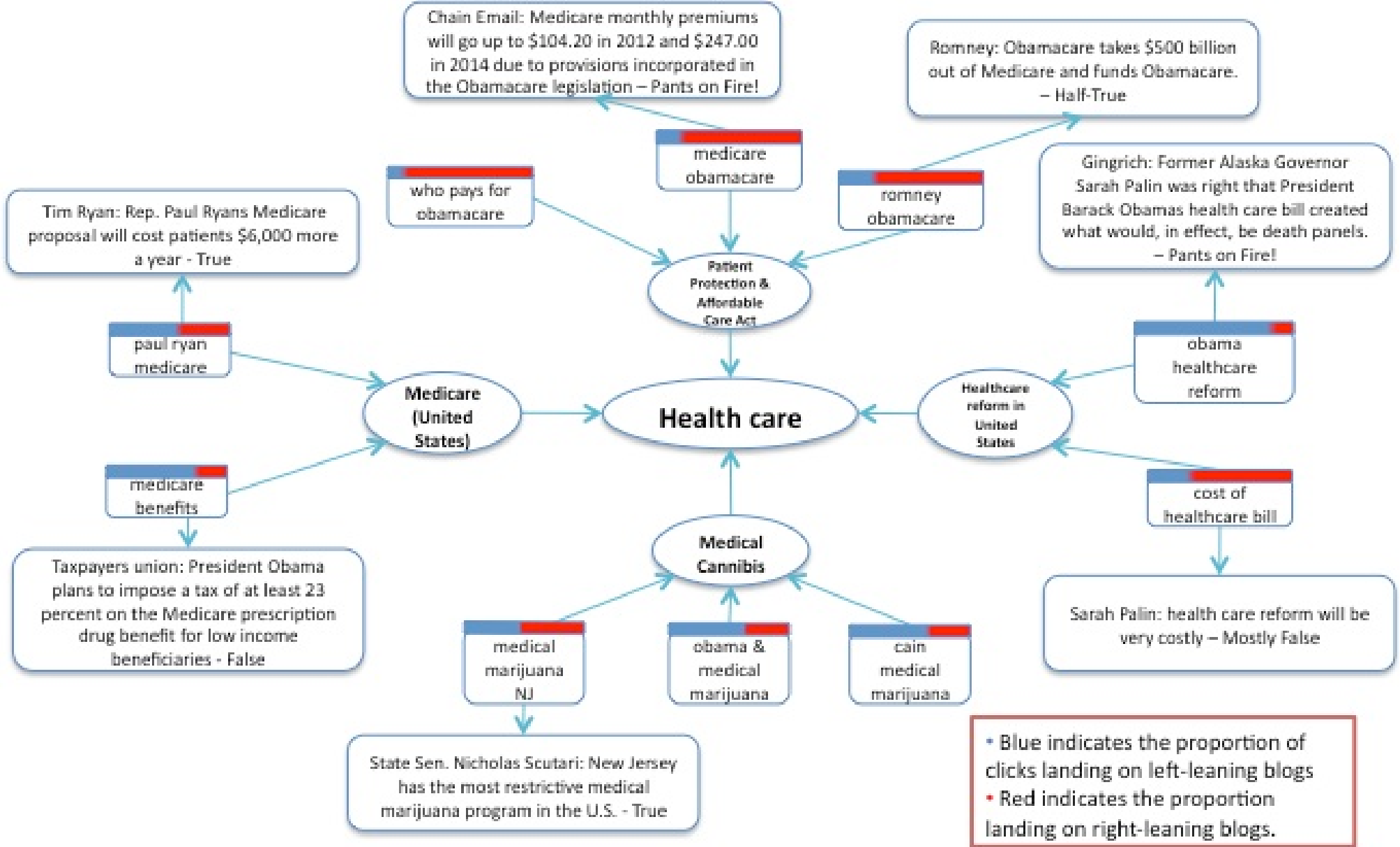
By combining these metrics, the authors created "Controversy Maps." For instance, in the "Health Care" debate, they could automatically plot which sub-issues (like "medical marijuana") slanted Left and which (like "Obamacare waivers") slanted Right.
Critical Analysis & Conclusion
This work highlights a fundamental shift in how we view search engines: they are not just information retrieval systems; they are ideological sensors.
Key Takeaways:
- Inertia: Most queries have stable leanings, but those that "flip" are almost always associated with high-intensity "bursts" of news activity.
- Sentiment Correlation: There is a clear statistical link between right-leaning queries and negative sentiment in the resulting search snippets, reflecting a highly critical stance toward the status quo (during the Obama era).
Limitations: The study is limited by the "ground truth" of the blog list. If a major centrist or non-aligned blog is missed, the leaning score could be skewed. Furthermore, the sentiment analysis is performed on the results, not the user's intent, which can be noisy.
As we move into an era of AI-driven search, this methodology remains a vital blueprint for understanding how algorithms might inadvertently amplify "catchy lies" or deepen partisan divides.