
Social Strength: A New Frontier in Combating Spam over Internet Telephony (SPIT)
Mitigating SPIT with Social Strength
The paper proposes a novel SPIT (Spam over Internet Telephony) detection mechanism based on "Social Strength," which utilizes a comprehensive set of social network features and the EigenTrust algorithm. It achieves a 99% True Positive Rate and less than 10% False Positive Rate across various network distributions without requiring user feedback.
Executive Summary
Voice over IP (VoIP) has revolutionized communication but opened the door to SPIT (Spam over Internet Telephony)—the voice equivalent of email spam, ranging from aggressive telemarketing to malicious phishing. Unlike email, technical obstacles like real-time requirements and privacy constraints make content filtering nearly impossible.
This paper introduces a Social Strength approach that identifies spammers by analyzing their behavioral "footprint" within a social graph. By moving beyond simple call duration and eliminating the need for user feedback, the authors achieve a staggering 99% True Positive Rate (TPR). This work establishes a non-intrusive, provider-level defense mechanism that fits seamlessly into existing SIP architectures.
The Problem: Why Your "Mute" Button Isn't Enough
Existing anti-SPIT solutions are often hampered by two major flaws:
- Intrusiveness: Many systems require users to "rate" calls or pass Turing tests (puzzles), which degrades user experience.
- Feature Simplicity: Earlier reputation models like CallRank focus heavily on average call duration. Professional spammers can easily "game" this by staying on the line longer or targeting gullible users.
Furthermore, the real-time nature of VoIP means a decision must be made before the callee picks up, leaving no room for deep packet inspection or semantic analysis of the conversation.
Methodology: Quantifying "Relationship"
The core innovation lies in the Social Strength formula. The authors argue that a legitimate relationship is defined by reciprocity and repetition.
1. Local Strength Computation
Instead of just looking at how long a call lasts, the model calculates local trust between Caller (S) and Callee (R) using:
- Interaction Rate: How often they talk.
- Reciprocity: Does the callee ever call back? (Spammers almost never receive return calls).
- Out-Degree Penalty: If a caller tries to reach hundreds of unique people but gets no return engagement, their strength score plummets.
2. Global Reputation via EigenTrust
To prevent a spammer from appearing legitimate just because they fooled a few users, the system uses the EigenTrust algorithm.
- The Twist: The authors modify the initialization vector. By setting the initial trust to , they mathematically "poison" the reputation of nodes that exhibit typical broad-spectrum spamming behavior before the algorithm even iterates.
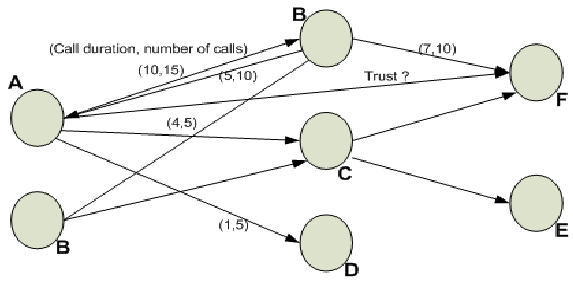 Fig 1. The social network graph where edge weights represents social strength derived from CDR logs.
Experiments: Beating the Baselines
The authors tested their model against four synthetic network distributions (Power Law, Exponential, Uniform, and Normal).
- Against CallRank: While the baseline CallRank performed well in uniform networks, its accuracy collapsed (below 50%) in more realistic Power Law distributions.
- Social Strength Performance: The proposed model remained stable, maintaining a False Positive Rate (FPR) of less than 10%. Even when spammers made up 30% of the network, the system's accuracy remained above 95%.
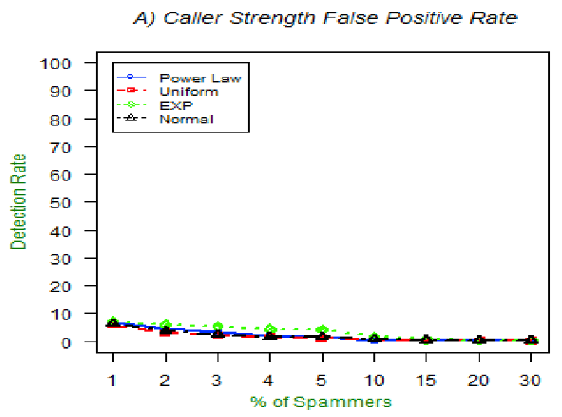 Fig 2. Accuracy of Social Strength across different SPIT rates and degree distributions.
Critical Insight: The "Cold Start" and "Bank" Problem
The authors identify a critical edge case: Call Centers and Banks. These legitimate entities have high out-degrees and often low reciprocity, making them look like spammers.
- The Solution: The paper suggests providing a higher "initial global trust" for verified white-listed entities.
- Stability: As shown in Fig. 4, the system becomes highly stable after as few as 3 interactions, meaning new legitimate users can quickly build their reputation.
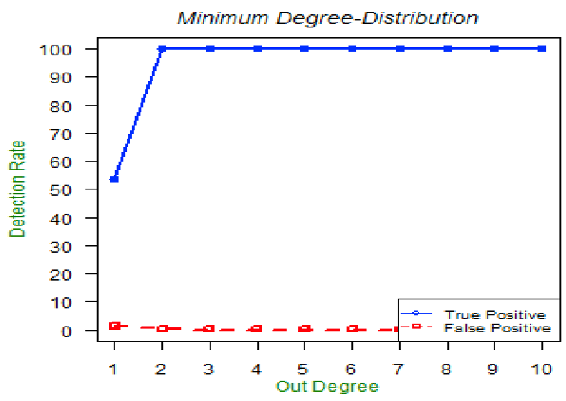 Fig 3. System stability relative to the number of user interactions (Out-degree).
Conclusion
This "Social Strength" framework proves that the metadata of our interactions (who we call, who calls us back, and how often) contains enough signal to filter 99% of spam without ever listening to a word of the conversation. For VoIP providers, this offers a path to a "silent" security layer that protects the user without ever bothering them with a puzzle or a feedback form.
Future Outlook: Integrating AI-driven dynamic thresholds could further reduce the 10% false positive rate, potentially distinguishing between a "helpful" automated reminder from a pharmacy and a "malicious" vishing attempt.