
MIT's Digital Renaissance: Engineering the Future of Global Education (1999–2003)
12487_MIT's Strategy for Educational Technology Innovation, 1999-2003.
This paper provides a historical analysis of MIT's strategic educational technology initiatives between 1999 and 2003, highlighting the launch of OpenCourseWare (OCW), iLabs, and the d’Arbeloff Fund. It details how MIT transitioned from exploring commercial distance learning to championing an "Information Commons" and "Active Learning" model, setting a global standard for open education.
TL;DR
At the turn of the millennium, MIT rejected the "pay-to-play" model of online distance education that dominated the dot-com era. Instead, it invested $50M into a radical synthesis: OpenCourseWare (OCW) for global knowledge sharing and Active Learning (TEAL) for on-campus residential excellence. This decade-long journey transformed MIT from a "zip code 02139" institution into the primary architect of the global Information Commons.
The Motivation: A Conflict of Identities
In 1999, the academic world was in a panic. Management consultants predicted that residential campuses would become "relics" as the Internet made distance learning ubiquitous. MIT stood at a crossroads:
- The Expansionist Vision: Create "MIT of Singapore" or sell "Knowledge Update" modules to alumni and corporations for profit.
- The Residential Vision: Protect the "academic city on the hill" and ignore the digital threat to preserve community.
The breakthrough came when MIT realized that content is not king—community is. By giving away the content (OCW), they could focus on the "thrill of discovery" on campus, effectively devaluing competing commercial content while increasing the prestige of an MIT degree.
Methodology: The Three Pillars of Innovation
MIT’s strategy was not a single "plan" but an evolution across three dimensions:
1. Active Learning (The TEAL Project)
To solve the "drudgery" of large lecture halls, Professor John Belcher pioneered Technology Enabled Active Learning (TEAL).
- The Insight: Use simulations and desktop experiments to provide immediate visual feedback of invisible physics concepts (electromagnetism).
- The Shift: Lectures were replaced by "studio instruction" where students work in small groups in high-tech, collaborative spaces.
 Figure 1: Early conceptualization of the MIT educational technology framework.
2. The Information Commons (OCW & DSpace)
The most "disruptive" move was OpenCourseWare.
- The Grand Idea: Reminder of the "democratic and civilizing possibilities" of the information age.
- DSpace: Working with HP, MIT built an open-source digital archive to handle research that was "born digital," challenging the extortionate pricing of academic journals.
3. Institutional Collaboration (iLabs)
Beyond sharing PDFs, MIT wanted to share hardware. The iLabs project enabled students around the world (from Singapore to Nigeria) to access expensive MIT laboratory equipment via a web browser, turning scarcity into abundance.
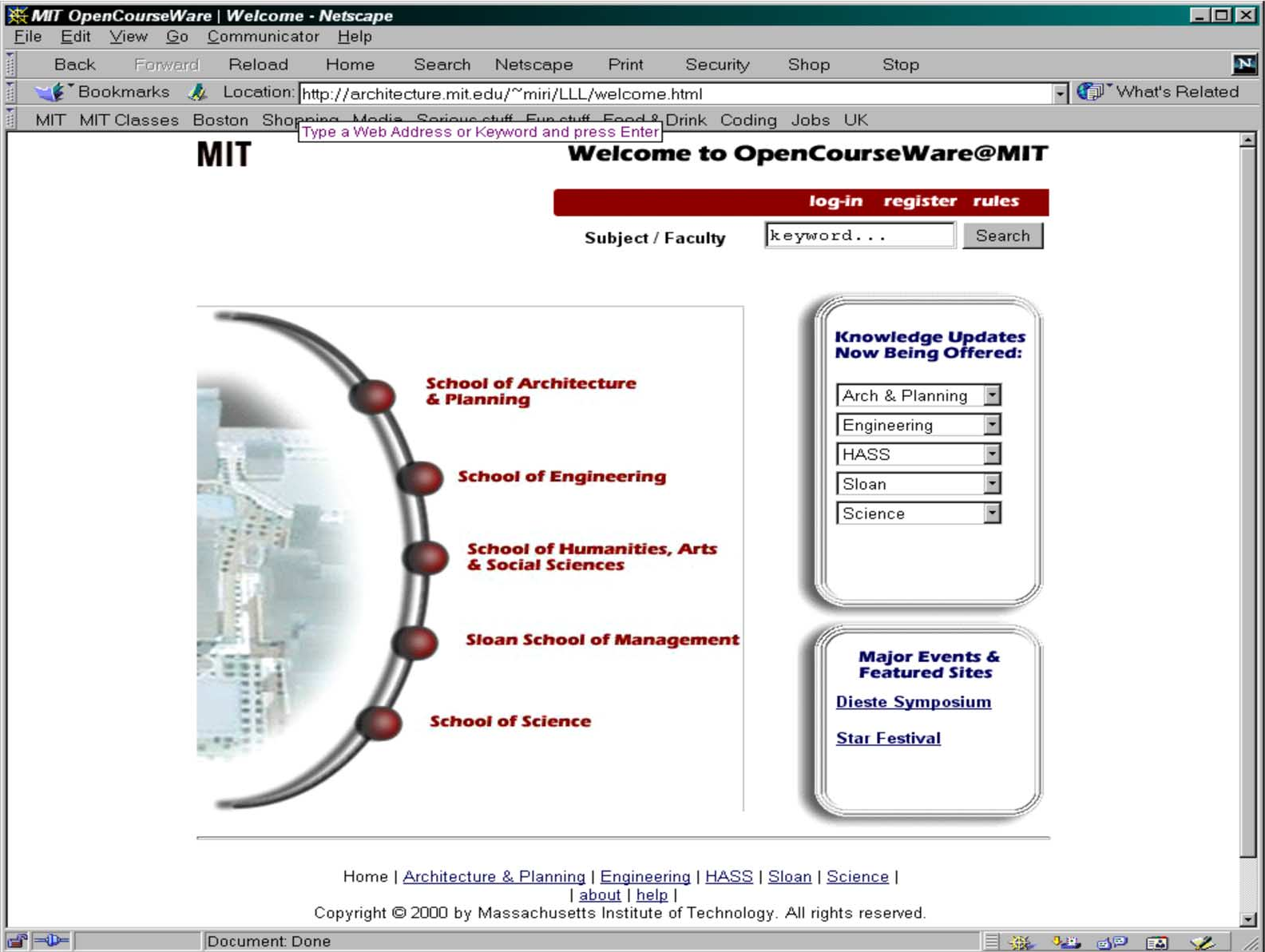 Figure 2: The original "revolutionary" mock-up for OpenCourseWare that shifted the strategy from profit to open access.
Experiments & Results: The Verdict of 2007
By 2007, the "measured period of taking stock" revealed significant victories:
- SOTA in Physics: TEAL became the default format for introductory physics, with data showing improved conceptual understanding over traditional auditoriums.
- Massive Scale: OCW reached its goal of 1,800 courses online, involving 90% of MIT's faculty.
- The "Knowledge Update" Failure: Interestingly, the attempt to sell "mini-courses" for $450 failed. The market preferred free, high-quality open resources—the very ecosystem MIT helped create.
 Figure 3: Global expansion of the CDIO and OCW initiatives as of mid-2007.
Critical Insights & Conclusion
Takeaway: Strategic planning in universities is often "oxymoronic" because innovation usually happens bottom-up. However, MIT’s central administration succeeded by providing infrastructure (wireless, repositories) and funding (d’Arbeloff, iCampus), then letting faculty's internal dissatisfactions drive the pedagogical change.
The Paradox of Speed: While technology moves in months, institutionalizing educational change takes a decade. MIT's true achievement wasn't the software—it was the cultural shift from "knowledge as a secret" to "knowledge as a shared platform."
Future Outlook: As we enter the age of AI-tutors, the MIT 1999–2003 strategy serves as a blueprint: focus on the human community and residential experience, and leverage technology to commoditize the content so that the experience remains the premium product.