
ML-SOR: Bridging the Gap Between Online Ties and Offline Encounters for Efficient Routing
ML-SOR: Message routing using multi-layer social networks in opportunistic communications
This paper introduces ML-SOR (Multi-layer Social Network based Routing), an opportunistic routing protocol that leverages structural information from multiple social layers—physical encounters, online friendships (Facebook), and shared interests—to optimize message delivery in Delay Tolerant Networks (DTNs). By synthesizing node centrality, tie strength, and link prediction across these layers, ML-SOR achieves message delivery ratios comparable to Epidemic routing while significantly reducing overhead.
TL;DR
ML-SOR is a novel protocol for opportunistic networks that doesn't just look at who you've met, but who you know online. By combining physical encounter history with Facebook friendships and common interests, it achieves high delivery rates in Delay Tolerant Networks (DTNs) while drastically cutting down on redundant message traffic (overhead).
The "Warm-up" Problem in Opportunistic Networks
In the world of Opportunistic Networks, devices (like phones) move unpredictably and connect only when in close proximity. Standard protocols like Bubble Rap or PeoPleRank rely on encounter history to find "popular" nodes to act as relays.
However, there is a fundamental flaw: The Cold Start/Dynamic Gap. It takes a long time to learn which nodes are truly central based solely on intermittent Bluetooth/Wi-Fi contacts. While you're learning the network, messages are lost or sent on suboptimal paths. Meanwhile, your "online" life—your Facebook friends and your research interests—is a stable, pre-defined map of potential social interactions that routing protocols traditionally ignore.
Methodology: The Multi-Layer Insight
The authors argue that a single "Detected Social Network" (DSN) is insufficient. Instead, they propose a Multi-Layer Social Network (MLSN) model.
1. Structural Analysis of the Layers
The paper first proves through analysis of real traces (Lapland and Sigcomm) that:
- Facebook ties are excellent indicators of DSN Strong Ties (frequent physical meetings).
- Shared Interests can predict Future Encounters with accuracy comparable to historical contact data.
2. The ML-SOR Metric
The protocol uses a sophisticated utility score (MLS) to decide whether to hand off a message to an encountered node for destination :
- CS (Centrality Score): Measures general popularity in the physical world (who sees the most unique people?).
- TSS (Tie Strength Score): Leverages the OSN (Facebook) to find if the relay has a stable link to the destination.
- LPS (Link Predictor Score): Uses Jaccard similarity on the Interest layer to predict if the relay will move toward the destination.
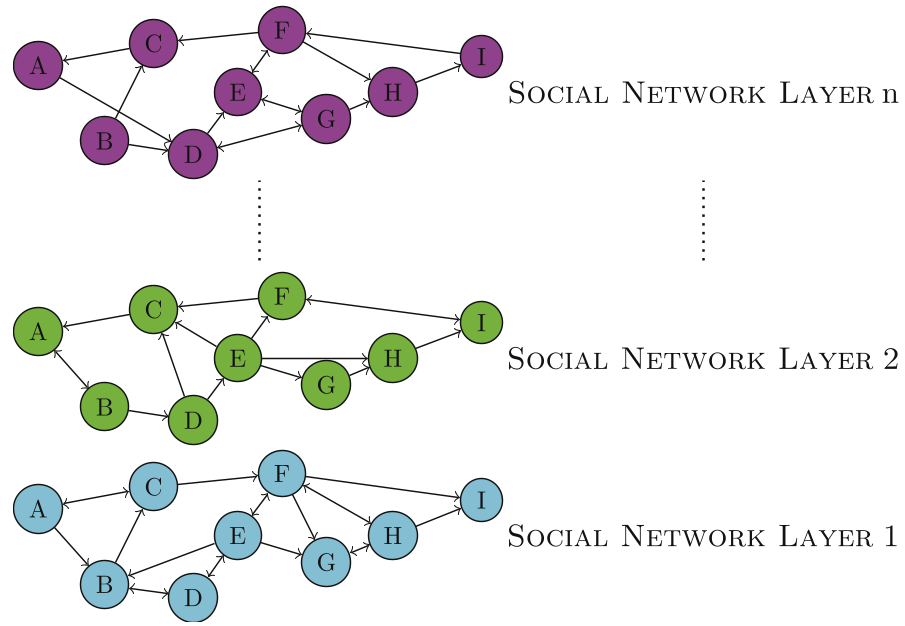 Figure 1: Conceptual model of a multi-layer social network where nodes connect across physical, friendship, and interest planes.
Experiments & Results: Efficient Intelligence
The researchers tested ML-SOR against benchmarks like Epidemic (flooding) and PRoPHET (probabilistic).
SOTA Comparison
In the Sigcomm dataset, ML-SOR and its hybrid cousin H-Bubble Rap were able to match the performance of Epidemic routing (~95%+ delivery) but with a fraction of the cost. Unlike Epidemic, which blindly sprays messages, ML-SOR uses its "multi-layer knowledge" to pick only the most promising carriers.
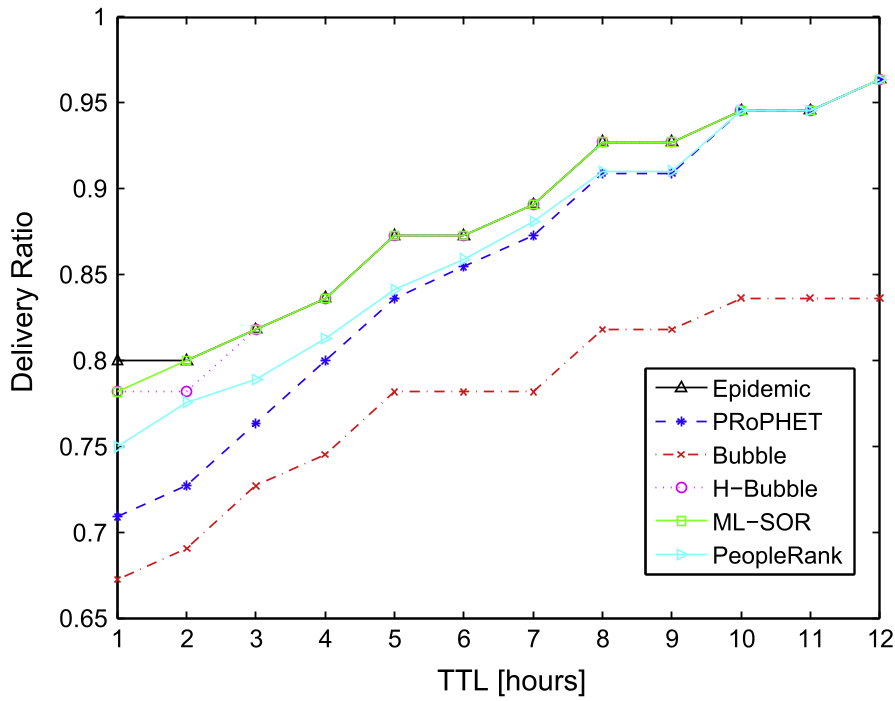 Figure 2: Delivery Ratio Comparison. Note how ML-SOR (and H-Bubble) closely follow the upper-bound Epidemic line while outperforming other social protocols.
Key Findings:
- Ablation: Centrality (CS) is the most powerful single factor, but adding Tie Strength (TSS) and Link Prediction (LPS) provided a 10% boost in delivery in the Sigcomm trace.
- Overhead: ML-SOR consistently showed lower overhead than non-social protocols, making it much more energy-efficient for mobile devices.
Critical Analysis & Conclusion
The genius of ML-SOR lies in its data fusion. By recognizing that human mobility is driven by social intent (who we like and what we care about), the protocol bootstraps its intelligence using static online data to solve the dynamic uncertainty of the physical world.
Limitations: Like many social-based systems, it relies on users being willing to share (at least a hashed version of) their friendlists and interests. Privacy-preserving computation or Differential Privacy would be a natural next step for this technology.
Future Outlook: As we move toward 6G and ubiquitous edge computing, the "social-awareness" of routing will likely evolve from simple friendlists to complex AI models of human behavior, making ML-SOR a foundational blueprint for multi-modal network intelligence.