
ML-SOR: Bridging Online Social Ties and Physical Opportunistic Routing
ML-SOR: Message routing using multi-layer social networks in opportunistic communications
This paper introduces ML-SOR (Multi-layer Social Network based Routing), an opportunistic routing protocol that leverages multi-layer social network data—including physical encounters (DSN), online friendships (OSN), and shared interests—to optimize message forwarding. By combining node centrality, tie strength, and link prediction across these layers, ML-SOR achieves performance comparable to Epidemic routing while significantly reducing network overhead.
Executive Summary
In the world of Opportunistic Networks (part of Delay Tolerant Networking), the "store-carry-forward" paradigm is king. However, the efficiency of this paradigm relies on a critical question: Who is the best next-hop relay? This paper, "ML-SOR: Message routing using multi-layer social networks," breaks away from the limitation of looking only at physical encounter history. By synthesizing a Multi-Layer Social Network (MLSN) that includes Facebook friendships and shared interests, the authors provide a routing metric that predicts future encounters even before they happen.
The "Knowledge Gap" in Opportunistic Routing
Most social-aware routing protocols (like Bubble Rap) suffer from a cold-start problem. They need time to observe encounters to calculate "Centrality" or "Community." During this observation period, routing is often inefficient.
The authors' core insight is that human relationships are multi-dimensional. While your physical proximity to someone might be intermittent, your "Online Social Network (OSN)" ties are stable. By leveraging these "virtual" layers, we can infer the "strength" of physical links that haven't been fully realized yet.
Methodology: The Multi-Layer Metric
The authors define a composite utility score, MLS, which evaluates a node against an encountered node for a destination :
- Centrality Score (CS): Uses Cumulative Degree Centrality—how many unique nodes you meet over time.
- Tie Strength Score (TSS): Leverages OSN layers (Facebook). If you are friends online, the likelihood of a successful physical encounter is statistically higher.
- Link Predictor Score (LPS): Uses a Jaccard coefficient on the Interest Layer. If two people share scientific interests, they are likely to encounter each other at common venues or events.
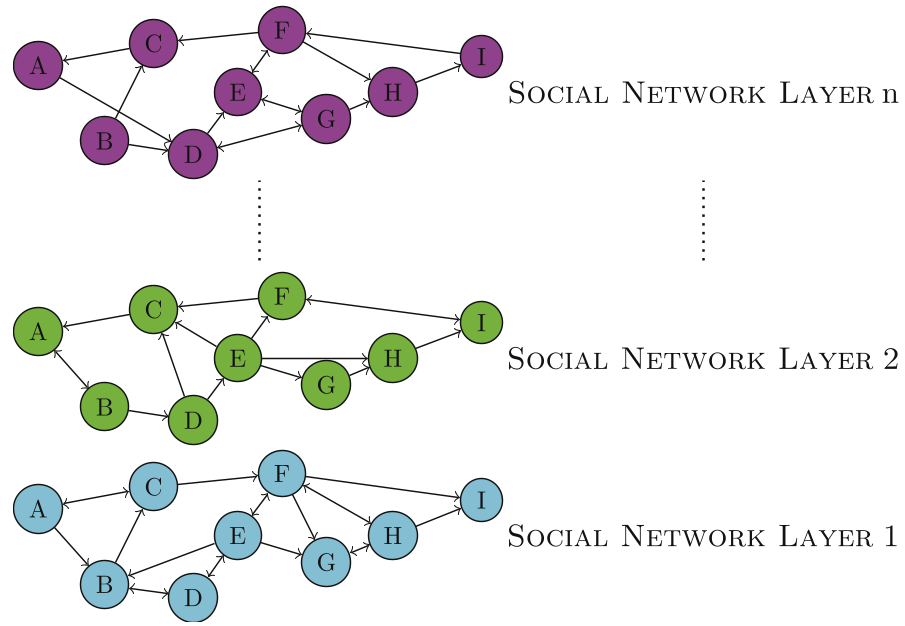 Figure 1: Conceptual view of a Multi-layer Social Network where nodes are connected across different social contexts.
Experimental Insights
The research utilized two high-fidelity datasets: Lapland (ExtremeCom '09) and Sigcomm (SIGCOMM '09).
Key Discoveries from Analysis:
- Low Correlation: Centrality on Facebook does not necessarily predict centrality in physical encounters. This justifies the "multi-layer" approach—one layer provides what the other lacks.
- Link Prediction: Shared interests were found to be excellent predictors of future DSN (Detected Social Network) links, rivaling the accuracy of using the first day's encounter data.
Performance Results:
ML-SOR was pitted against benchmarks like Epidemic, PRoPHET, and Bubble Rap.
- Efficiency: In the Sigcomm trace, ML-SOR reached the delivery ceiling of Epidemic routing but with an overhead cost reduction of nearly 80%.
- Hop Count: ML-SOR consistently delivered messages in fewer hops compared to PeopleRank, proving its relay selection was more surgical and less "broadcast-heavy."
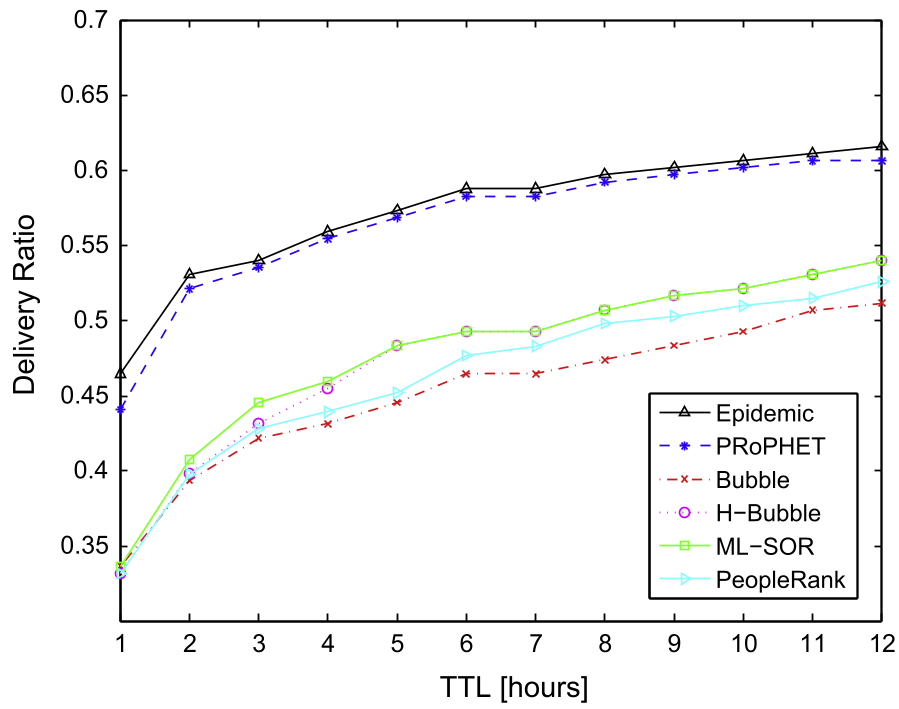 Figure 2: Delivery ratio comparison in the Lapland dataset. While Epidemic is the upper bound, ML-SOR shows strong competitiveness among social protocols.
Critical Analysis & Conclusion
ML-SOR proves that social metadata is a robust proxy for physical mobility. By using "virtual" ties as an inductive bias for routing, the system overcomes the sparsity of physical contacts.
Limitations:
- The protocol assumes nodes are willing to share their OSN friend lists or interests, raising significant privacy concerns.
- The methodology relies on static interest profiles; in reality, interests and OSN ties also evolve, though at a slower pace than mobility.
Future Outlook: The next step for this tech is likely Privacy-Preserving Multi-Layer Routing, perhaps using Zero-Knowledge Proofs to verify "Interest Similarity" without revealing the actual interests. As we move toward a more hyper-connected IoT world, ML-SOR's philosophy of leveraging cross-platform identity for networking will become even more relevant.