
ML-SST: How Mouse Tracking and Machine Learning are Revolutionizing Adult ADHD Diagnosis
Machine Learning Stop Signal Test (ML-SST): ML-based Mouse Tracking Enhances Adult ADHD Diagnosis
The paper introduces the Machine Learning Stop Signal Test (ML-SST), a novel diagnostic framework for adult ADHD that integrates high-frequency mouse cursor tracking with Ridge regression. By capturing fine-grained motor dynamics such as velocity and acceleration, ML-SST significantly outperforms standard keyboard-based behavioral tests in aligning with established clinical ADHD questionnaires (CAARS).
TL;DR
Diagnosis of adult ADHD is notoriously difficult because traditional behavioral tests (like the Stop-Signal Task) are often too "coarse" to catch subtle impairments. Researchers at Texas A&M University have developed ML-SST, a system that replaces keyboard presses with mouse cursor tracking. By analyzing the "how" of a movement—specifically velocity and acceleration—rather than just the "when," they achieved a significantly stronger correlation with clinical diagnostic scales, providing a new, high-sensitivity digital tool for mental health assessment.
The Problem: The "Sensitivity Gap" in ADHD Testing
For decades, the Stop-Signal Task (SST) has been the gold standard for measuring motor inhibition. You are told to "Go" (react to a stimulus) unless a "Stop" signal appears, in which case you must withhold your response.
While this works for severe clinical cases, it often fails in adults with mild or late-onset ADHD. The data collected—hit or miss, and how fast—is simply too sparse. There is a "Sensitivity Gap" where an individual might feel the symptoms of ADHD (as recorded in questionnaires like CAARS), but their laboratory test results look perfectly normal.
The Insight: Movement as a Window into Inhibition
The authors hypothesized that even if a person successfully "stops" or "goes," the way they move the mouse reveals the underlying cognitive conflict. A person with ADHD might start a movement and try to pull back, resulting in specific velocity profiles that a simple keyboard press cannot capture.
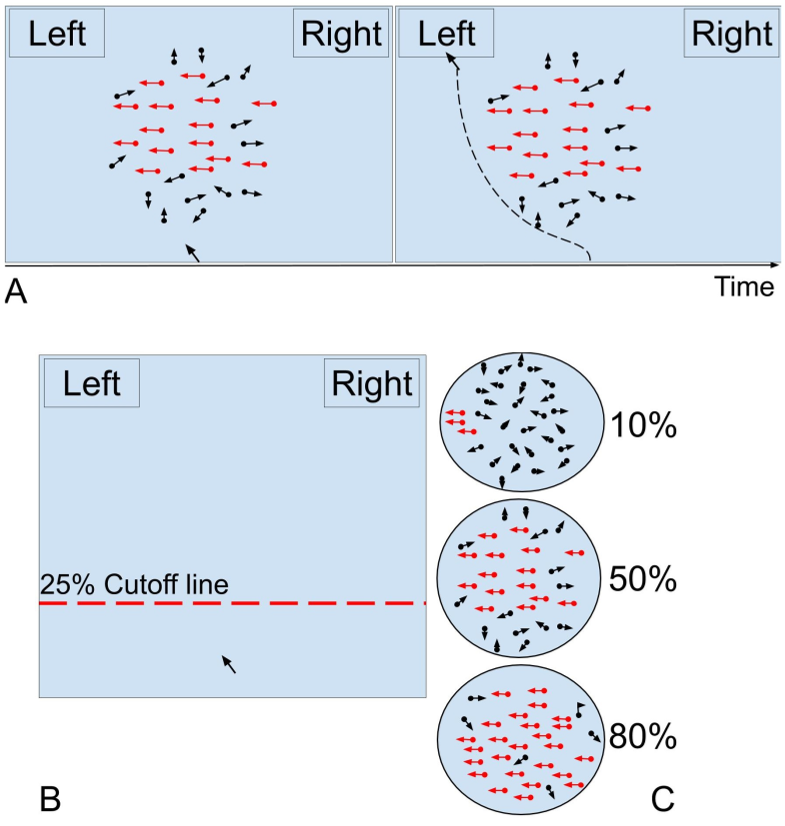 Fig 1: Unlike traditional tests, ML-SST tracks the entire trajectory. A movement of 25% toward the target during a "Stop" signal is recorded as an inhibition failure, capturing "micro-impulses".
Methodology: From Pixels to Predictions
The ML-SST records x-y coordinates every 16 milliseconds. This high-frequency sampling allows the extraction of several "Kinematic Features":
- Maximum Velocity: How fast the cursor moves.
- Maximum Acceleration: How quickly the user reacts or changes direction.
- Total Distance: The efficiency of the path taken.
To handle this data, the researchers employed a robust Machine Learning pipeline. They compared Ridge Regression, Random Forest, and Support Vector Machines (SVM). Given the relatively small sample size (100 participants), Ridge Regression emerged as the winner because its linear constraints prevented the model from "hallucinating" patterns (overfitting) in the noise.
Experimental Results: The Proof is in the Path
The results were striking. When using the standard keyboard test (s-SST), the correlation between the test and the actual ADHD diagnosis was virtually non-existent or even negative.
However, with ML-SST, the researchers found:
- High Correlation: Significant associations with the DSM-IV Inattentive and Combined subscales.
- Subtype Differentiation: Velocity was more predictive of Inattentiveness, while acceleration was more predictive of Hyperactivity.
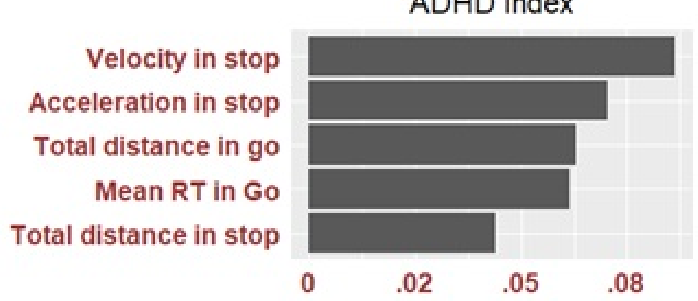 Fig 2: Relative importance of different features. Note how velocity and acceleration in 'stop' trials dominate the diagnostic weight.
Critical Analysis & Conclusion
Why this matters
The ML-SST proves that we don't necessarily need more complex tests; we need better sensors. By simply switching the input device from a keyboard to a mouse, we unlock a "High-Definition" view of the user's executive function.
Limitations
The study utilized a sample of undergraduate students. While this is a valid "sub-clinical" population, further validation on a broader clinical sample (patients seeking treatment) is necessary to confirm the tool's diagnostic power in a medical setting.
Outlook
This approach could easily be extended to other devices. Could touchscreen dynamics on a smartphone or eye-tracking on a VR headset provide similar insights? The ML-SST opens the door for continuous, non-invasive mental health monitoring through the tools we already use every day.