
MobiSNA: The Architect of Mobile Video Socialization
MobiSNA: a Mobile Video Social Network Application (Demo Paper)
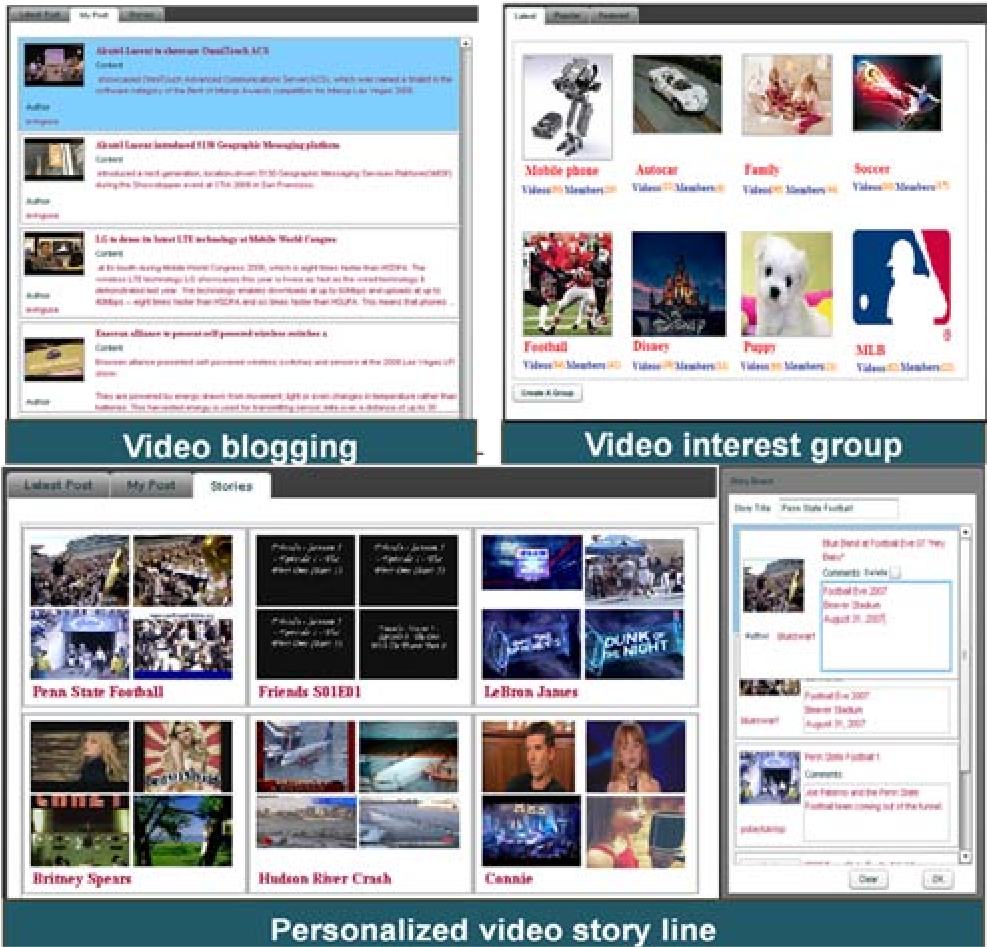
MobiSNA is a mobile video social networking application designed for 3G/4G networks that enables real-time video sharing, social-based exploration, and collaborative video storytelling. It utilizes a client-server architecture built on Adobe Flex and Flash Media Server to deliver high-quality video experiences on mobile devices.
Executive Summary
TL;DR: Published in 2009, MobiSNA (Mobile Video Social Network Application) was a visionary project that anticipated the shift from text-based social media to video-centric platforms. It introduced real-time video sharing, video blogging, and collaborative storytelling, optimized for the then-emerging 4G wireless networks.
Positioning: This work serves as a foundational prototype for the "Mobile Video First" era, moving beyond simple video repositories like YouTube to create an interactive, social-graph-driven multimedia ecosystem.
Problem & Motivation: The Bandwidth-Hardware Gap
In the late 2000s, the mobile landscape was at a crossroads. While 3G networks were becoming ubiquitous and 4G (LTE/WiMAX) was on the horizon, most social applications remained tethered to text and static images (e.g., Early Facebook, JuiceCaster).
The authors identified two major gaps:
- Social Isolation: Mobile video players were "read-only" silos; you could watch a video, but you couldn't see the social context of the creator.
- Technological Constraints: Real-time video sharing was hindered by limited mobile processing power and inconsistent network speeds.
The insight behind MobiSNA was to treat video not just as data, but as a "social object" that could be used for real-time presence and collaborative reporting (e.g., citizen journalism).
Methodology: The Architecture of Interaction
MobiSNA employs a robust Client-Server Architecture designed to keep the mobile client "thin" while the server handles the heavy lifting.
1. Social-Centric UI Design
Instead of a standard list view, MobiSNA uses a central video player surrounded by "blocks" representing friends' collections.
- Bandwidth Trick: To prevent network congestion, only the central video is streamed. The surrounding blocks use animated keyframes (extracted via FFmpeg) to provide a "preview" without the heavy load of multiple video streams.
2. The Backend Pipeline
- Extraction & Assembling: When a user uploads a video, the server uses FFmpeg for keyframe extraction and ImageMagick to create animated GIFs/previews.
- Flash Media Server: Utilized for low-latency RTMP/P2P streaming, allowing users to "call" into a live feed, much like modern Instagram Live or Zoom.
Experiments & Results: Real-World Scenarios
The paper validates its design through transition scenarios that were futuristic at the time:
- Live Event Sharing: Multi-continental live video sync between friends (the precursor to FaceTime/Houseparty).
- Citizen Journalism: Using mobile videos to cover areas inaccessible to traditional TV crews (e.g., earthquake zones).
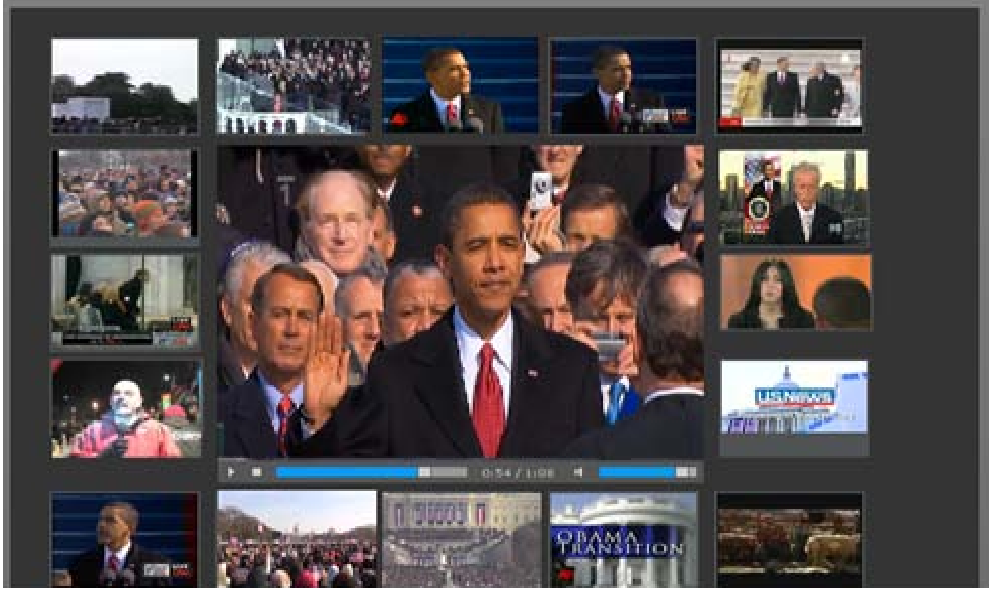 Figure: The "Obama Inauguration" exploration view demonstrating how social context is visualized alongside the video content.
Critical Analysis & Conclusion
Takeaway
MobiSNA's primary contribution was the conceptualization of Video Storytelling—the ability to compile videos from multiple social sources into a cohesive narrative. This is the direct ancestor of "Collaborative Stories" found in modern apps.
Limitations
- Dependency on Flash: The reliance on Adobe Flex and Flash Media Server eventually became a dead-end as the industry shifted to HTML5 and native iOS/Android frameworks.
- Computational Latency: While it offloaded processing to the server, the round-trip time for "Real-time" keyframe generation in 2009 was still significant compared to modern edge computing.
Future Outlook
The paper concludes by suggesting the integration of Location-Based Services (LBS). Today, we see this fully realized in Snapchat's "Snap Map," where users can watch videos based on geographic proximity—a direct extension of the MobiSNA vision.