
Kaleido: Elevating Social Media Recommendation via Affective Pulses and Edge Computing
Mobile Contextual Recommender System for Online Social Media
The paper presents Kaleido, an affective-aware mobile recommender system for Online Social Networks (OSNs). It introduces a cluster-based Latent Bias Model (LBM) that integrates emotional pulses, social closeness, behavior patterns, and location context to predict user engagement with media content.
TL;DR
Researchers from Tsinghua University have developed Kaleido, a mobile recommender system that proves "feelings" matter as much as "features." By analyzing affective pulses (immediate emotional triggers) alongside social and location context, Kaleido achieves an 87% accuracy rate—outperforming traditional models by 25%. It leverages an edge-cloud architecture to train heavy ML models 1,000x faster than a smartphone could, while keeping energy costs negligible.
Problem & Motivation: Beyond the Click
Why do we click on some tweets but ignore others? Prior work focused heavily on what a user likes (content-based) or who they follow (social-based). However, the authors argue that the affective pulse—the gut emotional reaction triggered within milliseconds—is the true driver of media consumption.
Data-driven measurements showed that 60% of user clicks are motivated by media content, and 76% of those are triggered by explicit emotional pulses like happiness or surprise. Despite this, psychological effects have rarely been integrated into real-time mobile systems due to:
- The complexity of inferring emotion from visual data.
- The computational burden of training multi-context models on mobile hardware.
Methodology: The Core Mechanism
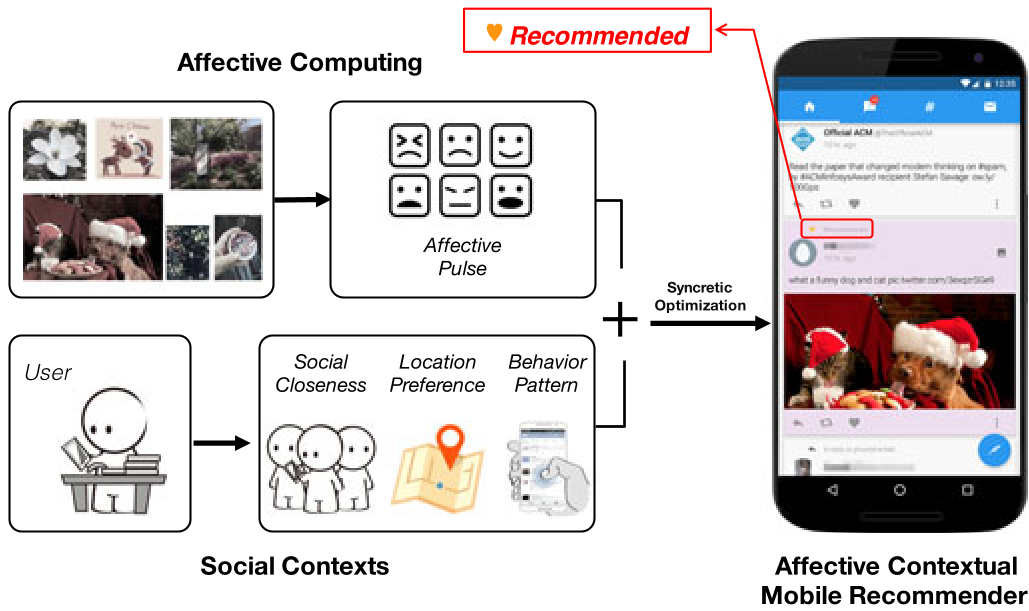
Kaleido’s architecture is split into two phases: Affective Inference and Contextual Joint Training.
1. Inferring the Affective Pulse
The system maps images into a 6-dimensional affective space (Happiness, Surprise, Anger, Disgust, Fear, Sadness) using visual variables like saturation contrast and brightness.
2. The Cluster-Based Latent Bias Model (LBM)
The innovation lies in how Kaleido handles contextual "noise." Instead of treating every friend or location as a unique variable, it uses clustering:
- Social Closeness: Friends are clustered into Close, Familiar, and Unfamiliar groups (K=3).
- Location Preference: Activities are clustered around geo-centrals like Home and Office (G=2).
The Cluster-based LBM then calculates a user action score () by summing the base behavior rate with bias terms representing these clustered features.
Experiments & Results: Real-World Performance
The authors integrated Kaleido into Twidere (a popular third-party Twitter client) and collected traces from 16,952 users.
SOTA Comparison
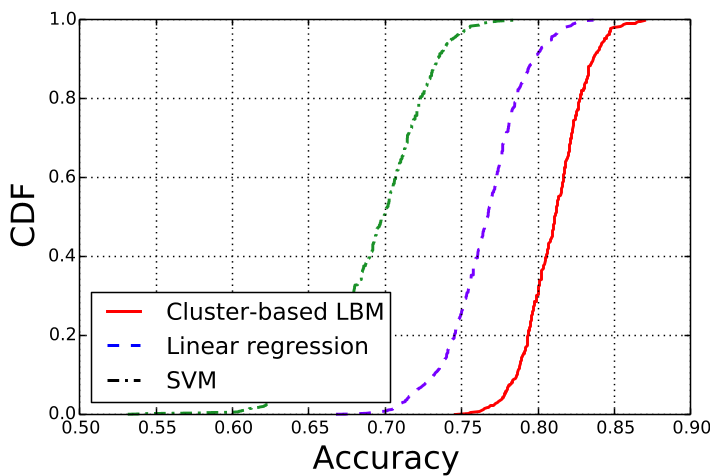
Kaleido achieved a Balanced Accuracy of 0.87, significantly higher than Linear Regression (0.76) and SVM (0.69).
The Strategy: Train on Cloud, Test on Local
The paper provides a masterclass in mobile optimization:
- Training (Cloud): Offloading training to edge-cloud servers results in a 1,000x speed-up.
- Testing (Local): Inference is done locally on the phone to minimize latency (reducing the 670ms network lag) and save data bandwidth.
Critical Analysis & Conclusion
Takeaway
Kaleido proves that Affective Context is a "missing link" in recommendation. When the authors removed the affective feature from their model, accuracy dropped by 11%, proving its unique value over traditional behavior/social features.
Limitations
- Privacy: While the authors anonymized data, the reliance on coarse geolocation remains a point of friction for privacy-conscious users.
- Visual-Centric: The current model focuses on images. In the era of TikTok and Reels, extension to short-form video affective pulse is the necessary next step.
Future Outlook
As edge computing becomes more pervasive with 5G/6G, the "Train-Cloud/Test-Local" paradigm used here will likely become the standard for mobile AI, allowing for highly complex psychological models to run in the palm of our hands.