
TripleS: Redefining Mobile Crowdsensing through Social Cloud Integration
A mobile crowdsensing system enhanced by cloud-based social networking services
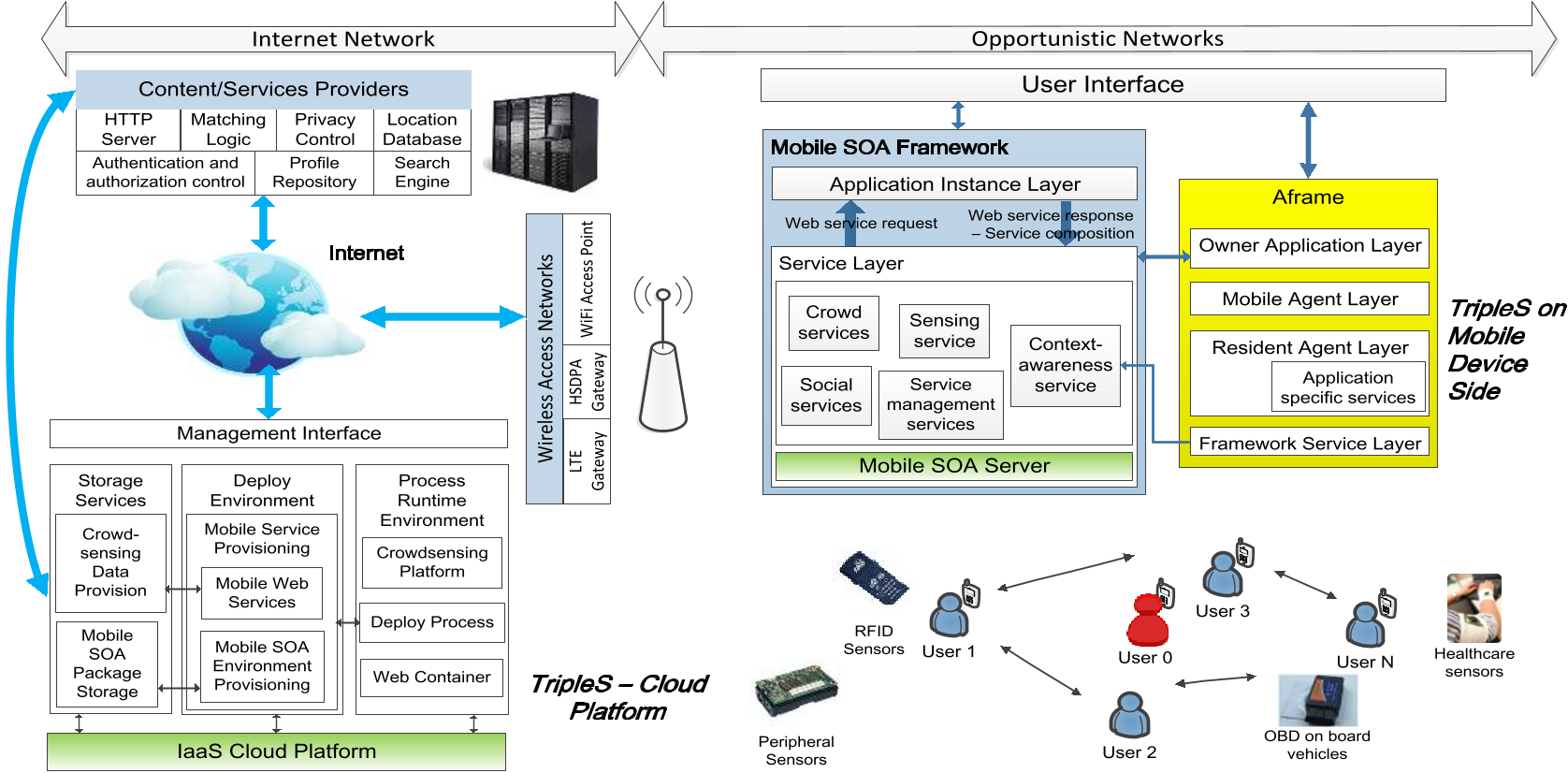
This paper introduces TripleS, a mobile crowdsensing system enhanced by Cloud-based Social Networking Services (SNS) that facilitates efficient multi-task participation. It utilizes a Service-Oriented Architecture (SOA) combined with a multi-agent framework (Aframe) to achieve a flexible, cross-platform architecture between mobile devices and the cloud.
TL;DR
TripleS is an innovative architecture that bridges the gap between cloud computing and mobile crowdsensing. By leveraging Service-Oriented Architecture (SOA) and Social Networking Services (SNS), it creates a universal ecosystem where sensing tasks are disseminated through social circles and executed by intelligent mobile agents, achieving a 5x speedup in response time compared to traditional message-based systems.
Background & Motivation: The Interoperability Gap
Mobile crowdsensing—using the sensors in our pockets to map the world—has long promised to revolutionize urban planning and crisis management. However, early systems were "walled gardens." A traffic sensing app couldn't talk to a weather sensing app. Moreover, getting enough people to participate was a constant struggle.
The authors observed that while people might not open a dedicated sensing app, they are constantly active on social networks. TripleS was born from the insight that Social Networks provide the ultimate recruitment engine, while SOA provides the necessary "common language" for different sensing services to collaborate.
Methodology: The Core Engine
TripleS is built on a sophisticated dual-platform design:
1. The Cloud Platform
Acting as the brain, the cloud platform manages global task coordination. It uses BPEL (Business Process Execution Language) to orchestrate complex sensing workflows. A key technical bridge here is the REST-SOAP Adapter, allowing modern mobile devices (REST-based) to communicate with enterprise-grade coordination engines (SOAP-based).
2. The Mobile SOA Framework & Aframe
On the device side, TripleS runs a local web server (i-Jetty).
- Aframe (Multi-agent system): Autonomous agents can "hop" between devices in opportunistic networks (like WiFi hotspots) to collect data even when internet connectivity is spotty.
- Service Layer: Standardizes access to GPS, camera, and social APIs.
Experiments: Efficiency at Scale
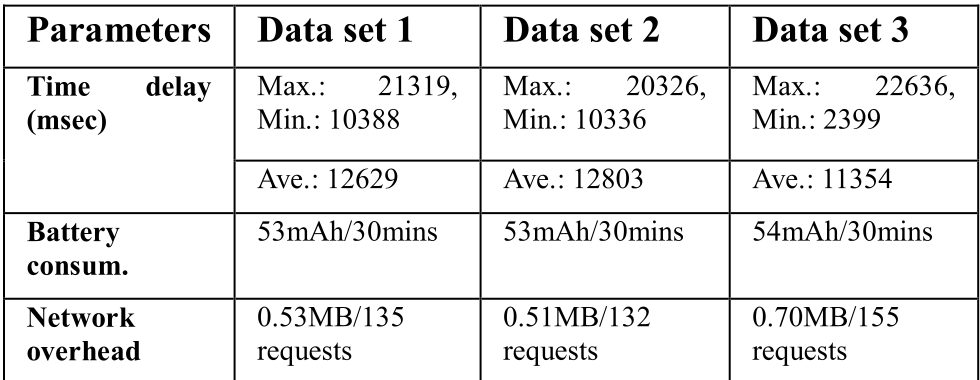
The researchers validated TripleS using real-world Android deployments. They focused on three critical metrics for any mobile system: Latency, Battery, and Data.
- Response Latency: TripleS clocked in at ~12s, dwarfing Medusa's 64s. This is largely due to bypassing slow SMS-based triggers in favor of direct Web Service calls.
- Task Success: In opportunistic networks (simulating people moving in a 150m x 150m area), the Aframe agents maintained high success rates even with intermittent disconnections.
- Resource Footprint: Consuming only ~53mAh in 30 minutes, the system is lightweight enough for "always-on" background participation.
Critical Insights & Conclusion
TripleS stands out because it treats social interaction as a first-class citizen in the system architecture. By wrapping social recruitment into a web service, it solves the "cold start" problem of crowdsensing.
Future Outlook: While TripleS solves interoperability, the next frontier for such systems will be incentive mechanisms (how to pay/reward social participants fairly) and data privacy (ensuring social data doesn't leak sensitive location history).
In conclusion, TripleS provides a robust, standardized framework that moves mobile crowdsensing from experimental silos toward a truly open, social-integrated utility.