
SmartPhonebook: Beyond the Static Contact List with Probabilistic Social Mining
Mobile Human Network Management and Recommendation by Probabilistic Social Mining
The paper introduces "SmartPhonebook," a mobile social network management system that utilizes Bayesian Networks to infer users' personal and social contexts. It provides context-aware callee recommendations and social relationship visualization, achieving approximately 70% accuracy in predicting contact targets and outperforming traditional address books in usability tests.
TL;DR
SmartPhonebook is a pioneering system that transforms the humble mobile contact list into an intelligent assistant. By using Bayesian Networks to analyze mobile logs, it infers your current mood, activity, and the strength of your social ties to recommend exactly who you might want to call next. It moves beyond "What is the phone number?" to "Who is relevant right now?"
The Intelligence Gap in Communication
Despite smartphones becoming "smarter," our primary communication gatekeeper—the address book—remains remarkably "dumb." We still scroll through alphabetical lists or type names manually. While some prior works added "presence cues" (like whether a friend is online), they required manual status updates, which users find cumbersome. The core problem is uncertainty: how can a device know if you are too busy for a social chat or if you need to call a colleague based on your current location and stress level?
Methodology: Bayesian Networks for Social Context
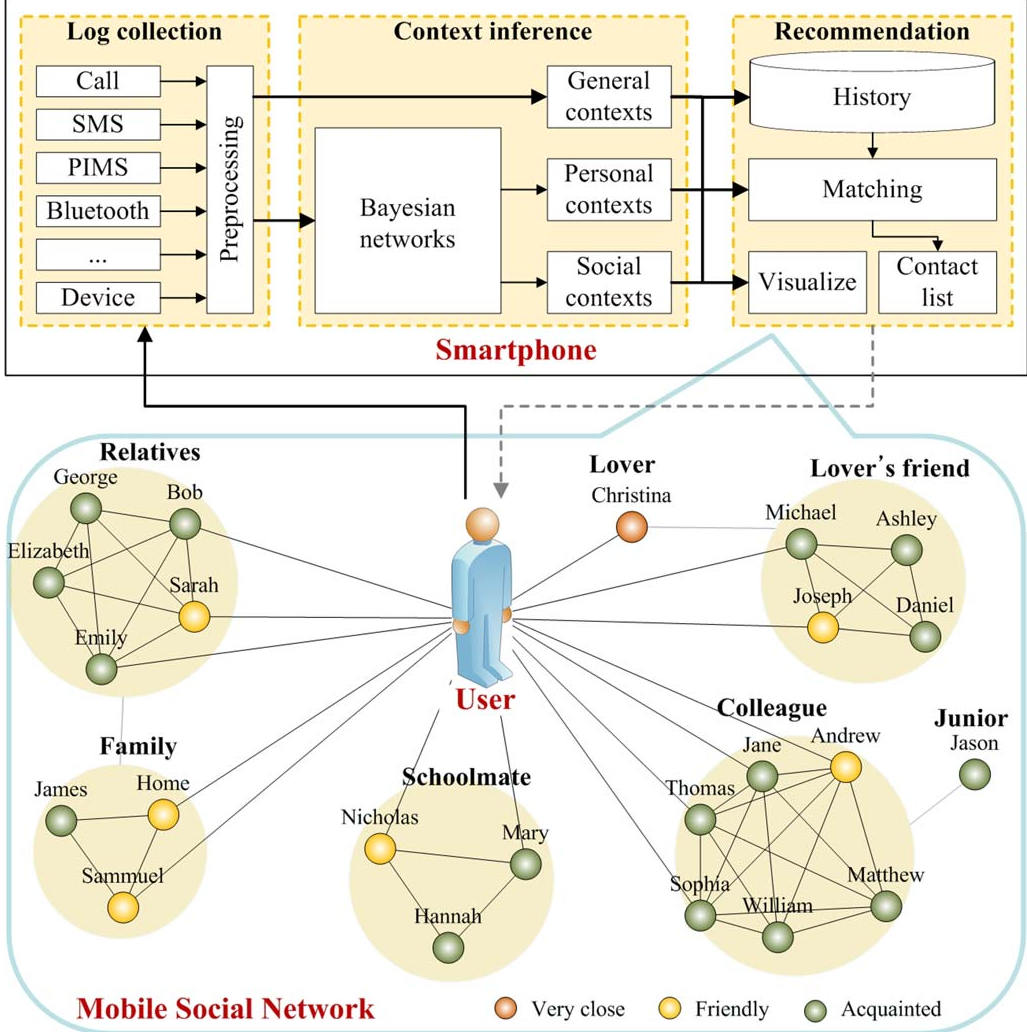
The authors argue that communication is a function of two dimensions: Personal Context (How do I feel? What am I doing?) and Social Context (How close am I to this person? Is our relationship professional or private?).
1. Handling Uncertainty
The system uses Bayesian Networks (BNs) because they excel at reasoning under uncertainty. For example, if your GPS shows you at a "workplace" and your phone is on "vibrate," the BN can infer a high probability of you being "busy."
2. The Architecture
The system architecture follows a pipeline: Log Collection Context Inference Recommendation/Visualization.
3. Solving the Discrete-Continuous Conflict
Standard BNs require discrete states (e.g., "Hot" or "Cold"). To handle continuous sensor data (like exact temperature or signal strength) without losing information, the authors implemented dummy child nodes. This allows the network to update "beliefs" based on continuous evidence functions rather than hard-coded thresholds.
Experiments and "Reality Mining"
The system was tested in two phases:
- Small-scale Study: 10 students over a month. The system achieved 92% accuracy in detecting activities and 77.8% for relationship types.
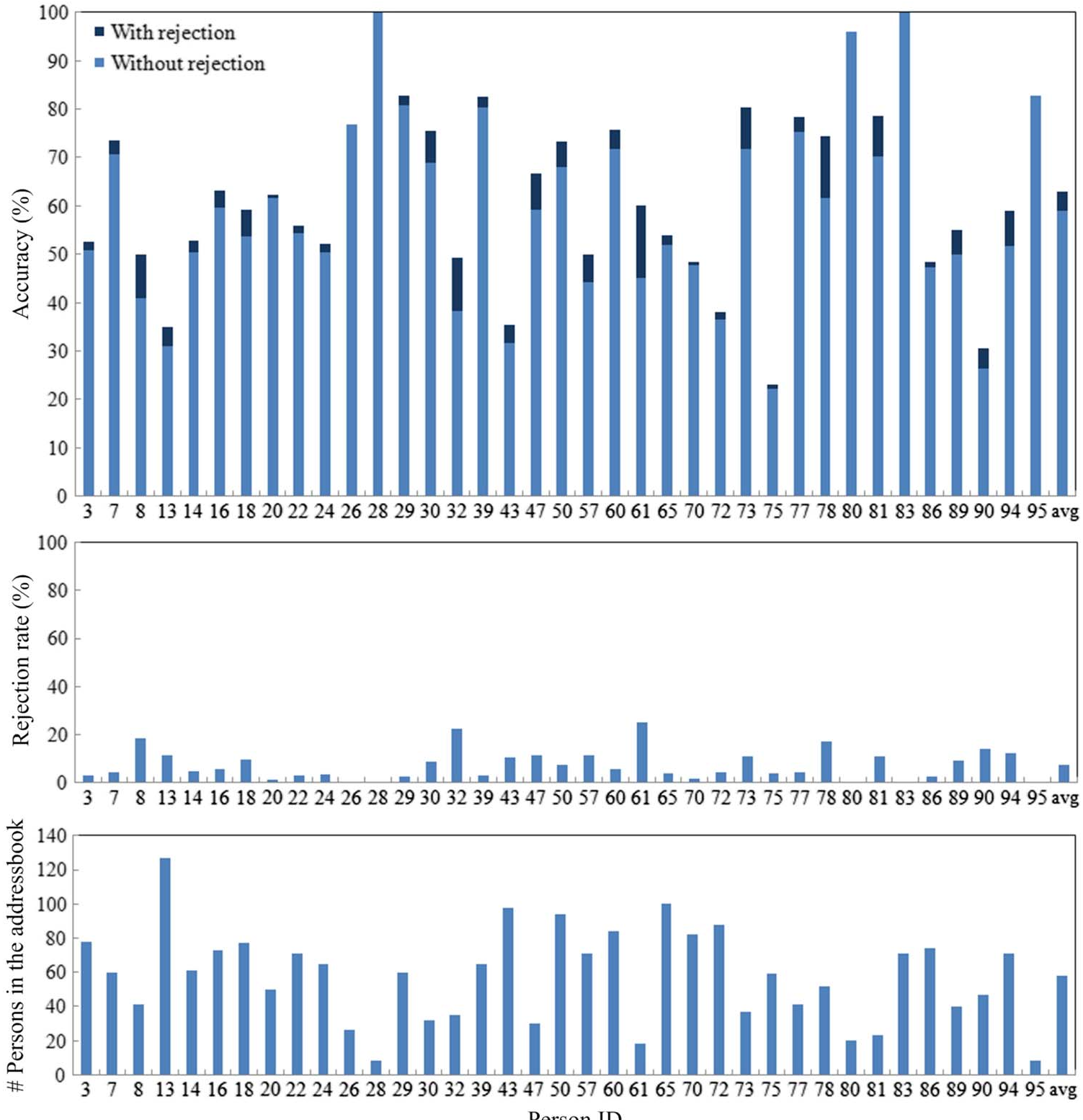
- Large-scale Validation: Using the MIT Reality Mining dataset (100 users, 9 months). Even with a simplified model, the system hit a 63% recommendation accuracy, proving it scales to diverse user behaviors.
User Experience & Visualization
One of the standout features is the Visualization Mode. Instead of a list, it shows a social graph where:
- Link Length represents the time since the last contact.
- Link Thickness represents closeness.
- Node Color represents the relationship type (family, friend, colleague).
In usability tests (SUS), users rated SmartPhonebook higher than standard systems, particularly praising its ability to "remind" them of relevant contacts based on current context.
Critical Insight: The Future of Personal Graphs
The real value of this research lies in its Inductive Bias: the assumption that our communication patterns are periodic and context-dependent. While the accuracy is lower during "busy" workdays due to highly dynamic factors, the system thrives in "idle" or "rest" states where social preferences dominate.
Future Outlook: As we move toward AI-native OSs, the probabilistic logic used here—mapping raw sensor logs to high-level social relationships—is becoming the foundation for personal "Social Graphs" that will drive next-generation digital assistants.
Conclusion
SmartPhonebook proves that our mobile phones know more about our social lives than we give them credit for. By mining this "digital exhaust" through a formal probabilistic framework, we can significantly reduce the cognitive load of staying connected.