
Leveraging Friendship to Power P2P: Reducing Psychological Costs in Mobile Multicast
Mobile P2P Multicast Based on Social Network Reducing Psychological Forwarding Cost
This paper introduces a social-network-based P2P multicast architecture specifically designed for mobile environments. By constructing distribution trees that prioritize "social links" (friends and friends-of-friends), the method significantly increases user cooperation and extends service duration by reducing the psychological forwarding cost associated with battery consumption.
TL;DR
Why are people reluctant to share their mobile data or battery power? It’s not just the physical cost—it’s the psychological cost. This paper proposes a Social-Network based P2P multicast architecture that intelligently routes video streams through "friends," significantly increasing the time users are willing to contribute their battery life to the network.
Context: The Battery-Social Dilemma
In the era of mobile streaming, P2P architecture is a double-edged sword. It offers scalability, but it relies on the altruism of users who have limited battery life. Most users are "free-riders" because the psychological cost of seeing their battery drop for a stranger is too high.
The authors argue that the solution isn't just better compression or hardware—it's Social Awareness. By leveraging Social Networking Services (SNS), we can map the distribution tree to existing human relationships.
Methodology: Mapping Social Logic to Technical Routing
The researchers modeled user behavior based on two psychological thresholds:
- Remaining battery capacity (): The point where a user says "I need to save the rest for myself."
- Battery decreasing speed (): How fast the battery is draining due to forwarding tasks.
The Distribution Tree Logic
To prevent the network from collapsing (which happens if you simply follow a raw social graph where "popular" people get overwhelmed), the authors proposed three rules:
- Rule 1 (Centrality): Select the "Socially Central" node as the first forwarder to minimize hop counts.
- Rule 2 (Load Balancing): Set a fixed number of branches () to keep the load per node sustainable.
- Rule 3 (The Friendship Priority): The provider attempts to link a node to a friend first, then a friend-of-a-friend, and only then a stranger.
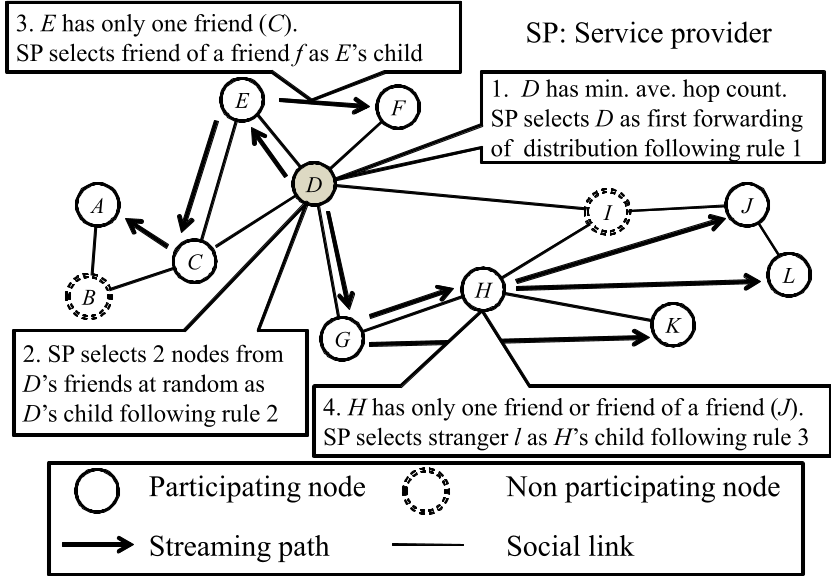 Fig 1: Example of Social-Network based distribution tree construction.
Experimental Results: Humans are Socially Biased (In a Good Way)
The team conducted an emulation with 58 subjects. They found a striking difference in tolerance levels:
- Forwarding to a Friend: Users were willing to let their battery drop to 41.2%.
- Forwarding to a Stranger: Users quit once their battery reached 60.8%.
This confirms the "Psychological Cost" theory: we are roughly 20% more generous with our resources when we know the recipient.
Performance Comparison
In multi-agent simulations, the proposed PFF (Proposed method with Friend-of-Friend) showed significantly higher "In-service agents" over time compared to:
- RAND: Random assignment.
- SG: Direct social graph (which crashed early due to load imbalance on "hubs").
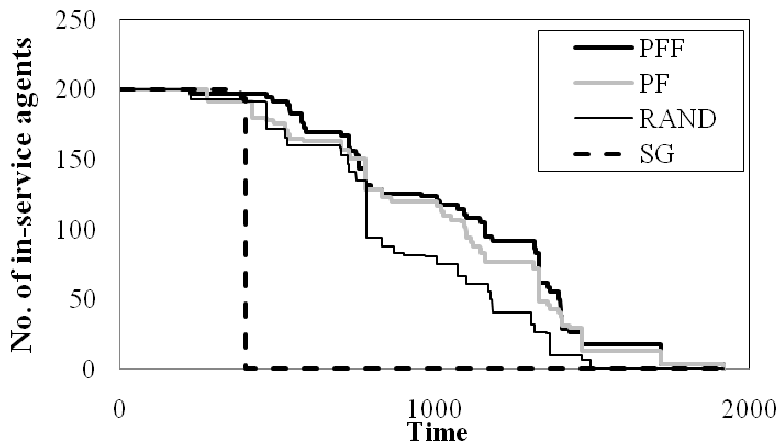 Fig 2: Basic performance showing longer service duration for PFF.
Critical Insight & Conclusion
The genius of this work lies in its recognition that P2P is a socio-technical system. Most P2P research treats nodes as cold, rational machines. By quantifying "psychological cost" through actual human experiments and baking that into the routing algorithm, the authors achieved better stability than complex mathematical optimizations could alone.
Limitations: The current model assumes a static social graph and doesn't account for users moving in real-time (mobility). Future work should address how the tree reconfigures when "friends" walk out of signal range.
Takeaway: If you want people to share resources in a decentralized system, don't just ask them to be altruistic—make sure they are sharing with people they actually care about.