
Beyond Initial Hype: Decoding Why Users Stick with Mobile SNS
Understanding mobile SNS continuance usage in China from the perspectives of social influence and privacy concern
This study investigates the determinants of mobile Social Network Service (SNS) continuance usage in China, specifically integrating Social Influence Theory and Privacy Concern. It proposes a model where social influence (compliance, identification, internalization) and privacy calculus (privacy concern, risk, and trust) concurrently dictate user retention, yielding a high explanatory power ().
TL;DR
Acquiring a user is just the beginning; keeping them is the real battle. This research dives into the dual-engine of mobile SNS retention in China: Social Influence (the pull) and Privacy Concerns (the push). By analyzing 330 users, the study reveals that subjective norms and social identity are powerful "lock-in" mechanisms, while privacy risk acts as a silent killer of user loyalty.
The Retention Crisis: Why "Nice-to-Have" Isn't Enough
In the hyper-competitive Chinese market—dominated by titans like WeChat and Renren—the cost of churn is devastating. Users can switch platforms with a single tap. Traditional models focused on "Perceived Usefulness," but this paper argues that mobile SNS is fundamentally a social ecosystem. The mismatch in prior research was the failure to account for how group dynamics override individual utility, and how mobile-specific data (like location) heightens the "Privacy Paradox."
Methodology: The Social-Privacy Framework
The authors propose a comprehensive model that views the user through two lenses:
1. The Social Influence Triple-Threat
Instead of treating "influence" as a monolith, the study breaks it down into Kelman’s three processes:
- Compliance (Subjective Norm): "My friends think I should use it, so I do."
- Identification (Social Identity): "I feel like I belong to this digital tribe."
- Internalization (Group Norm): "The group's values align with my own."
2. The Privacy Calculus
On the flip side, the study models the inhibitors: Privacy Concern and Privacy Risk. It posits that Trust is the only bridge capable of narrowing the gap between fearing data misuse and continuing to engage.
 Figure 1: The proposed structural model integrating Social Influence and Privacy factors.
Key Findings: What Drives the "Stickiness"?
The results from the Structural Equation Modeling (SEM) provide several high-impact insights:
- Social influence is the strongest predictor: Subjective norms (Compliance) actually had the most significant impact. This suggests that in collectivist cultures like China, peer pressure and recommendations are the ultimate retention tools.
- The Privacy-Risk Link: There is a direct, strong positive correlation between Privacy Concern and Privacy Risk. However, Trust acts as a critical buffer, significantly reducing perceived risk and indirectly boosting continuance.
- Social Identity as a "Lock-in": When users feel their self-image overlaps with the platform, the psychological cost of leaving becomes too high.
Performance Metrics
The researchers validated the model using several strict academic benchmarks, ensuring the findings weren't just statistical noise.
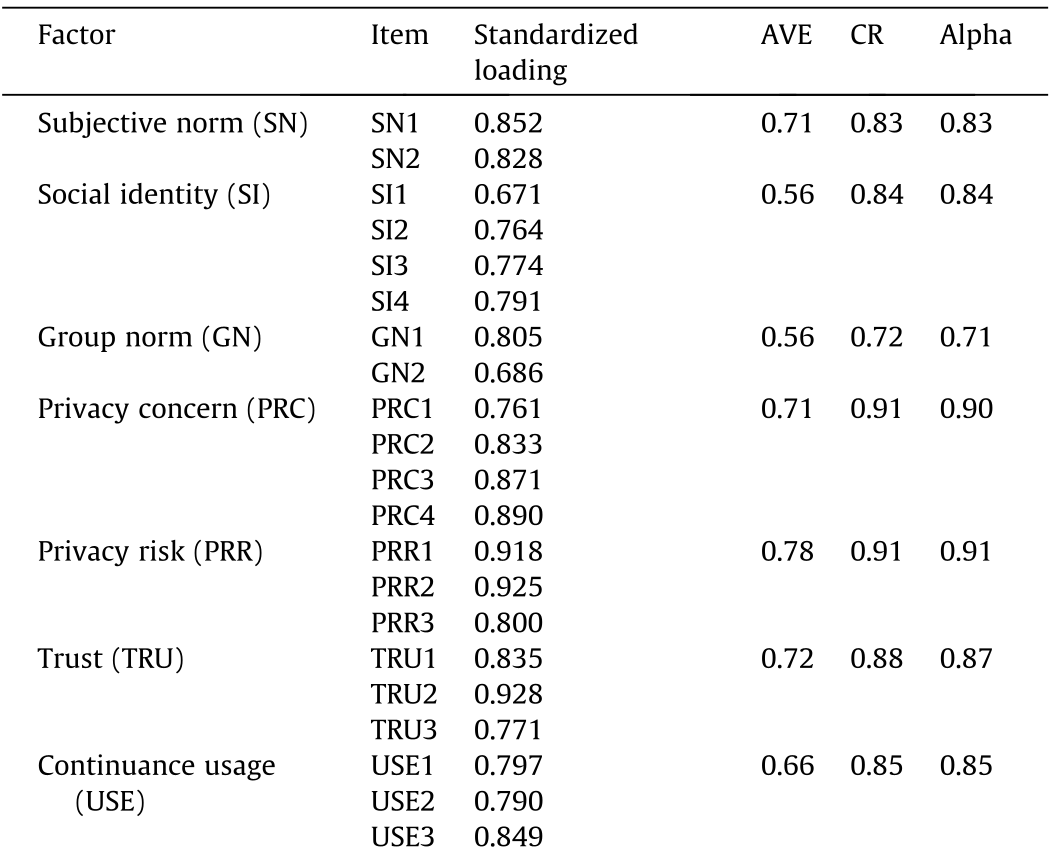 Table 1: Factor loadings and reliability metrics showing high convergent validity.
 Table 2: Comparison of actual vs. recommended fit indices, confirming a robust model.
Critical Insight: The Managerial Action Plan
For product managers and architects of social platforms, the take-home message is clear:
- Incentivize Reviews: Since Subjective Norms drive usage, features that allow users to broadcast their positive experiences are vital.
- Transparency is a Feature: Privacy isn't just a legal requirement; it's a retention strategy. Displaying trust seals (like TRUSTe) and clear, granular privacy controls can directly reduce the "inhibitor" effect of perceived risk.
- Build a "Tribe": Enhance social identity by moving beyond generic features and fostering specific group norms—give the users a vision they can internalize.
Conclusion & Future Look
While this study was conducted in the context of 2014-2016 China, its core logic remains eerily relevant in the age of Algorithmic Social Media. The tension between the "Pull" of the social group and the "Push" of privacy anxiety is the defining struggle of modern digital life. Future research should look at how AI-driven personalization further complicates this privacy calculus.
Limitations: The study is cross-sectional (a "snapshot" in time) and focused on a collectivist culture. Longitudinal studies across diverse cultures would help determine if these social "pulls" are universal or culturally specific.