
MSN-GTS: Balancing Power and Reliability in Mobile Group Touring
A Mobile Social Network-Based Group Touring Scheme with FEC Packet Loss Recovery
The paper introduces MSN-GTS (Mobile Social Network-based Group Touring Scheme), a collaborative LBS framework that utilizes a mobile proxy to share cellular data via Wi-Fi multicast. It features an adaptive Forward Error Correction (FEC) mechanism and a dynamic group management protocol to reduce redundant data downloads and battery consumption.
TL;DR
The Mobile Social Network-based Group Touring Scheme (MSN-GTS) is an innovative framework designed to optimize Location-Based Services (LBS) for groups traveling together. By designating a "Mobile Proxy" to handle 4G data downloads and multicasting the information to the group via Wi-Fi, it significantly reduces redundant bandwidth use. Crucially, it employs an Adaptive FEC (Forward Error Correction) mechanism to overcome the inherent unreliability of Wi-Fi multicast.
Problem & Motivation: The Redundancy Trap
When a group—such as a tour group or a field trip—visits a landmark, every member typically uses their own smartphone to fetch Point of Interest (POI) data. This leads to two critical inefficiencies:
- Redundant Data: Multiple devices downloading the exact same high-resolution POI content.
- Battery Drain: Constant GPS polling and power-hungry cellular (3G/4G) data transfers on every device.
The authors observed that while Wi-Fi is more power-efficient for local sharing, its multicast performance is notoriously unstable, characterized by high and erratic packet loss.
Methodology: The Core Mechanics
MSN-GTS solves these issues through a four-pronged strategy:
1. Dynamic Group Management & Social Integration
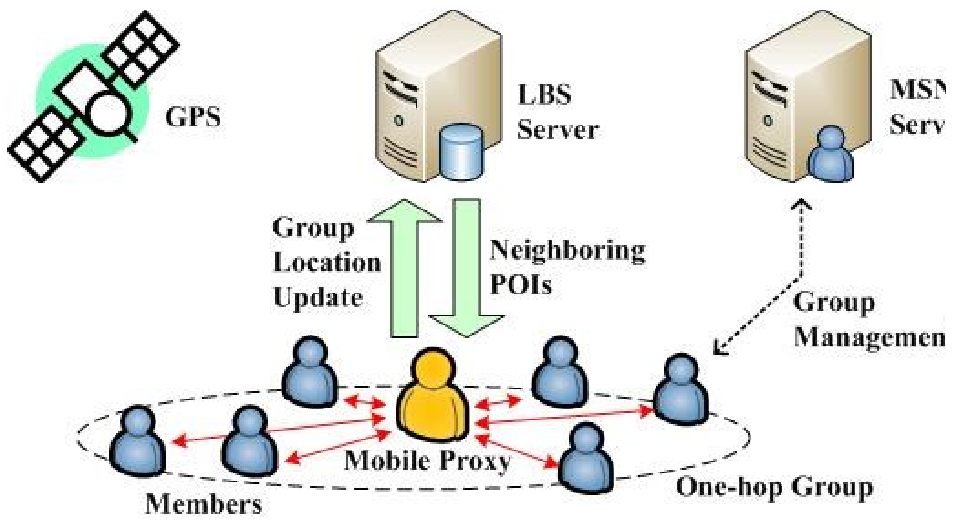
The system leverages social network metadata (via an MSN Server) to help users find their group. Once at the rendezvous point, they form a one-hop Wi-Fi ad-hoc network where one member acts as the Mobile Proxy.
2. Group-Based Location Updates
Instead of every user pinging the LBS server, the Proxy sends a "Group-based Location Update" containing its own coordinates plus the Maximum Relative Distance (MRD) of the members. This defines a larger "Group Searching Region" (MRD + MSR), ensuring all members receive relevant POI data for their specific positions.
3. The Adaptive FEC Mechanism
To handle packet loss without the overhead of massive redundancy, the proxy calculates the optimal encoding rate using the feedback from members: Where:
- is the mean packet loss rate from previous slots.
- is the standard deviation.
- is a safety factor (typically 1 or 2) to buffer against oscillations.
4. Member Monitoring & Re-joining
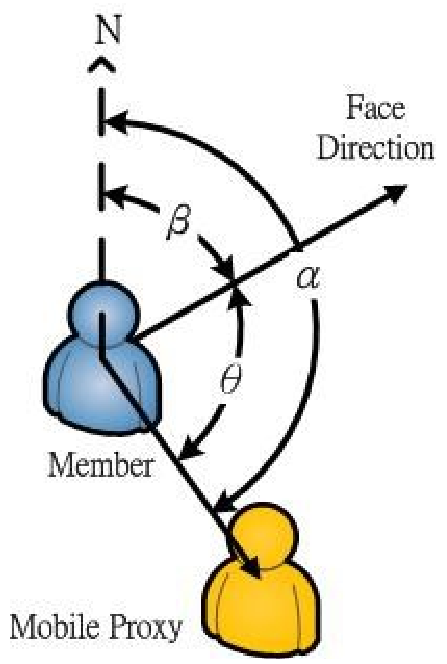
The system uses orientation sensors and signal strength to provide a Return Azimuth () to members who wander too far from the proxy's Wi-Fi range.
Experiments & Results
The authors tested the system on Android devices across four locations (A through D) with varying signal quality.
- Reliability: With in the FEC formula, the system reduced the "Un-recovery Rate" to under 6.5%, even in challenging environments.
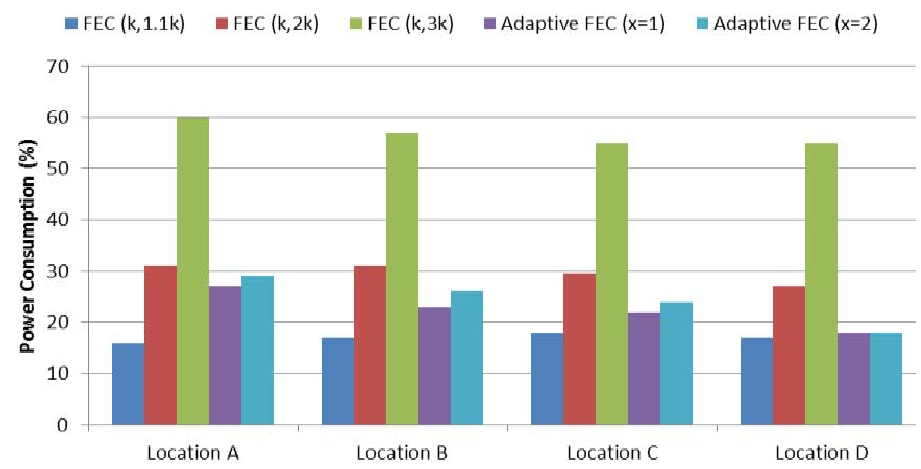
- Power Efficiency: In stable environments (Location D), the MSN-GTS scheme proved superior for groups larger than 5 people. However, in extremely unstable environments (Location A), the overhead of FEC redundancy can exceed the energy saved from cellular offloading, marking a clear trade-off boundary.
Critical Analysis & Conclusion
MSN-GTS successfully moves LBS from an "individualistic" model to a "collaborative" one.
Takeaways:
- The use of Adaptive FEC is the "secret sauce" that makes Wi-Fi multicast viable for real-world movement.
- Limitations: The scheme's efficiency is highly sensitive to environmental Wi-Fi noise. In high-interference areas, the energy cost of sending redundant FEC packets can "eat" the savings gained from turning off cellular radios.
- Future Outlook: This logic could be applied to modern 5G Side-Link (D2D) communications or collaborative AR touring, where high-bandwidth content sharing is even more critical.
MSN-GTS demonstrates that in the world of mobile networking, social proximity isn't just a human connection—it's a resource for technological optimization.