
The Trust Catalyst: Decoding How Social Recommendations Drive the Sharing Economy
Influence Mechanism of Mobile Social Network Users’ Product Recommendation Information on Consumers’ Intention to Participate Sharing Economy
This paper proposes an integrated influence mechanism model to investigate how product recommendations in mobile social networks affect consumers' intention to participate in the sharing economy. By combining the Theory of Planned Behavior (TPB) and Source Credibility Theory, the authors identify a second-order variable—source credibility (comprising five dimensions)—as the primary driver of behavioral intentions.
TL;DR
This paper explores the psychological mechanics behind why we trust our friends' recommendations to use services like Airbnb or Uber. By merging the Theory of Planned Behavior (TPB) with an enhanced Source Credibility Theory, the authors reveal that participation in the sharing economy isn't just about the product—it's about the intimacy and past behavior of the person recommending it.
Background Positioning
In the spectrum of marketing research, this work moves beyond traditional e-commerce "Word-of-Mouth" (WoM) into the specialized territory of the Sharing Economy. It serves as a theoretical bridge, connecting social psychological constructs to modern digital marketing strategies for collaborative consumption.
Problem & Motivation: The Gap in Collaborative Consumption
The sharing economy (or collaborative consumption) relies on the redistribution of idle resources. However, sharing a car or home with a stranger requires a higher threshold of trust than buying a book.
The Pain Point: Current marketing strategies often fail because they treat social media recommendations as generic advertisements. They ignore the "Source" factor—failing to understand why a recommendation from a "Best Friend" carries more weight than one from a "General Influencer" in the context of shared resources.
Methodology: The Integrated Influence Model
The researchers constructed a dual-layer model that explains the internal decision-making process of a consumer.
1. The Expanded Source Credibility (The "How")
Traditionally, credibility was defined by Expertise, Trustworthiness, and Attractiveness. This paper adds two critical dimensions:
- Intimacy: The strength of the social tie (strong vs. weak).
- Past Behavior: The track record of the recommender's previous suggestions.
2. The TPB Framework (The "Why")
These credibility factors don't work in a vacuum; they feed into the Theory of Planned Behavior:
- Attitude: Does the consumer feel positive about the sharing act?
- Subjective Norm: Do "important others" approve of this behavior?
- Perceived Behavioral Control: How easy or difficult does the consumer think the participation will be?
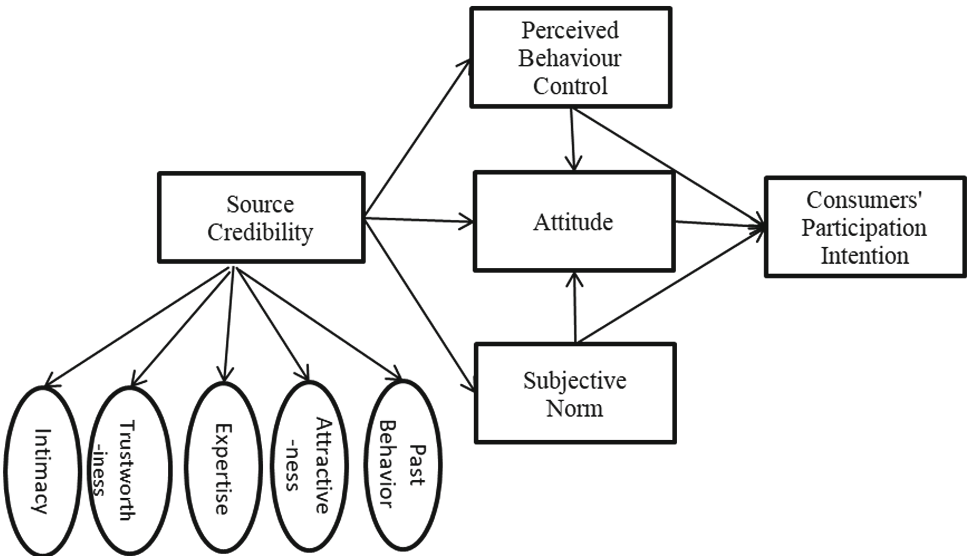 Figure 1: The theoretical model illustrating the flow from Source Credibility to Participation Intention.
Insights: Why This Works
The paper argues that Intimacy creates a "normative influence." When a close friend recommends a sharing platform, the consumer experiences a "Subjective Norm" pressure—a desire to maintain social consistency with their circle.
Furthermore, Perceived Behavioral Control is a silent killer of conversion. Even if a user trusts a friend, if the mobile app's interface is complex, the "intention" will never cross over into "action." This highlights the necessity of UI/UX simplicity as a psychological enabler.
Management Implications: Strategic Takeaways
The authors provide a roadmap for sharing economy firms:
- Cultivate Opinion Leaders: Identify loyal users and transform them into "experts" through exclusive training and early access.
- The "One-Click" Rule: To boost Perceived Behavioral Control, firms must utilize simple navigation (e.g., "Share with satisfied friends" buttons) to reduce cognitive load.
- Quality over Quantity: Avoid "information bombardment." Credibility is easily eroded by fatigue marketing.
Critical Analysis & Conclusion
Summary: The core contribution here is the validation of Intimacy and Past Behavior as vital components of digital trust. By mapping these onto the TPB framework, the paper provides a logical sequence for how social influence converts into economic action.
Limitations: The model is primarily theoretical and would benefit from large-scale empirical data (SEM analysis) across different cultures, as "Subjective Norms" vary significantly between individualistic and collectivistic societies.
Future Outlook: As we move toward Web 3.0 and decentralized sharing, the "Source Credibility" of anonymous but verified digital identities (via blockchain ratings) will likely become the next frontier for this research.
Takeaway for the Industry: In the sharing economy, your product is only as good as the social capital of the person recommending it.