
MSNS: Empowering Mental Health Through Mobile Social Connectivity
12565_Mobile social networks as quality of life technology for people with severe mental illness.
The paper introduces a general architecture for Mobile Social Network Services (MSNSs) designed as assistive technology for individuals with severe mental illness. It leverages GPS-enabled PDAs and a web-service-based backend to facilitate supported employment by connecting patients with a network of nomadic caregivers and job coaches.
TL;DR
This research presents a pioneering Mobile Social Network Service (MSNS) architecture that transforms hand-held devices into Quality of Life (QoL) technology. By integrating GPS tracking with a dynamic matching system, it provides a safety net for people with severe mental illness navigating supported employment, effectively "virtualizing" the job coach.
Contextual Positioning
Published at a time when mobile social networks were primarily for entertainment (Dodgeball, Plazes), this paper marks a critical pivot toward Assistive Technology for Cognitive Impairment. It moves beyond mere tracking (the "What") to collaborative intervention (the "Who" and "How").
Problem & Motivation: The "Shadowing" Bottleneck
For individuals with severe mental illness, the transition to work often fails at the commute.
- Resource Scarcity: Job coaches are scarce (one coach per 30 trainees in some regions).
- The Panic Factor: When a patient gets lost, they often cannot describe their location, exacerbating panic.
- Technical Rigidity: Prior Location-Based Services (LBS) were often "tightly coupled" with specific telecom infrastructures like CORBA, making them expensive and difficult to scale.
Methodology: A Modular, Social-Aware Architecture
The authors break away from traditional middleware by using a Web Services Mashup.
1. Vector-Based Matching Logic
Instead of just finding the "closest" person, the system uses a mathematical approach to find the right person. It constructs two vectors:
- Capability Vector (): Certifications and professional skills of the caregiver.
- Requirement Vector (): The specific needs of the service type.
The system solves for (proximity) subject to (competence).
2. Geometric Monitoring (Point-in-Polygon)
The system defines safe zones using polygons. It employs an algorithm for non-convex polygons to track whether a trainee is within the designated work or transit area.
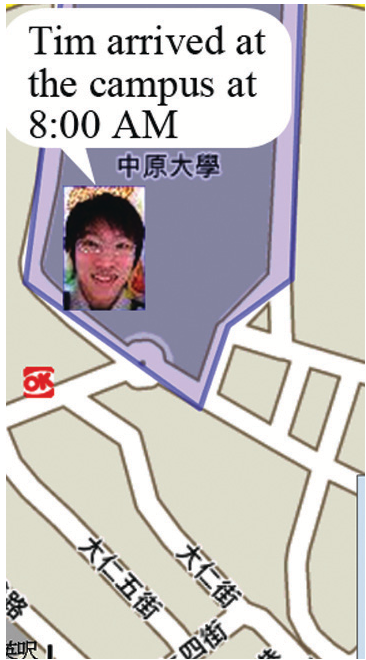 Figure 1: The MSNS System Architecture showing the interaction between client devices, location modules, and the web-based matching server.
Experiments & Real-World Validation
The system was tested with a heterogeneous group (schizophrenia, mental retardation, mania).
Key Findings:
- Active Alarms: The system successfully triggered alerts not just based on time (being late) but space (leaving a zone unexpectedly).
- Accuracy: Achieved a 5-10 meter resolution, crucial for urban navigation.
- Reliability: A success ratio of 100% was achieved in field trials for boundary-crossing notifications.
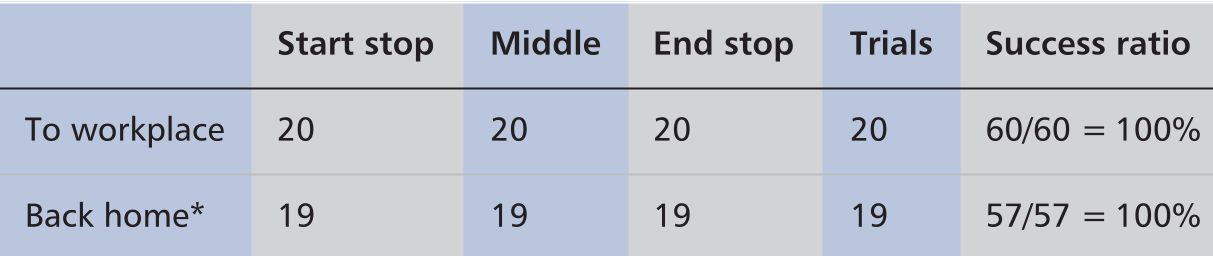 Table 1: Field trial results confirming perfect success rates in alerting for "To Workplace" and "Back Home" transitions.
Critical Analysis & Future Outlook
Strength: The "Human in the Loop"
Unlike purely automated systems, this architecture recognizes that a "HELP" button is a social request. By sending SMS alerts to nearby matched caregivers, it fosters a community-based support layer.
Limitations
- Battery Life: The study noted that GPS/GPRS usage significantly drains the PDA battery (aborted trials), a classic bottleneck of 2009-era hardware.
- Scale: The participant pool was small (6 people), which limits the generalizability of the ethnographic findings.
Conclusion
This paper proves that MSNS is more than a social tool; it is a lifeline. By decoupling the service from the carrier and focusing on modular web services, the authors paved the way for modern pervasive healthcare apps. Future iterations involving proactive trajectory prediction (e.g., AI noticing a "panic" walking pattern before a button is pressed) could further revolutionize this field.