
CRUMBS: Engineering a Socially-Aware Hybrid Recommender for Mobile Tourism
Mobile Social Travel Recommender System
The paper presents the CRUMBS Mobile Social Travel Recommender System, a hybrid framework that recommends Points of Interest (POIs) by integrating content-based and collaborative filtering. It leverages a multifaceted user modeling approach that combines explicit preferences, demographic data, and social tagging behavior to overcome the cold-start problem in mobile tourism.
TL;DR
The CRUMBS project introduces a robust Mobile Social Travel Recommender System (TRS) designed to solve the information overload for tourists. By fusing collaborative filtering (peer behavior) with content-based filtering (POI attributes) and a sophisticated user modeling engine that infers interests from social tags and demographics, it creates a personalized travel guide that lives in your pocket.
Context & Motivation: Why Travel Recommendation is Hard
Travel recommendation isn't just about finding a "good" place; it's about finding the right place for a specific person at a specific time. Most recommendation systems fail in tourism because:
- The Cold-Start Trap: New tourists haven't rated anything yet.
- Sparsity: With thousands of POIs, the chances of two users rating the same "hidden gem" are slim.
- Context Sensitivity: Mobile users have limited screen real estate and need immediate, location-aware results.
The authors of CRUMBS address these by looking beyond simple ratings, tapping into social tags (implicit interest) and demographic stereotypes (initializing preferences).
Methodology: The Hybrid Engine Under the Hood
1. Dynamic User Modeling
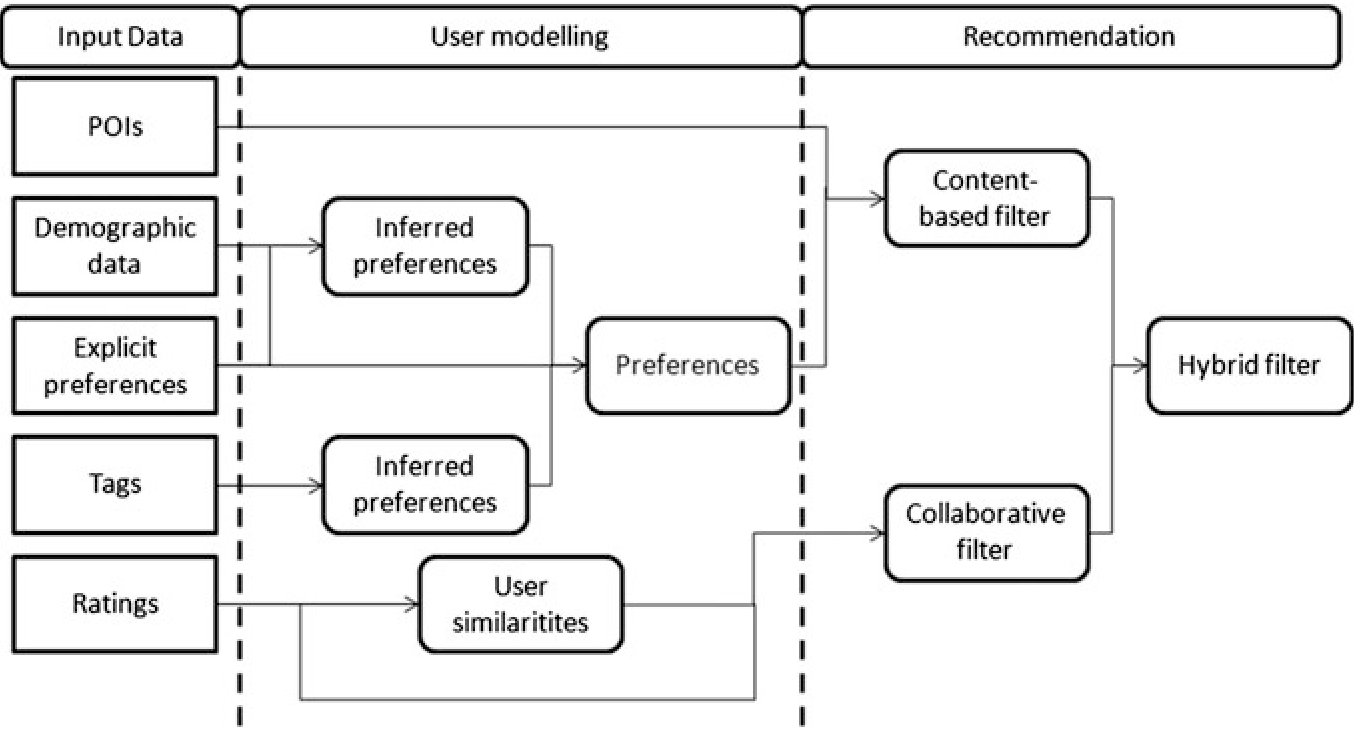
At the heart of CRUMBS is a user model that evolves. It calculates user preferences () across 72 categories using a weighted formula:

- Explicit Data: Direct user input via sliders.
- Inferred Tagging (): If you tag a "Gothic Cathedral," the system increases your weight for "History" and "Religion" categories.
- Demographic Inference (): Using Weka's machine learning libraries (M5P, Linear Regression), the system predicts the tastes of new users based on age, gender, and nationality.
2. The Hybrid Recommendation Strategy
The system doesn't rely on a single logic. Instead, it uses a Linear Combination strategy:
- Content-Based (CB): Measures the cosine similarity between the user’s preference vector and the POI’s attribute vector.
- Collaborative Filtering (CF): Uses Pearson correlation to find "social neighbors"—users with similar tastes—and predicts ratings based on their experiences.
Experiments & Real-World Validation
To ensure the system works in the real world, the authors conducted both synthetic stress tests and qualitative focus groups.
- Performance: To keep response times below 1 second, the system pre-calculates user models and similarities overnight (offline processing). For the "worst-case" scenario with new users, the real-time calculation still clocks in at an acceptable 4 seconds.
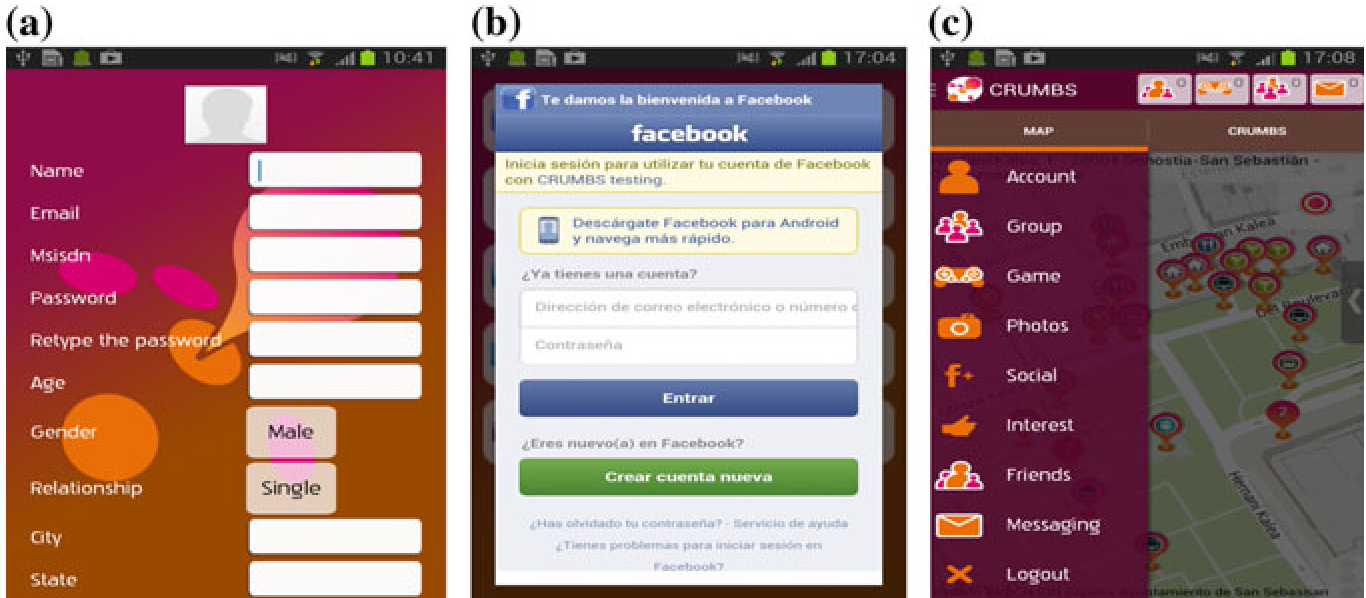
- User Feedback: 30 active internet users and 5 experts evaluated the Android prototype. While the recommendations were highly valued, users voiced a significant "Intrusiveness" concern. They wanted the ability to "turn off" the learning algorithm, highlighting a crucial design requirement for future AI: Transparency and Control.
Critical Insight & Future Outlook
The most striking takeaway from CRUMBS is not just the algorithm, but the human-centric feedback. The authors identified two major blockers for mobile TRS adoption:
- The Connectivity Barrier: Tourists often disable data while roaming to avoid high costs. Future systems must prioritize on-device/offline indices.
- The Privacy Paradox: Users want highly personalized results but are wary of "permanent monitoring."
CRUMBS effectively demonstrates that a hybrid approach—blending social, demographic, and behavioral data—can create a highly accurate "geospatial social world," but the next generation of these systems must be "Privacy-by-Design" to win user trust.
Conclusion
By integrating machine learning models for demographic inference with traditional filtering techniques, CRUMBS provides a blueprint for building context-aware mobile services that feel personal from the very first click.