
Can Mobile Workforce Revolutionize Country-Scale Crowdsourcing?
Can Mobile Workforce Revolutionize Country-Scale Crowdsourcing?
This paper explores "Country-Scale Crowdsourcing" by leveraging the mobile workforce of the Belgian Post Group (bpost). It proposes a system that embeds data collection tasks into the daily routines of postal workers, utilizing their nationwide movement to achieve superior spatiotemporal coverage compared to traditional voluntary crowdsourcing.
Executive Summary
TL;DR: Traditional crowdsourcing is often "hit or miss," relying on the whims of volunteers who stick to city centers. This paper proposes a paradigm shift: leveraging the postal workforce—a group that already visits every doorstep in the country—to collect high-quality, qualitative urban data. By integrating a context-aware smartwatch system into their daily routines, the authors demonstrate a path toward reliable, nationwide data collection without the need for constant monetary incentives.
Positioning: This work moves beyond "volunteer-based" crowdsourcing into "infrastructure-based" mobile crowdsourcing, positioning existing professional logistics as a ready-made sensing network for smart cities.
The "Crowd" Problem: Why Volunteers Are Not Enough
Current urban sensing relies heavily on static IoT sensors or voluntary apps. The authors identify three "caveats" that cripple these methods:
- Spatial Bias: Volunteers avoid poor neighborhoods or suburbs, focusing on trendy city centers.
- Epistemic Uncertainty: There is no way to verify if a random user's report is accurate.
- The "Drop-out" Effect: User engagement typically follows a power-law distribution where a tiny minority does all the work before eventually quitting.
Methodology: Tapping into the Postal Pulse
The researchers turned to bpost (Belgian Post Group). The study is split into two rigorous dimensions:
1. Quantitative Capability
They analyzed 200,000 events from over 6,300 workers. The data revealed that while workers don't spend all day in one spot (limiting real-time sensing), they provide unparalleled spatial coverage.
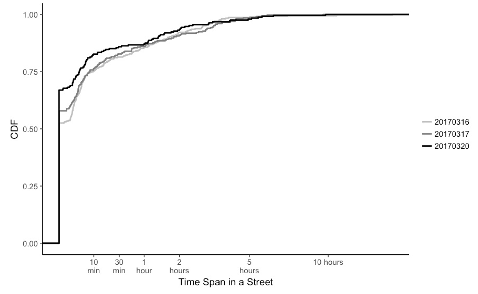 Figure: Analysis shows most streets are visited frequently enough for non-time-sensitive data collection.
2. Qualitative Intuition (Shadowing)
By "shadowing" workers on their rounds, the authors discovered that:
- Pedestrians have high social trust with residents.
- Drivers (parcels) have "waiting moments" (e.g., waiting for someone to answer the door) that are perfect for mobile interaction.
- The Trust Boundary: Workers are willing to help but will not "spy" on residents (e.g., reporting tax-evading solar panels) because it ruins their professional relationship.
System Architecture: The Smartwatch Intervention
To minimize "situational disadvantage" (workers having their hands full with mail), the authors designed a system that switches between three modes:
- Coasting Mode: Low-power GPS monitoring.
- Sensing Mode: High-accuracy sensing (accelerometer/mic) to detect if the worker is walking, driving, or talking.
- Task Mode: Presenting the query only when the worker is "idle" or between tasks.
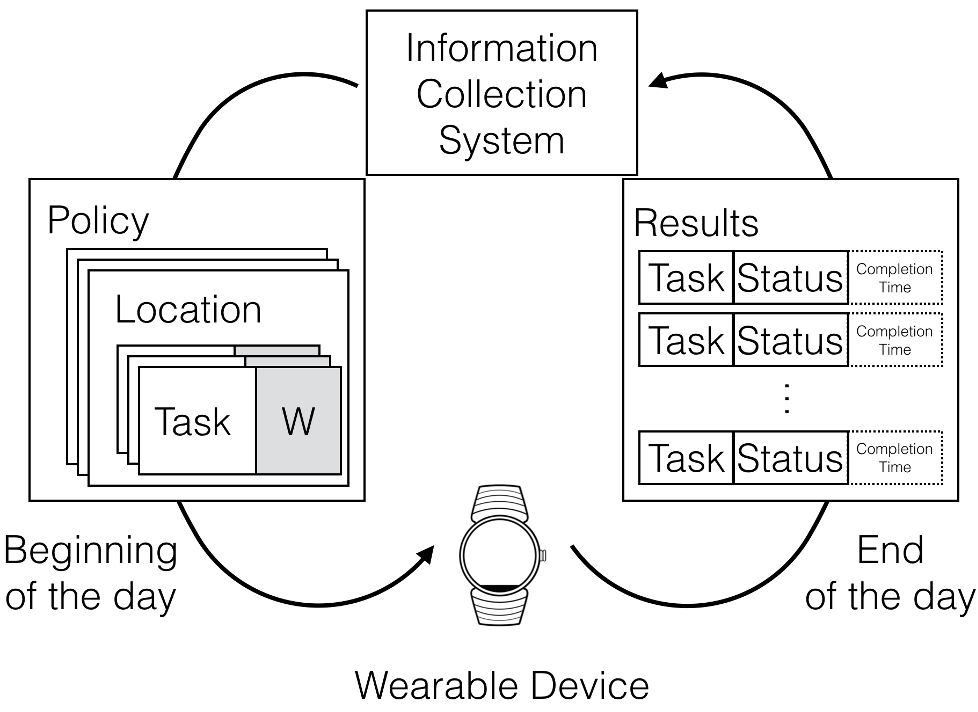 Figure: The synchronization workflow between the backend Information Collection System and the wearable device.
Experiments & Key Insights
The study highlights a fascinating contrast between Urban and Rural workers. Urban drivers are often too rushed (parking issues), while rural workers have more flexibility.
| Strategy | Mean Round Duration | Avg. Deliveries | Distance covered |
|---|---|---|---|
| Postal Round | 3.69 hrs | 28.33 | 24.94 km |
A crucial finding was the "Social Proxy" effect: Postal workers don't just observe; they act as a bridge. They can ask residents questions directly, essentially multiplying the reach of the crowdsourcing task through their existing social capital.
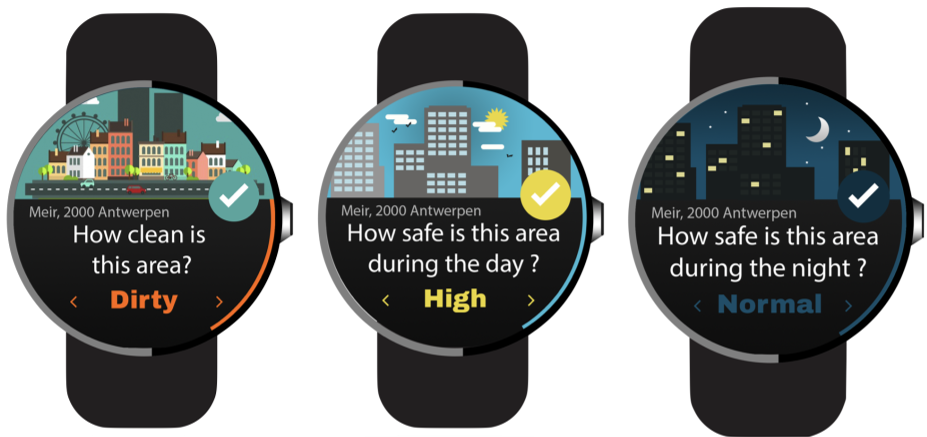 Figure: The simplified smartwatch UI designed for "glanceable" interaction.
Critical Analysis & Future Outlook
Takeaway: The study proves that "professionalizing" the crowd is the key to scale. By using workers whose job is to navigate the city, you solve the engagement problem at the source.
Limitations:
- Not for Real-time: You can't use mail carriers to track a fast-moving fire or sudden traffic jam; they only visit most streets once or twice a day.
- Context Sensitivity: The success of this model is highly dependent on the "social status" of postal workers, which varies significantly between countries (e.g., Belgium vs. US).
Future Prospect: This framework could be extended to garbage collection trucks or utilities inspectors, creating a multi-layered "Sensing-as-a-Service" infrastructure for future Smart Countries.