
MATCS: Solving the Trust and Mobility Crisis in Smart City Crowdsourcing
Mobility-aware trustworthy crowdsourcing in cloud-centric Internet of Things
The paper introduces the Mobility-Aware Trustworthy Crowdsourcing (MATCS) framework for cloud-centric IoT, enabling Sensing-as-a-Service (S2aaS) for smart cities. It proposes a novel auction-based incentive mechanism that integrates user mobility prediction and reputation-based filtering to ensure data reliability and maximize platform utility, outperforming traditional mobility-unaware and reputation-unaware benchmarks.
TL;DR
Sensing-as-a-Service (S2aaS) relies on the "crowd" to provide real-time data for smart cities. However, people move, and some lie. MATCS (Mobility-aware Trustworthy Crowdsourcing) is a sophisticated auction framework that predicts where users will be in the future and how much their data is worth based on their past honesty. It boosts platform utility by up to 300% and slashes disinformation by up to 55%.
Problem & Motivation: The Moving Target and the Malicious Actor
In a cloud-centric IoT ecosystem, the platform acts as a broker between city authorities and mobile users. Current models often assume users are stationary or inherently honest. This creates two fatal flaws:
- The "Wander-off" Problem: A user wins an auction but walks out of the sensing range before they can actually upload the data.
- The Disinformation Attack: Malicious users bid low to win auctions, then upload "garbage" or altered data to manipulate public safety alerts.
The authors argue that an incentive mechanism must account for spatial-temporal dynamics and behavioral reliability to be viable in the real world.
Methodology: The MATCS Engines
The framework operates on a four-layer architecture (Authority, Cloud, Publishing, Users) and utilizes two core innovations:
1. Mobility Forecasting
Instead of relying on current location, MATCS uses a Lightweight Triangulation method. By calculating the moving average of previous coordinates and the velocity vector, the system predicts a user's location at the end of the auction (). If the estimated location is out of task range, the user is disqualified from the auction immediately.
2. Reputation-Based Auction
MATCS utilizes a "Reputable Marginal Value" calculation.
- Modified Bids: A user's bid is scaled by their reputation (). A high-reputation user effectively becomes "cheaper" for the platform to hire.
- Adaptive Reputation: Using Equation 5, the system updates a user's score based on outlier detection. If you send outlier data, your weight shifts to favor your past (potentially poor) history, making recovery harder for malicious actors.
 Note: The formula above shows how marginal value is calculated based on reputation—if trust drops, the platform perceives less value from that user.
Experiments & Results: Triple-Digit Improvements
The MATCS framework was tested against two baselines: MACS (Mobility-aware only) and a Standard Benchmark (neither mobility nor trust-aware).
- Platform Utility: MATCS triples the utility improvement over the benchmark. By not paying users who wander off and filtering out "trash" data, the authority saves significant capital.
- Disinformation Defense: Under heavy loads, MATCS reduces the Disinformation Ratio (DIR) by 55%.
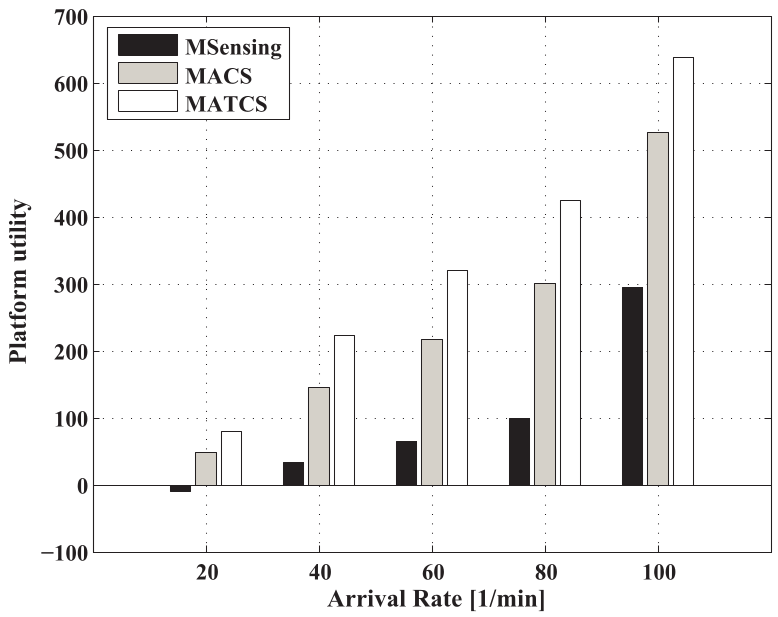 Fig 1: Utility of the authority increases drastically as task frequency grows, demonstrating the scalability of MATCS.
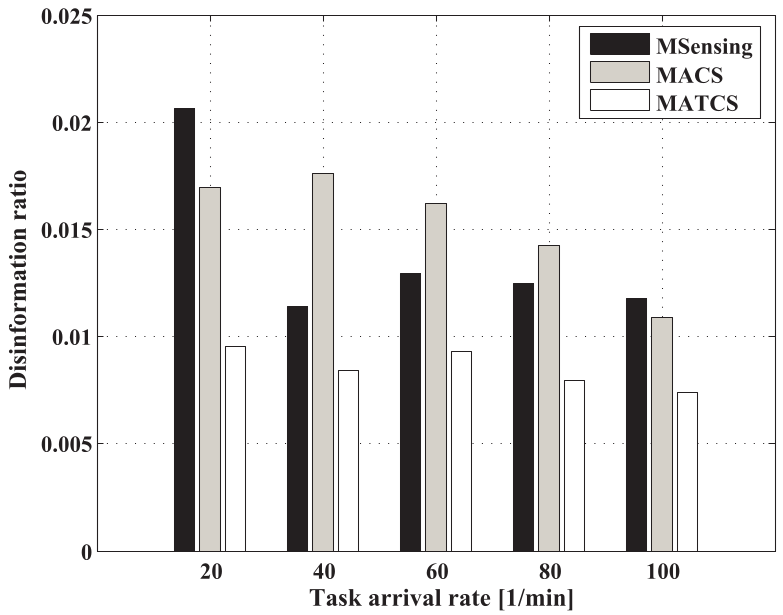 Fig 2: MATCS (blue line) maintains the lowest disinformation ratio across all task arrival rates.
Critical Insight & Conclusion
The genius of MATCS lies in its economic penalization of dishonesty. By scaling bids by reputation, the auction naturally gravitates toward high-quality participants without needing to set arbitrary "blacklists."
Limitations:
- The model assumes a Random Way-point Mobility Model, which might not reflect the structured movement of commuters (e.g., following roads or transit).
- It relies on social network check-ins for the "Discovery" layer, which might raise privacy concerns for users.
Future Work: Integrating sophisticated trajectory prediction (like LSTM-based pathing) and Privacy-Preserving Computation (like Differential Privacy) could make MATCS the gold standard for secure urban sensing.