
LSTM2V: Bridging Deep Learning and Markov Chains for Smart Taxi Crowdsourcing
Mobility Pattern-Aware Task Recommendation for Taxi Crowdsourcing Delivery
The paper proposes LSTM2V, a mobility pattern-aware task recommendation framework for taxi crowdsourcing delivery. It integrates a Long Short-Term Memory neural network with a feature window (LSTM-w) and a SpatioTemporal Markov (STM) model to achieve SOTA multi-location prediction for efficient logistics.
TL;DR
The explosive growth of logistics requires innovative delivery solutions. This paper introduces LSTM2V, a novel algorithm that turns taxis into reliable delivery couriers. By combining LSTM-w for high-level mobility pattern recognition and a SpatioTemporal Markov (STM) model for location forecasting, it achieves high precision in matching delivery tasks to a taxi's future route.
Background: The Infrastructure of the Sharing Economy
Logistics companies face extreme pressure during peak seasons like "Double 11" or "Black Friday." Traditional crowdsourcing (e.g., individual couriers) is often hindered by security concerns and background check difficulties. Taxis represent a perfect, underutilized resource: they are already on the road, driven by verified professionals, and follow predictable patterns.
The Core Challenge: Patterns vs. Randomness
Predicting a taxi's destination is difficult because it isn't purely random nor strictly fixed. Taxis exhibit cyclical mobility patterns (working days vs. rest days, large service areas vs. local loops). Prior works using simple Markov chains suffer from "error accumulation," where a single wrong segment ruins the entire predicted path.
Methodology: The LSTM2V Architecture
The authors solve this by splitting the problem into two dimensions: Temporal Pattern Recognition and Spatial Transition Modeling.
1. LSTM-w (Long Short-Term Memory with Feature Window)
Instead of passing raw coordinates, the authors define "Mobility Patterns" (Large Range vs. Small Range). The LSTM-w model uses a sliding window to capture the last several days of behavior to predict tomorrow's pattern.

2. STM (SpatioTemporal Markov) Model
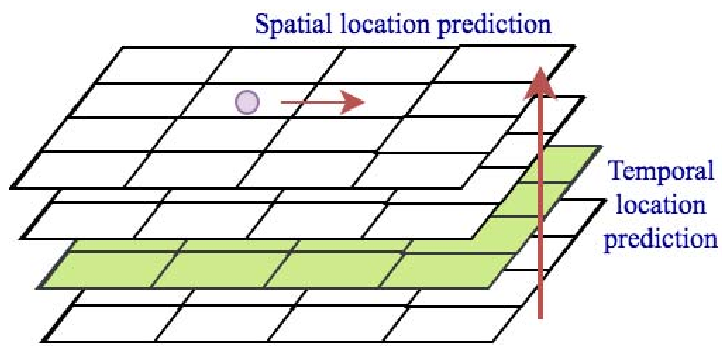
Once a pattern is identified, the STM model takes over to predict specific locations ():
- Temporal Prediction: Uses a 2x2 Markov matrix to judge the probability of visiting a specific grid based on historical frequency within that pattern.
- Spatial Prediction: Calculates the transition probability from the current location to the next, ensuring the route is physically plausible.
Experimental Insights: Real-World Performance
The model was validated using a massive dataset of 1.4 billion GPS records from Chengdu, China.
Window Size Matters
The study found that the optimal window size is 7, corresponding to the weekly cycle of human activity. Using yielded an accuracy of 87%, far outperforming standard LSTM-1 (which ignores the window) and simple Markov baselines.
Accuracy in Task Recommendation
The LSTM2V model outperforms S-Markov (Spatially-driven) and T-Markov (Temporally-driven) because it balances the global "Likelihood to visit" with the local "Next-step transition."
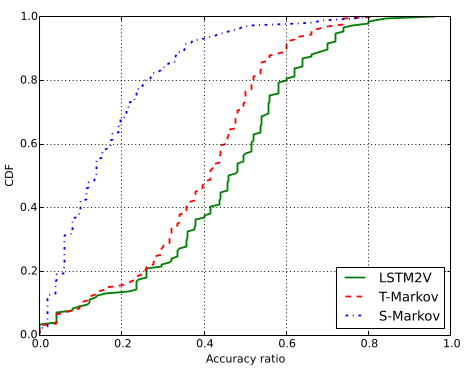
As shown in the CDF plots, LSTM2V maintains a higher cumulative accuracy even as the number of predicted locations () increases, which is vital for long-haul delivery sequences.
Critical Analysis & Conclusion
The genius of LSTM2V lies in its hybrid nature. While Deep Learning (LSTM) is excellent at capturing "what kind of day" the driver will have, Markov Chains are mathematically efficient at handling the "where to next" logic on a discrete grid.
Limitations: The model currently assumes a static grid. Real-world traffic conditions (accidents, road closures) could be integrated into the transition matrix to make the model dynamic.
Future Outlook: By integrating real-time traffic data, this framework could evolve from a "pattern-aware" system to a "real-time reactive" system, further optimizing the last-mile delivery efficiency of urban IoT.