
Harmonizing Social Ties and Spatial Traces: A Two-Level Approach to Human Behavior Modeling
Infer mobility patterns and social dynamics for modelling human behaviour
This paper introduces a multi-level human behavior model that integrates spatiotemporal data with social network dynamics to predict future mobility patterns. Utilizing a Recurrent Neural Network (RNN) and density-based clustering, the method achieves high-accuracy location forecasting specifically geared toward optimizing 5G telecommunication networks.
TL;DR
Predicting where a person will go next is not just a spatial puzzle; it is a social one. This research proposes a behavioral model that operates at both the individual and crowd levels, utilizing Recurrent Neural Networks (RNNs) and Social Network Analysis (SNA). By integrating these dimensions, the work aims to revolutionize 5G network management through self-optimizing policies based on forecasted user density and interests.
The Missing Link: Why Social Context Matters
For years, human mobility research focused on the "regularity" of patterns—most of us are creatures of habit. However, even the best Order-k Markov or SVM models hit a glass ceiling in accuracy. The reason? They ignore the social catalysts of movement.
The author identifies a crucial insight: physical location and social ties are "strongly interlaced." We visit places because our friends are there, or because of socioeconomic interests identified in our online interactions. The motivation of this work is to stop treating these as separate signals and start treating them as a unified behavioral layer.
Methodology: From Raw GPS to Deep Learning
The core of the proposed framework relies on a sophisticated pre-processing pipeline that transforms "noisy" data into "semantic" insights.
1. Spatiotemporal Data Mining
Raw GPS data is often too erratic for direct prediction. The author employs a two-step refinement:
- Velocity Filtering: Removing any movement faster than 1.3m/s to isolate stationary "Points of Interest" (PoIs).
- DBSCAN Clustering: Grouping points within 100 meters to define stable geographical hubs.
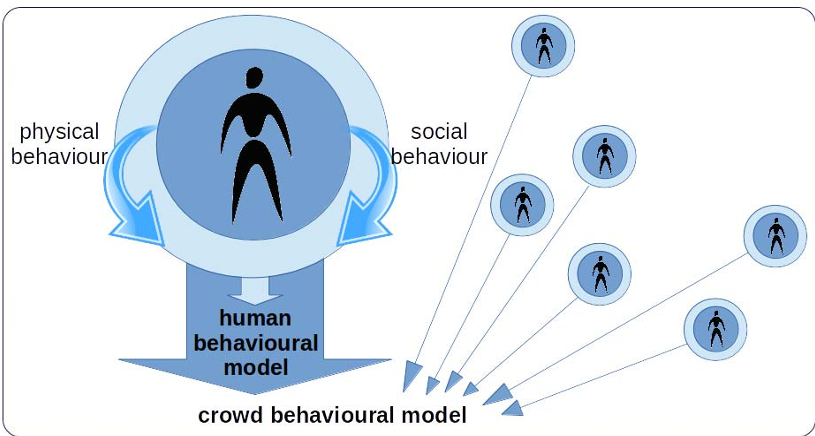
2. The Behavioral Model Architecture
The proposed model operates on two granularities to ensure robustness. If an individual's data is sparse, the model "falls back" to crowd-level dynamics to maintain inference stability.
3. RNN Prediction
The refined PoI sequences are fed into a Recurrent Neural Network (RNN). Unlike feed-forward networks, the RNN’s internal state allows it to "remember" the sequence of previous locations, making it ideal for temporal forecasting.
Experimental Validation
Using the Mobile Data Challenge (MDC) dataset (185 users), the study demonstrates the power of even a relatively simple RNN architecture:
- Architecture: 1 hidden layer, 20 units.
- Input: Historical PoI sequences (65% for training).
- Result: An average prediction accuracy of 80.2%.
This high accuracy validates that PoI sequence prediction is a viable foundation for more complex socio-technical models.
Future Vision: 5G Self-Optimization
The ultimate value of this research lies in its application to 5G infrastructure. By predicting where crowds will congregate and what content they will consume (via text mining of social posts), telecommunication networks can:
- Dynamically Tune Parameters: Adjust bandwidth and latency in real-time.
- Personalized Routing: Optimize data flow based on predicted user needs.
- Predictive Management: Mitigate congestion before it actually happens.
Critical Analysis & Conclusion
While the current 80.2% accuracy is a strong baseline, the real test will be the successful integration of the Social Network Analysis (SNA) layer. The current results rely primarily on GPS; adding the "social weight" of a user's network is expected to push accuracy even higher.
Key Takeaway: The future of urban planning and network management lies in "Socially-Aware Mobility." By understanding that our movements are dictated by our connections, we can build smarter, more responsive digital infrastructures.