
Beyond Simple Joy and Sadness: A Unified Model of Facial Expression Perception
A Model of the Perception of Facial Expressions of Emotion by Humans: Research Overview and Perspectives.
This paper proposes a revised computational model for human facial expression perception that bridges the gap between categorical and continuous models. By representing emotions as a set of C distinct continuous face spaces that can be linearly combined, it achieves state-of-the-art results in classifying compound emotions (e.g., "happily surprised") while maintaining sensitivity to intensity.
TL;DR
For decades, scientists debated whether we perceive emotions as distinct bins (Categorical) or coordinates on a map (Continuous). This paper presents a synthesis: C-distinct continuous spaces that can be linearly combined. By shifting the focus from "what" an emotion is to "how" the facial geometry changes (Configural Features), the authors provide a roadmap for AI that can recognize nuanced, compound emotions like "angrily surprised" with high precision.
Contextual Positioning
In the landscape of computer vision, we often oscillate between holistic "appearance-based" models (think Eigenfaces) and "feature-based" models. This work, published in the Journal of Machine Learning Research, acts as a theoretical bridge. It argues that the "magic" of human perception isn't in complex deep classifiers, but in our extreme sensitivity to the geometric distances between our features.
The Problem: The Rigidity of Current Models
Why is it that when you see a "happily surprised" face, you don't just see a messy blur of pixels?
- Categorical Models are too rigid; they treat "Happy" and "Surprised" as isolated islands, failing to explain how we see different intensities (like a slight grin vs. a roar of laughter).
- Continuous Models are too fluid; they struggle to explain why we categorize morphs as one or the other, not a "half-joy."
- The Data Wall: To learn every possible combination of emotions (Disgust + Anger, Fear + Surprise), traditional ML would need millions of labeled examples for every specific blend.
Methodology: The Linear Combination of Face Spaces
The author's insight is elegant: Linearity. By defining a small set of "basis" emotions (the classic six: joy, surprise, anger, sadness, disgust, and fear), any complex human emotion can be modeled as a weighted vector sum.
The Power of Configural Features
The model identifies that humans use shape and configuration over texture. A "configural feature" is a specific distance—such as the vertical gap between the eyebrows and the mouth.
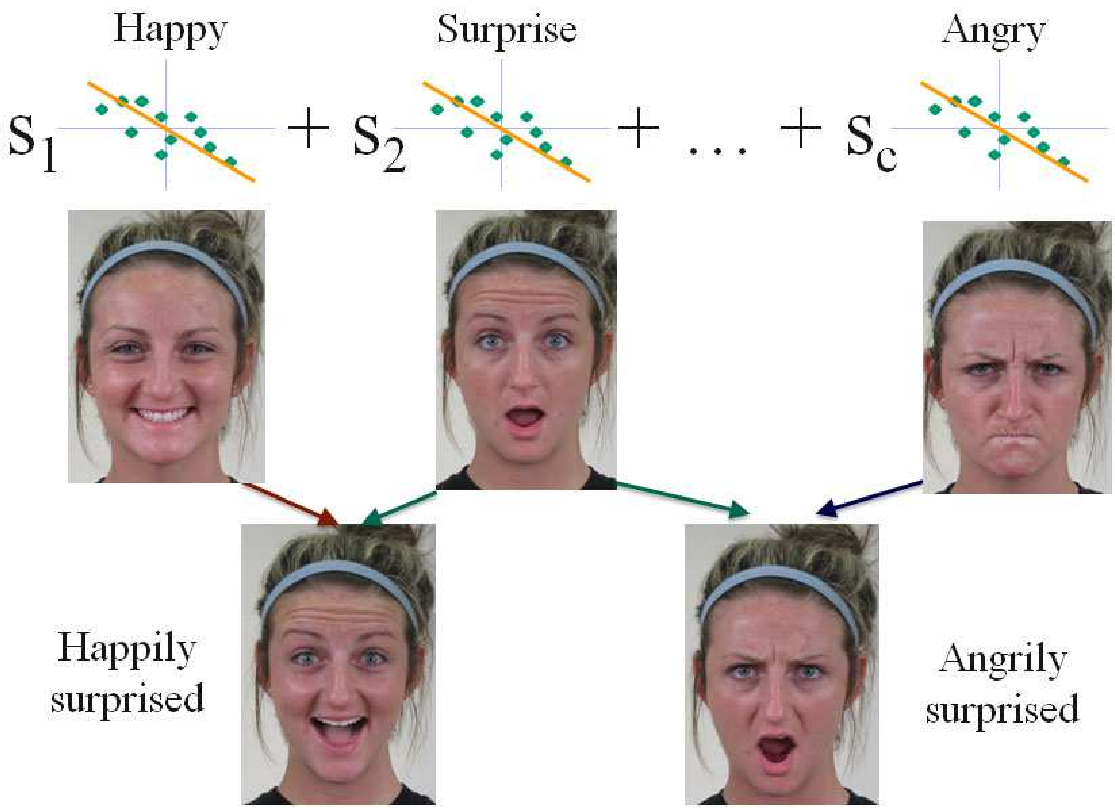 Figure 1: The proposed model showing how complex emotions are constructed via weighted sums (si) of individual continuous face spaces.
In this model:
- Landmarks are detected (eyes, brows, nose, mouth).
- Procrustes Analysis makes the shape invariant to scale and translation.
- Rotation Invariant Kernels (RIK) handle 3D head poses.
- Discriminant Analysis identifies which geometric shifts define the emotion.
Experimental Proof: Robustness to Resolution
One of the paper's strongest arguments is how humans recognize "Joy" and "Surprise" even at incredibly low resolutions where features are blurred.
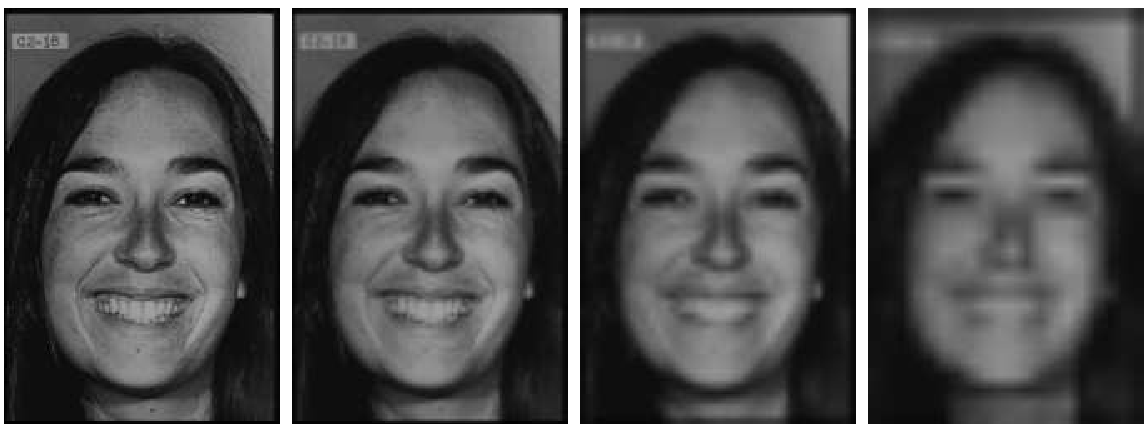 Figure 2: Happy faces at varying resolutions. Human-level recognition remains stable, suggesting that we rely on large-scale configural shifts rather than high-frequency textures.
Results Comparison
Using simple linear Support Vector Machines (SVMs) on these shape-based spaces, the accuracy was remarkably high:
- Happiness: 99%
- Surprise: 95%
- Anger: 94%
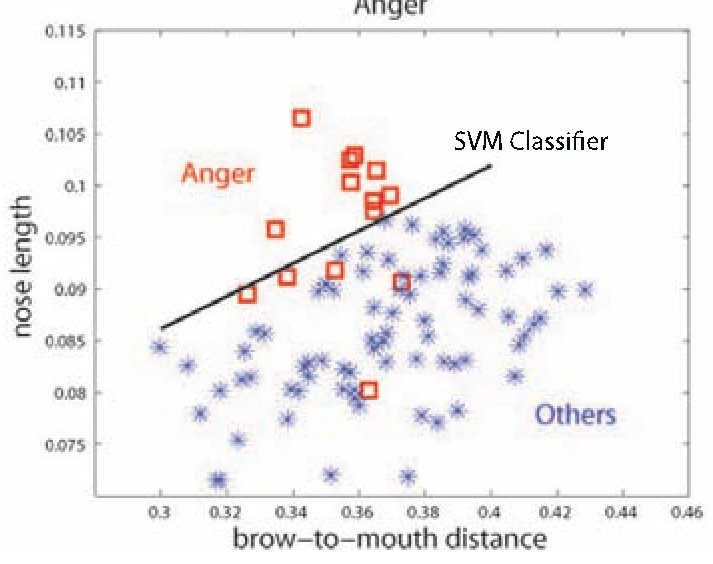 Figure 3: Visualization of the 2D discriminant spaces for the six basic categories. Note how even with only two dimensions, the categories are largely separable.
Critical Insight: Detection is the Real Challenge
The author makes a bold claim: Classification is easy; detection is hard. If a system can pinpoint the corner of an eye or the arch of a brow with 98% accuracy, the "emotion recognition" part is just simple geometry. The paper introduces a "features versus context" approach to prevent the "shifting box" problem in standard object detection, aiming for the sub-pixel precision that human eyes achieve.
Conclusion & Future Outlook
This model has profound implications for:
- HCI (Human-Computer Interaction): Creating systems that understand nuance, not just "binary" emotions.
- Clinical Psychology: Helping diagnose disorders like Autism or Schizophrenia by modeling how their "face spaces" differ from the norm.
- Evolutionary Biology: Understanding why we developed "loud" expressions like Joy (for long-distance signaling) vs. "quiet" ones like Fear (perhaps originally for sensory intake, not communication).
The future of the field isn't necessarily more complex neural layers, but a more "human" way of looking at the geometry of the face.