
Beyond the Toggle: Modeling the Complex Dynamics of OSN Privacy Management
Modeling and Analyzing User Behavior of Privacy Management on Online Social Network: Research in Progress
This research proposes a new causal model to analyze user privacy management on Online Social Networks (OSNs). By applying Structural Equation Modeling (SEM) and the Theory of Reasoned Action (TRA), the authors integrate multi-dimensional threats and behavioral intentions beyond simple binary "adopt-or-not" decisions.
TL;DR
This research challenges the oversimplified view of social media privacy as a binary choice. By integrating the Theory of Reasoned Action (TRA) with environmental and communication privacy theories, the authors propose a Structural Equation Model (SEM) that views privacy as a dynamic process of "boundary control." It categorizes threats from cybercriminals, vendors, and the public, mapping them to nuanced behavioral intentions.
Background Positioning: This is a foundational methodology paper that shifts the focus from "service adoption" to "responsive behavior," bridging the gap between social psychology and system design.
The Problem: The "E-Commerce" Bias in Privacy Research
Most existing literature treats online privacy through the lens of e-commerce—a transactional relationship between a user and a vendor. However, Online Social Networks (OSNs) are different. Your privacy isn't just threatened by the platform selling your data; it is threatened by:
- Unintended Audiences: A boss seeing a weekend party photo.
- Public Revelation: Personally identifiable information (PII) being scraped from "public" profiles.
- Communication Leaks: Private conversations falling into the wrong hands.
Current models lack the granularity to explain why a user might keep their profile public but meticulously filter who sees specific posts.
Methodology: The Core Framework
The authors leverage Structural Equation Modeling (SEM) to test the causal links between perceived threats, psychological concerns, and behavioral outcomes.
1. The Dual-Concern Mechanism
Unlike previous models that focus solely on Information Privacy Concerns (IPC), this model introduces Communication Privacy Concerns (CPC). This reflects the tension between wanting to share/disclose and wanting to protect.
2. Second-Order Factor Structure
The most innovative part of the methodology is the categorization of Behavioral Intention (BI) based on Altman’s theory of social dynamics. Instead of "will protect/will not protect," the model looks at:
- CIHI/CILI: Controlling incoming information for high/low interaction.
- COHI/COLI: Controlling outgoing information for high/low interaction.
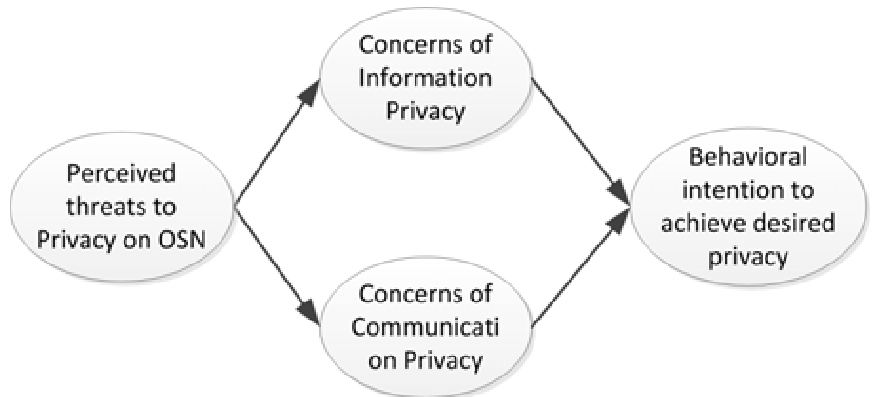 Figure 1: The proposed causality model linking threats to behavioral intention through mediating concerns.
Measuring "The Threat"
The research breaks down "Perceived Threats" into a three-pronged construct:
- Cybercrime Threats (C_Threats): Phishing, hacking, and malware.
- Vendor Threats (V_Threats): Secondary use of data or selling to third parties.
- Public Threats (P_Threats): Commercial scanning of profiles and visibility to strangers.
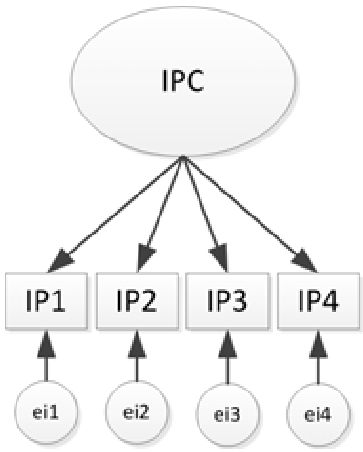 Figure 2: The measurement model for Information Privacy Concerns (IPC).
Preliminary Results & Insights
A pilot study conducted in 2010 revealed that users found traditional "semantic evaluative scales" (e.g., Unlikely vs. Likely) confusing when applied to complex privacy scenarios. This led the authors to propose a more robust "Use Scenario Analysis" to better capture how users actually interact with privacy settings in the real world.
Key Hypotheses being tested:
- H1: Higher perceived threats lead to higher IPC and CPC.
- H2: Higher concerns lead to a stronger intention to manage privacy (BI).
- H3: There is a transitive influence where specific threats trigger specific types of boundary-control behaviors.
Critical Analysis & Conclusion
Takeaway
The research moves the needle by recognizing that OSN privacy is socially situated. It isn't just about data security; it's about managing relationships. The distinction between incoming and outgoing information control is a vital insight for UX designers.
Limitations
- Sample Size: The pilot study (N=35) was insufficient for stable SEM analysis, requiring a larger follow-up.
- Temporal Context: As a 2010-era paper, it lacks the context of modern "dark patterns" in UI design that actively discourage the very behaviors the authors are modeling.
Future Outlook
The authors are currently refining "Privacy Threat Analysis" and "Use Scenario Analysis." This workflow promises to provide a "blueprint" for future social networks to design privacy interfaces that are actually aligned with human social intuition.