
Beyond Volume: Why Your Network Centrality Needs a Pareto Frontier
Modeling centrality measures in social network analysis using bi-criteria network flow optimization problems
The paper introduces a new family of centrality measures for Social Network Analysis (SNA) by modeling the problem as a bi-criteria network flow optimization. It extends classical flow-based betweenness and closeness measures to simultaneously account for both maximum flow (information volume) and communication costs (efficiency).
TL;DR
Classic network flow centrality metrics tell you how much information a node can handle, but they ignore the price of that communication. This paper introduces a bi-criteria optimization framework—balancing flow volume against communication cost. By using Pareto-optimal sets (Non-Dominated vectors), the authors provide a much more granular "vibe check" for social networks, distinguishing between efficient power players and redundant intermediaries.
Background: The Flattening of Network Importance
In Social Network Analysis (SNA), "Centrality" is the holy grail. Are you a bridge (Betweenness)? Are you close to everyone (Closeness)? Or do you just have many friends (Degree)?
Freeman et al. (1991) advanced this by treating information like water in a pipe—Flow Centrality. However, most flow models have a glaring weakness: they treat every path as equal. In the real world, a direct line is always better than a five-tiered game of "telephone," even if both can technically carry the same amount of data. Previous SOTA methods amalgamated these heterogeneous dimensions into a single scalar, losing the nuanced trade-offs between speed and capacity.
Methodology: The Bi-Criteria Breakthrough
The authors propose that centrality should not be a single number, but a set of possibilities. They frame the problem as a Bi-Objective Integer Network Flow (BOINF) optimization:
- Objective 1 (Maximize Flow): How much information can node push to node ?
- Objective 2 (Minimize Cost): What is the "distance" or resource penalty associated with that transfer?
The Architecture of Flow-Cost Analysis
The core of the method lies in identifying Non-Dominated (ND) Vectors. A solution is "non-dominated" if you can't increase flow without also increasing cost.
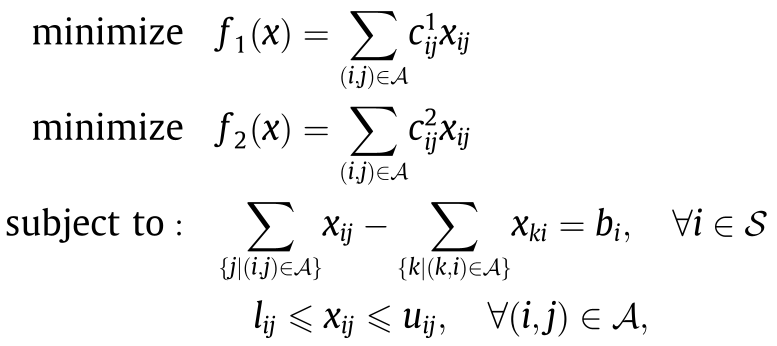
The authors redefine centrality using these ND sets. Instead of saying Node A has a score of 0.5, they say Node A has a set of potential states: {(Max Flow, Min Cost), (Med Flow, Lower Cost), ...}.
They introduce a custom operator—the ND Sum ()—to aggregate these sets across the entire network, allowing for a "Flow-Cost Closeness" measure that respects the complexity of the Pareto frontier.
Dissecting Power: The Iranian Government Case Study
To prove this isn't just mathematical gymnastics, the researchers applied the model to the Iranian Government's political network.
Using classical flow, leaders like Mohammad Khatami and Nategh Nouri appeared to have similar influence over key government bodies. However, when the "Unitary Cost" (representing the friction of using intermediaries) was added, the model revealed a hidden hierarchy.
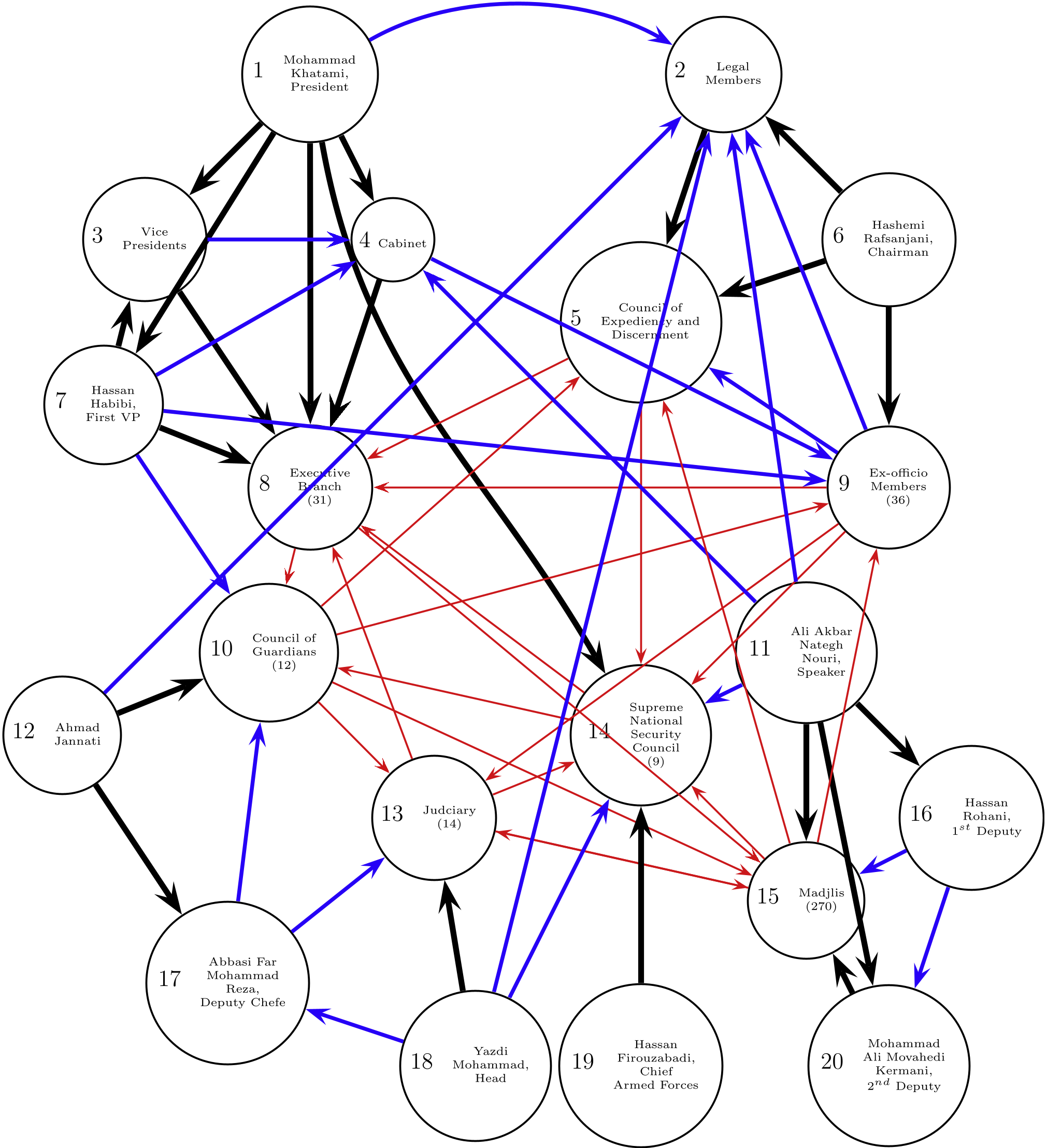
Key Insight: Khatami might control high flow, but he requires more "hops" (higher cost), making his influence more fragile or expensive compared to nodes with direct, low-cost access to the Council of Guardians.
Critical Comparison: When to use Flow-Cost Centrality?
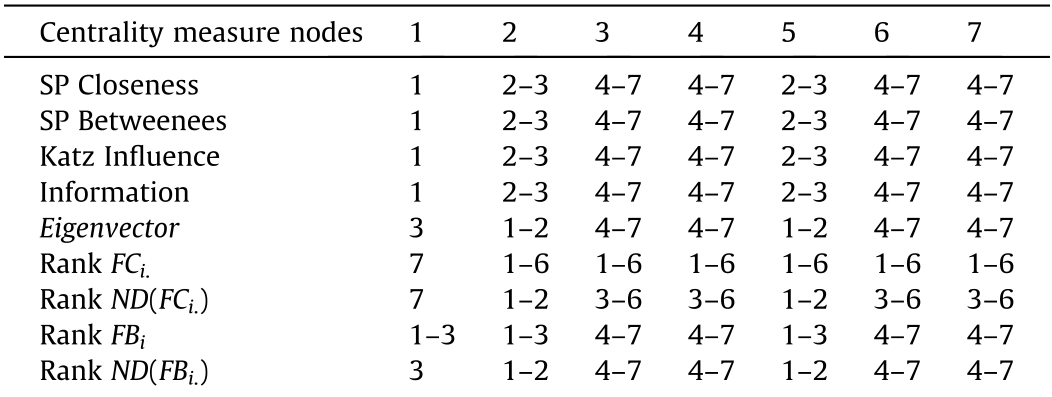
The paper provides a definitive guide on which centrality to use based on how information spreads:
| Spreading Method | Suitable Topology | Recommended Measure |
|---|---|---|
| Geodesic Path | Transfer of physical goods | SP Closeness/Betweenness |
| Walks | Gossip, infection | Eigenvector / Katz |
| Parallel Flow | Targeted Information diffusion | Flow-Cost Centrality (Proposed) |
Conclusion and Future Outlook
The genius of this work is the rejection of the "single-number" fallacy. By embracing multi-objective optimization, we can finally rank nodes in a way that aligns with the physical reality of communication friction.
Limitations: The computational complexity of calculating ND sets for integer flows is significantly higher than simple shortest-path algorithms. While feasible for a government network of 20-50 nodes, applying this to a million-node graph would require heavy heuristic approximations or distributed Pareto-optimization solvers.
The Takeaway: If you are analyzing a network where "efficiency" matters as much as "capacity," you can no longer afford to ignore the cost dimension. Centrality is a trade-off, not a constant.