
Beyond the Robot: Modeling Emotional Intelligence in Game AI Agents
Modeling of Emotional Effects on Decision-making by Game Agents
The paper introduces a "lightweight" emotional game agent architecture that integrates hybrid appraisal and dimensional theories of emotion into a dual-process cognitive model. By linking emotional valence to memory nodes and decision-making logic, the architecture enables agents to exhibit realistic, humanlike affective behaviors in real-time simulations.
TL;DR
Despite the sophistication of modern Game AI, most agents still lack the "gut feeling" and irrational biases that define human decision-making. This paper presents a novel agent architecture that infuses cognitive science—specifically appraisal and dimensional theories of emotion—into a lightweight framework. By allowing emotional states to bias memory recall and attention, these agents can finally behave with the realism required for advanced training simulations and immersive gaming.
Background: The Affective Gap
In high-stakes environments—like a nuclear power plant control room or a tactical battlefield—human decisions are never purely "utility-based." We get distracted, we become pessimistic under stress, and we ignore subtle cues when overwhelmed. Current Game AI fails to capture this, remaining stuck in a paradigm of perfect rationality or scripted randomness. The authors bridge this gap by synthesizing cognitive modeling with emotional science to create agents that don't just "act," but "feel" their way through a problem.
The Core Insight: A Dual-Process Architecture
The researchers built their architecture on the foundation of Dual-Process Theory, which splits cognition into two systems:
- The Associative Subsystem: Fast, intuitive, and parallel. This is where emotion resides, influencing the "activation strength" of concepts in memory.
- The Deliberative Subsystem: Slow, rule-based, and serial. This is the "charioteer" trying to make logical choices while being tugged by the emotional "horses" of the associative system.
Architecture Breakdown
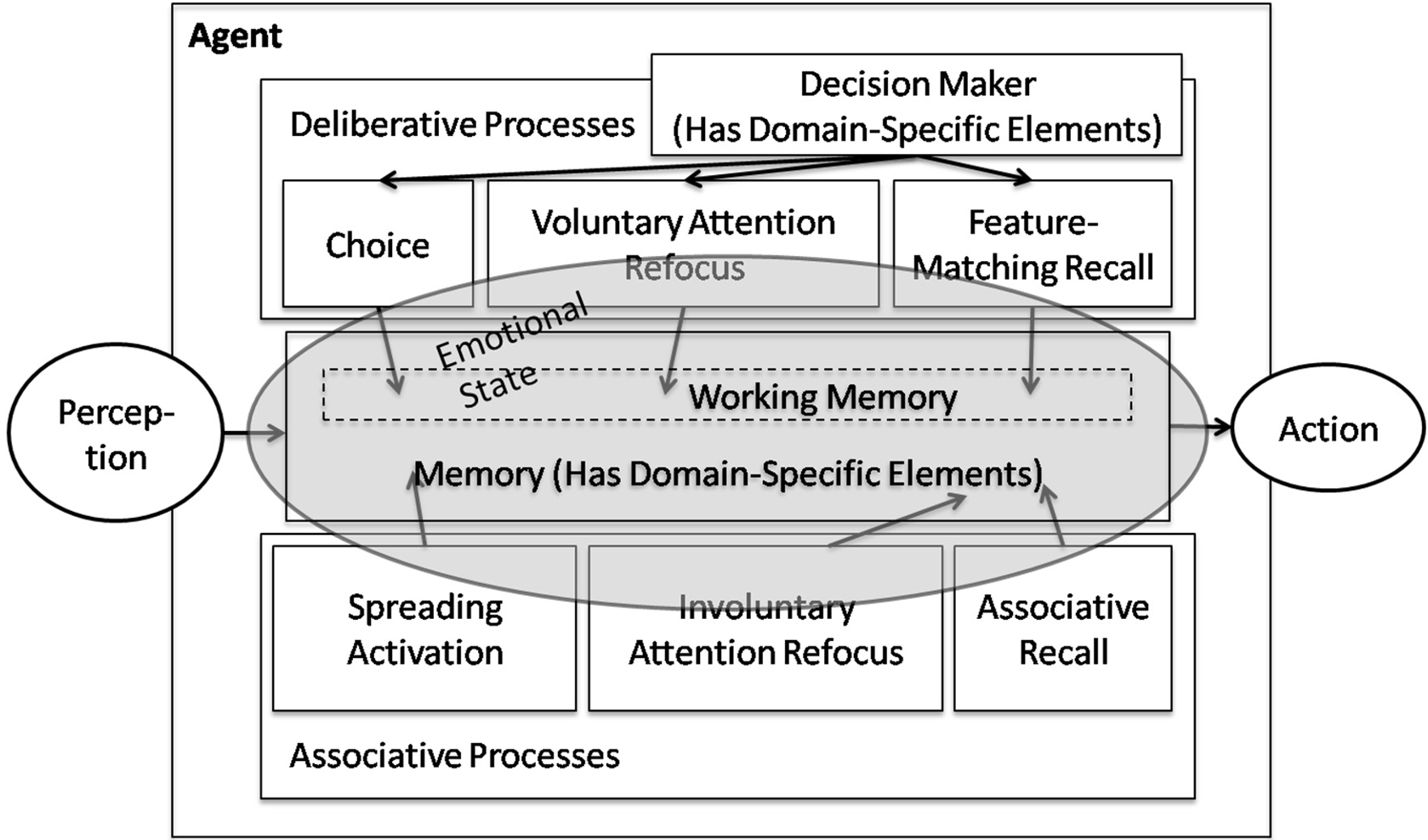
The design rests on four pillars:
- Emotional Valence: A global state ranging from -1.0 (Negative) to 1.0 (Positive).
- Memory Network: A semantic web where ideas (nodes) have "emotional charges." If your state matches a node's charge, you're more likely to remember it.
- Attention Flexibility: Positive moods open up the mind (leading to creativity or distraction), while negative moods create "tunnel vision."
- Success Probability Bias: An optimistic agent (positive state) overestimates success; a pessimistic agent (negative state) prepares for the worst.
Proving Reality: From Lab Tasks to Nuclear Meltdowns
The authors didn't just build a model; they validated it against actual human psychological data.
1. Calibration against Cognitive Science
The agent was tested on the AX-CPT (measuring flexibility) and the Tower of London (measuring planning/distraction) tasks. The results were striking: the agent's performance patterns showed a ~90% correlation with human experimental results. When "happy," the agent was more flexible but easily distracted; when "sad," it was focused but rigid.
2. The Nuclear Power Plant Crisis
To test real-world applicability, the team simulated a water pipe rupture in a nuclear plant.
- The Findings: An "emotion-neutral" agent always followed the manual (shutting down the reactor). However, a "pessimistic" agent (negative state) correctly suspected a critical rupture and attempted a repair sooner—reflecting how negative emotions can sometimes sharpen focus on survival-critical threats.
- The Limit: If the negative state became too extreme (below -0.5), the agent suffered from "hyper-focus" on irrelevant details, leading to a total meltdown.
(Note: Experimental data shows the shifts in success rates between pipe-fixes, shutdowns, and meltdowns as emotional valence moves from -1.0 to +1.0.)
Critical Insight & Future Outlook
The true value of this work lies in its "lightweight" nature. It doesn't require a massive neural network to simulate human error; it achieves it through elegant, theory-driven biases in a semantic network.
Limitations: Currently, the agent’s emotion is a static variable for the duration of a task. The authors acknowledge that the next frontier is Dynamic Emotion Regulation—where the agent's state changes based on the success or failure of its own actions (e.g., panic rising as water pressure falls).
Conclusion
By moving away from "perfect" AI and embracing the messy, biased nature of human emotion, this architecture paves the way for a new generation of "Synthetic Role Players." Whether in a serious game for training emergency responders or a narrative-driven RPG, this model proves that to make an agent seem human, you first have to let it be emotional.