
The PAC Framework: Engineering Human Personality and Emotion into Social Agents
Modeling the Impact of Motivation, Personality, and Emotion on Social Behavior
The paper introduces the PAC (Personality, Affect, and Culture) framework, a theory-driven computational model designed to simulate diverse human social behaviors. By integrating motivational systems, personality traits (Big Five), and appraisal-based emotions, PAC achieves realistic agent variability in complex scenarios like counter-insurgency and epidemic spread.
TL;DR
Predicting social behavior is notoriously difficult due to human variability. The PAC (Personality, Affect, Culture) framework addresses this by modeling the "internal engine" of behavior. By combining hierarchical motivational systems with emotional appraisal theory, PAC allows researchers to simulate agents that don't just follow scripts, but react based on their unique personality profiles—ranging from cautious shopkeepers in war zones to high-risk individuals in public health crises.
The Missing Link: Why Traditional Models Fail
Most prior social modeling attempts (SBP) look at the what—crowd movements, cultural norms, or specific skills. However, they often treat individuals within a group as homogeneous units. In reality, two people from the same culture might react to a threat in opposite ways: one flees out of fear (Avoidance), while the other stays to protect status (Approach).
The authors argue that without modeling the interaction of motives, we cannot predict how local populations will react to external interventions, whether they are military patrols or health-related outreach.
Methodology: The "Macro-Architecture" of PAC
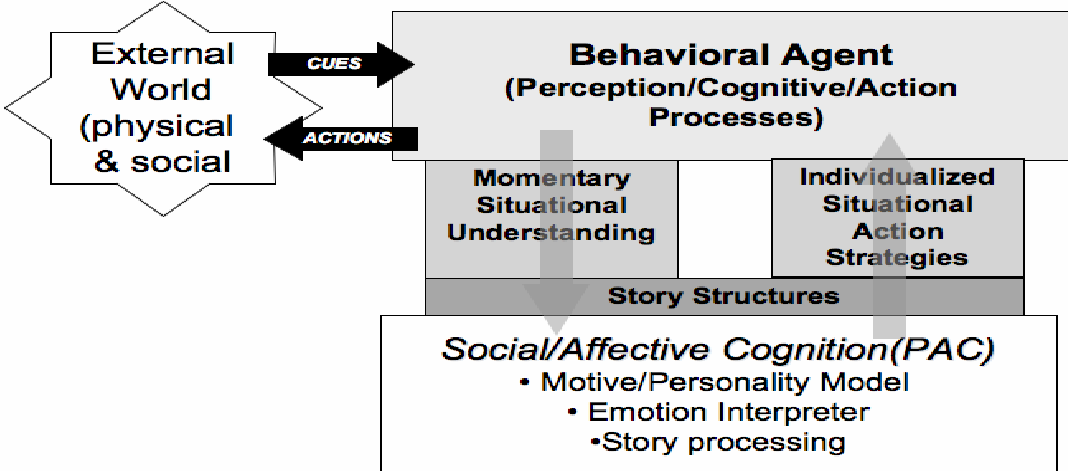
The core of PAC is a multi-layered system that translates abstract psychological theories into computational logic.
1. Motivational Systems & Hierarchical Control
At its base, PAC uses a hierarchical structure where broad "Control Systems" govern specific "Motives":
- Approach System: Governs rewards and correlates with Extraversion.
- Avoidance System: Governs responses to threats and correlates with Neuroticism.
- Disinhibition/Constraint: A higher-level system that moderates how many motives are active at once.
2. Story Processing & Situational Affordances
Agents understand their world through "Story Structures." When an agent enters a situation, the framework identifies "affordances"—opportunities to satisfy specific motives (e.g., a conversation might afford an opportunity for "Status" or "Affiliation").
3. The Appraisal Model of Emotion
Unlike simple "mood" variables, emotions in PAC are derived from Roseman’s Appraisal Model. Emotions are the result of what happens to an agent's motives:
- Joy: Getting what you want (Appetitive Success).
- Sadness: Not getting what you want + Low control potential.
- Anger: An obstacle blocking a motive + High control potential.
Experiments: From Insurgency to Epidemics
The paper highlights two powerful use cases for the PAC framework:
Case A: Counter-Insurgency Operations
In simulations involving US military patrols and Iraqi shopkeepers, PAC showed that "cultural story structures" clash. Western agents often used "directness" stories, while local agents expected "politeness" stories. By varying the shopkeepers' motives (e.g., increasing "fear for safety" vs. "economic gain"), the simulation successfully predicted varying levels of cooperation or hostility, providing a vital tool for pre-deployment training.
Case B: Social Behavior in Disease Spread (HIV/AIDS)
By applying Attachment Theory, the authors modeled how "rejection sensitivity" affects sexual risk-taking among MSM (men who have sex with men). The model illustrates how internal personality dynamics—fear of rejection and desire for closeness—drive the number of partners and type of risk, moving beyond simple demographic statistics to psychological drivers.
Critical Insight: The "Plug-in" Future of Social AI
The real value of PAC lies in its modularity. It is designed to "piggy-back" onto existing cognitive architectures like SOAR or ACT-R.
Takeaway: This work proves that realistic social simulation doesn't require "more data"—it requires better theoretical scaffolding. By encoding the mechanics of motivation and emotion, PAC transitions social modeling from a descriptive science to a predictive engineering discipline.
Limitations: While powerful, the framework relies heavily on manual "Story Structure" authoring. Future iterations could benefit from LLM-driven generation of these affordances to scale the complexity of social environments.