
The Hidden Cost of Hierarchy: How Social Stratification Bottlenecks Society
Modeling Impact of Social Stratification on the Basis of Time Allocation Heuristics in Society
This paper presents a multi-agent computational model to simulate how social stratification affects time allocation efficiency in social networks. Using NetLogo, the authors compare egalitarian systems against stratified ones by manipulating agent execution orders, discovering that while stratification benefits the elite, it compromises the overall efficiency of the society.
TL;DR
Is a hierarchy-based society more efficient because "experts" control the flow, or is it fundamentally broken? Using a sophisticated multi-agent system, researchers from the Polish-Japanese Institute of Information Technology proved that egalitarian systems outperform stratified ones in 97% of stable scenarios. While those at the top gain a significant advantage, the "social tax" paid by the rest of the population leads to a net loss in total societal efficiency.
Background: Time as the Ultimate Resource
In our modern world, status is often measured by who waits for whom. If you meet a CEO, you adjust to their calendar. This paper posits that time is the primary currency of social stratification. The authors set out to determine if this "top-down" scheduling actually helps society organize better or if it simply funnels benefits to the elite while wasting the collective's potential.
Problem & Motivation: The Myth of the Efficient Elite
Previous research into time-use behavior often fell into two camps: those focused on historical data-sets (diaries) and those focused on infectious spread. Few looked at the topology of power. The researchers noticed a gap: how does the order of decision-making—a proxy for social status—affect the ability of a network to satisfy the interests of its members?
Methodology: Simulating the "American Dream" vs. Rigid Castes
The study utilizes a multi-agent system where agents have "culture" (topics of interest) and "willingness" (the desire to discuss those topics).
1. The Stratification Mechanism
The researchers modeled hierarchy through the execution order of agents in each simulation turn:
- Egalitarian (None): Random order every turn. Everyone has an equal shot at proposing a meeting.
- Rigid Hierarchy (Fixed): A permanent queue. The same elite agents always pick their slots first.
- Meritocratic/Dynamic (Weighted Degree): Agents with more/stronger connections get priority.
2. Scheduling Heuristics
They tested two cognitive levels for the agents:
- Simple: Randomly picking friends until a slot works.
- Intelligent: Sorting interests and searching for the best partner—simulating the "technological progress" in personal management.
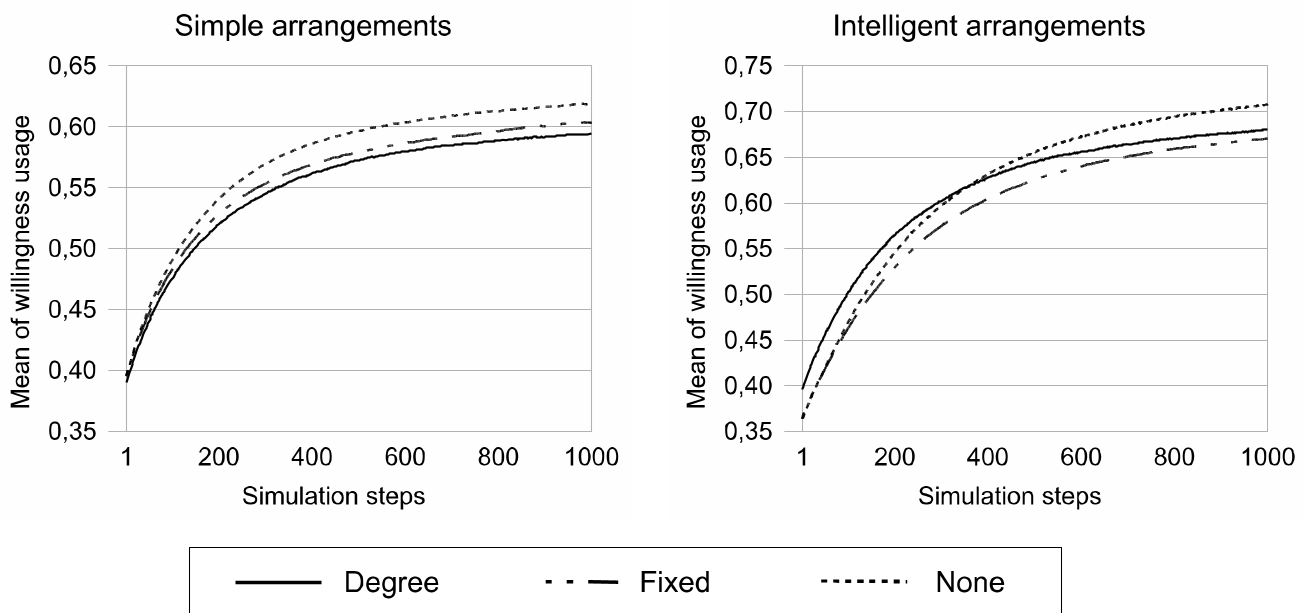 Figure 1: Comparison of Willingness Usage over time between stratified and non-stratified systems.
Experiments & Results: The "97%" Verdict
The simulation ran 288 different parameter combinations (varying culture size, network density, etc.) with 1,000 agents per run.
- The Egalitarian Advantage: In the "warm-up" phase (first 300 turns), stratified systems occasionally looked efficient. However, once the social network stabilized (1000 turns), the non-stratified system was superior in 97% of cases.
- The Elite Paradox: The top 10% of agents in stratified systems saw an efficiency boost of up to 29%. However, this gain was "stolen" from the lower tiers, whose inability to coordinate their own schedules led to a massive aggregate drop in the society's "Consumed Willingness."
| Arrangement | Turn | None (Egalitarian) | Degree (Stratified) | Fixed (Stratified) |
|---|---|---|---|---|
| Intelligent | 1000 | 0.708 | 0.670 | 0.680 |
| Simple | 1000 | 0.620 | 0.603 | 0.595 |
| Table 1: Mean willingness usage showing egalitarian (None) superiority in stable phases. |
Critical Insight: Technology Won't Save a Rigged System
One of the most profound findings was that "Intelligent" heuristics did not fix stratification. Even when agents used advanced algorithms to manage their time, the structural disadvantage of being "low in the queue" outweighed their individual optimization efforts. This suggests that in a stratified society, "working smarter" at the individual level cannot compensate for "structural bottlenecks" at the systemic level.
Conclusion & Perspective
The paper provides a quantitative backbone to the sociological theory presented in "The Spirit Level"—that more equal societies do better.
Key Takeaways:
- Inequality is a drag on total system throughput.
- Privilege is a zero-sum game in resource-constrained environments like time.
- Future Work: The authors suggest exploring "flexible hierarchies" where agents can climb the ladder based on performance, mimicking the "American Dream" more closely to see if social mobility mitigates these systemic losses.
Ultimately, this study warns that while stratification may offer a sense of order or reward for those at the top, it leaves a vast amount of societal "willingness" on the table, unused and wasted.