
Beyond the Follow Button: Deciphering Local and Global Influence in Social Movements
Modeling Influence on Posting Engagement: The Gaza Great Return March Analyzed on Twitter
This paper introduces a dual-influence model for Online Social Networks (OSNs) that quantifies both local (neighbor-to-neighbor) and global (non-neighbor) exposure to participation shifts. Applied to Twitter data from the Gaza Great Return March (GRM), the study utilizes Temporal Exponential Random Graph Models (TERGMs) to demonstrate that integrating global influence significantly improves the prediction of user posting engagement.
TL;DR
Is your Twitter activity driven only by your friends, or by the "vibe" of the entire platform? This research challenges the traditional "neighbor-to-neighbor" diffusion dogma by introducing a model that accounts for Global Influence. By analyzing 60,000+ tweets during the Gaza Great Return March (GRM), the study shows that accounting for non-neighbor exposure increases prediction accuracy (AUC 0.78) for user engagement.
The "Neighbor-Only" Fallacy
In network science, we often treat influence like a virus: you only catch it if you're in direct contact with an infected subject. Most structural models (like the Linear Threshold Model) assume that if User A doesn't follow User B, User B cannot influence them.
However, OSNs are public stages. We see trending hashtags, viral retweets, and algorithmic recommendations. The author argues that a "Participation Shift" (a change in how active a user is) in a non-neighbor can trigger a corresponding shift in you. To ignore this "Global Influence" is to ignore the very nature of modern digital discourse.
Methodology: Quantifying the Invisible
The core of this work lies in distinguishing between the "flow" coming from your direct edges and the "ambient noise" of the network that actually carries signal.
1. Defining Participation Shift
Instead of binary "active/inactive" states, the author uses a multidimensional centrality vector (including PageRank, Betweenness, and In-degree). A "shift" is calculated as the Euclidean distance between a user's centrality at time and .
2. The Dual-Influence Equations
The model splits influence into two components:
- Local Influence (): Proportional to the weights of incoming edges from active neighbors.
- Global Influence (): This is the "effective" exposure from the rest of the network. The author meticulously subtracts "redundant" exposures (information you might have already received from mutual neighbors) to ensure the global metric represents unique information.

Real-World Application: The Gaza Great Return March
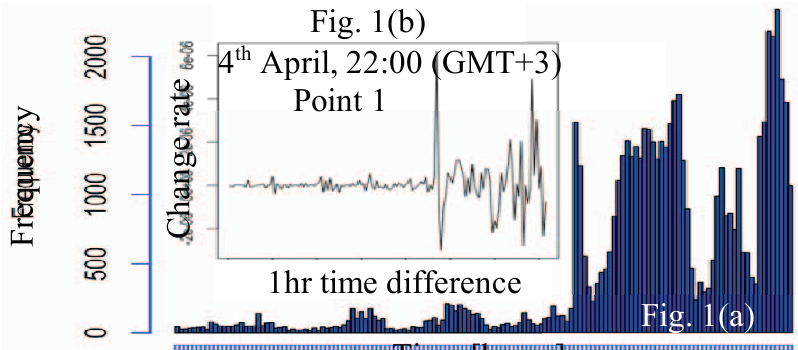
The model was tested on a high-volatility dataset: Twitter interactions during the 2018 Gaza protests. The activity was split into 192 one-hour intervals.
Key Findings from the TERGM Analysis:
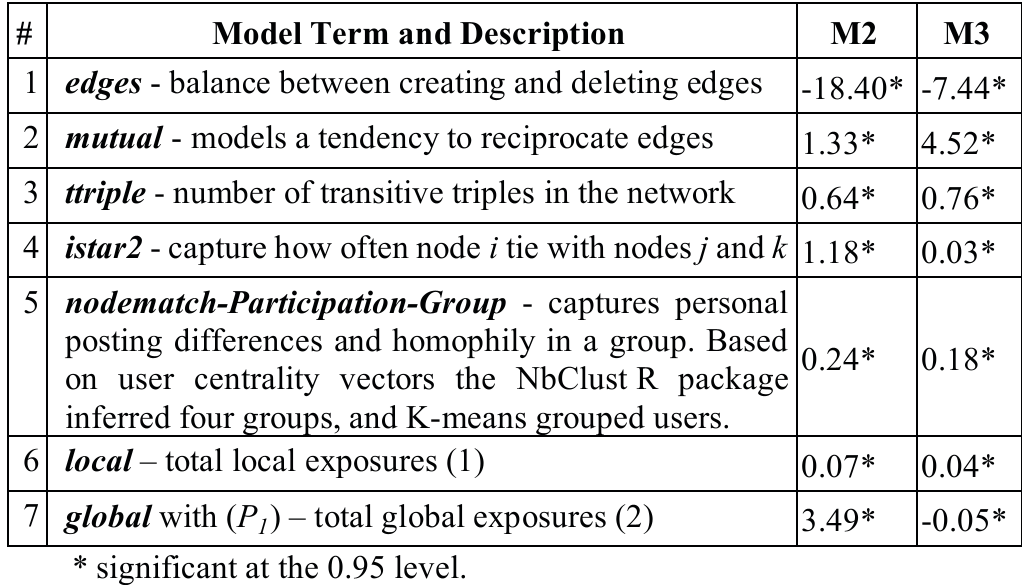
- Global Matters: In the period leading up to the escalation (Win#1), the Global Influence term was not just significant—it was a major driver of engagement.
- The Escalation Paradox: Interestingly, as the confrontation intensified (Win#2), the Global influence coefficient became negative. This suggests that in the heat of a crisis, users might retreat into "echo chambers" or rely more on trusted local sources rather than the global noise.
- Homophily: Users belonging to the same "participation group" (based on their network roles) were significantly more likely to interact, confirming that structural roles define social behavior.
Critical Insight & Conclusion
The novelty of this research isn't just the math; it's the architectural realization that OSNs are hybrid spaces. They are neither purely local (like a private chat) nor purely global (like a television broadcast).
Takeaway: If you are building predictive models for social engagement or sentiment contagion, you must model the "hidden" exposure of non-neighbors. The jump in AUC 0.78 proves that the "global vibe" of a network is often just as informative as the direct social graph.
Limitations: The model assumes Euclidean distance in centrality space perfectly captures "participation shift," which might miss qualitative nuances in content. Future work could integrate NLP to see if the topic of the shift impacts the influence weight.