
Deciphering the DNA of Social Links: Modeling Behavioral Stability in Dynamic Networks
Modeling Link Formation Behaviors in Dynamic Social Networks
This paper introduces a general framework for modeling individual "Link Formation (LF) behaviors" in dynamic social networks based on dyadic and triadic structures. Using the Epinions dataset, the authors quantify user behavior through metrics of Rule Usage and Rule Confidence, revealing stable patterns in how users establish new trust links over time.
TL;DR
Social networks are often viewed through the lens of global statistics, but the real magic happens at the micro-level. This paper moves beyond static graphs to model Link Formation (LF) behaviors—the "behavioral signatures" of how individual users create links over time. By defining specific rules based on dyads and triads, the authors show that users exhibit unique, stable preferences for how they choose their next connection.
Context: Why "What" is Less Important Than "How"
Most existing research in social network analysis focuses on the state of the network—who is connected to whom. However, in a dynamic environment like the Epinions "Web of Trust," links are formed sequentially. The core insight of this paper is that link formation is a deliberate process governed by local structures (pre-conditions). Instead of asking "will a link form?", the authors ask: "Given a specific structural opportunity, how likely is this specific user to take it?"
Methodology: The Five Rules of Engagement
The framework identifies five fundamental LF-rules ( to ) derived from dyadic (two-node) and triadic (three-node) structures. Importantly, these rules are temporal: the pre-condition must exist in the network before the new link is created.
The LF-Rule Suite:
- Reciprocity (): User A trusts B, then B trusts A.
- Transitivity (): A trusts B, B trusts C, then A trusts C.
- Cycle (): A trusts B, B trusts C, then C trusts A.
- Common Out-neighbor (): A and B both trust C, then A trusts B.
- Common In-neighbor (): C trusts both A and B, then A trusts B.
 Figure 1: The five structural rules where the blue dashed line represents the link being formed after the pre-condition.
The researchers quantify these behaviors using two metrics:
- Rule Usage: The proportion of a user's total links that follow a specific rule (Are you a "transitivity" person or a "reciprocity" person?).
- Rule Confidence: The "conversion rate"—if the pre-condition exists (e.g., you have a common neighbor), what is the probability you actually form the link?
Experimental Insights: Reciprocity vs. Transitivity
Using the Epinions dataset (1,295 active users), the study revealed a fascinating paradox:
- Transitivity () and Common Neighbors () are the most frequently used rules.
- Reciprocity () has very low usage (only 8% of links), but the highest confidence (19%).
This suggests that people want to reciprocate trust whenever possible, but they simply don't get the opportunity as often as they encounter common neighbors.
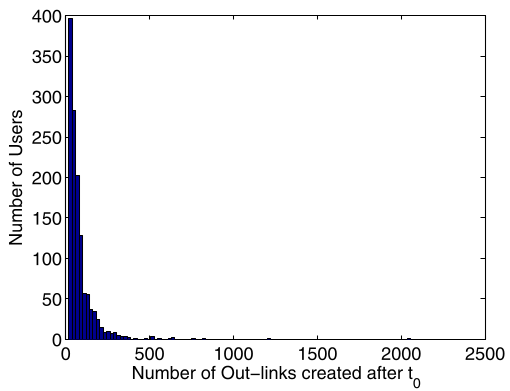 Figure 2: Distribution of behavior scores. Triadic rules dominate usage, while dyadic reciprocity dominates confidence.
Stability: The Mature Socialite
One of the most significant findings is the stability of behavior. As users create more links (moving from the 1st to the 10th partition of their lifecycle), the "average relative change" in their behavior scores drops significantly.
In plain English: Users develop a "style" of networking early on and stick to it. This stability validates the idea that LF-behaviors can be used as a reliable feature for User Profiling.
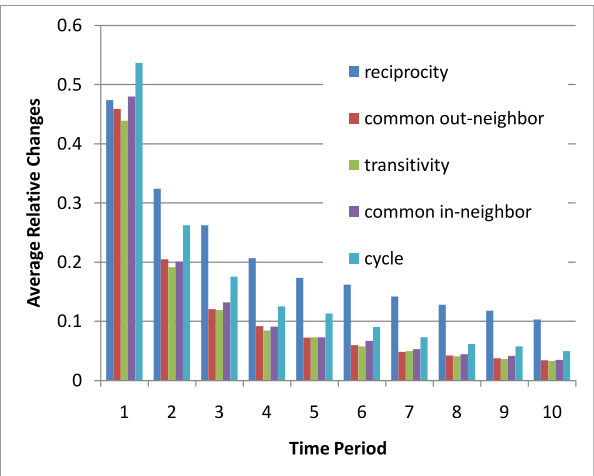 Figure 3: Average relative changes in behavior scores decrease over time, indicating a "crystallization" of link-forming habits.
Critical Analysis & Conclusion
Takeaway
This work provides a bridge between sociological theory (triad closure) and data mining. It proves that the "Two-Hop" neighborhood is where 90% of the action happens. By moving from a "random link" assumption to a "behavioral rule" assumption, the accuracy of social recommendations can be vastly improved.
Limitations
The study assumes that once a link is formed, it is never removed (static history). In modern ephemeral social networks (like Snapchat) or high-churn environments, the "removal" of links is just as vital a behavior as "formation," which this model does not yet account for.
Future Outlook
Integrating these rule-based features into Temporal Graph Neural Networks (T-GNNs) could be the next frontier. Imagine a recommendation engine that knows you are 4x more likely to reciprocate a trust link than to follow a "friend of a friend"—the precision of social discoverability would be transformed.