
MAT: Rethinking Viral Marketing Through Asynchronous Influence and Messengers
Modeling and maximizing influence diffusion in social networks for viral marketing
This paper introduces the Multiple-path Asynchronous Threshold (MAT) model, a novel framework for influence diffusion in viral marketing. It addresses the "Influence Maximization" (IM) problem by proposing IV-Greedy, a heuristic that outperforms traditional degree-based methods and matches the performance of Monte Carlo simulations with several orders of magnitude higher efficiency.
TL;DR
The success of a viral marketing campaign depends on picking the right "seeds." Traditional models (IC/LT) are often too simplistic for the real world. This paper proposes the MAT (Multiple-path Asynchronous Threshold) model, which accounts for "messengers" who don't buy but do talk, and the fact that influence fades over time and social distance. To solve the selection problem, they introduce IV-Greedy, an algorithm that is exponentially faster than standard simulations while being significantly more accurate than simply picking "popular" nodes.
The "Loudness" vs. "Purchase" Gap
Most influence models assume that if you aren't "infected" (i.e., you haven't bought the product), you stop spreading the word. The authors identify this as a major flaw. In reality, word-of-mouth (WOM) is a "coproduction" where even people who haven't adopted a technology might mention it to a friend.
Existing models also suffer from being "time-invariant"—they ignore the fact that a recommendation today is worth more than a recommendation a month from now, and that people check their feeds at different times (asynchrony).
Methodology: The 3A Process
The authors propose a 3A Process for influence: Awareness → Aggregation → Activation.
1. Quantification of Influence
Instead of a binary "active/inactive" switch, MAT treats influence as a fluid quantity that accumulates. It incorporates:
- Path Attenuation: Based on the three-degrees-of-influence phenomenon, influence drops by and usually dies after 3 hops.
- Temporal Decay: Influence vanishes exponentially () as the "hype" around a product cools.
- Poisson Asynchrony: Messaging frequency is modeled as a Poisson process, recognizing that some people communicate more often than others.

2. The IV-Greedy Algorithm
The "Influence Maximization" problem is NP-hard. Usually, researchers use Monte Carlo (MC) simulations to guess the outcome, but this is incredibly slow. The authors developed IV-Greedy, which:
- Builds an Influence Vector for each node (a map of its potential impact).
- Uses a greedy approach to select seeds that minimize overlap while maximizing aggregation.
Experimental Showdown
The authors tested MAT on four real-world datasets, including PGP (trust network) and WikiVote.
Performance Highlights:
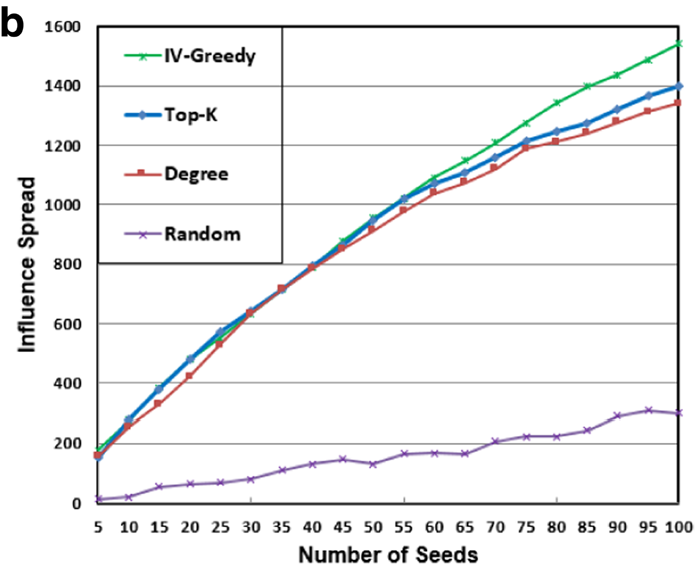
- Accuracy: IV-Greedy consistently beat the "Degree" heuristic (picking nodes with the most followers). In the PGP network, it achieved a 35.1% better spread.
- Speed: This is the real breakthrough. On the C.elegans network, the gold-standard MC-Greedy took 25 hours. IV-Greedy achieved virtually the same result in 0.2 seconds.
Critical Insight: Beyond the Hub
The study proves that simply targeting "social hubs" (high-degree nodes) is often inefficient because their influence overlaps too much. By using the MAT model, marketers can identify a more diverse "seed set" that leverages the messenger effect and respects the social horizon of three hops.
Limitations & Future Work
While MAT is a massive leap toward realism, the authors note that proving "submodularity" (the mathematical property that guarantees greedy algorithms work perfectly) for this model remains a theoretical challenge. Future research will focus on scaling this to massive-scale networks like Facebook or X (Twitter) and integrating negative sentiment (anti-viral marketing).
Conclusion
MAT and IV-Greedy provide the tools to move from "spray and pray" marketing to a calculated, realistic strategy that acknowledges how humans actually communicate: asynchronously, over limited distances, and through the power of messengers.