
Decoding Teacher Mentorship: What Drives Engagement in Educator Social Networks?
Modeling Mentoring Dialogue within a Teacher Social Networking Site
This paper presents a foundational study on modeling mentoring dialogue within teacher-specific social networking sites (specifically MSP2). By employing manual annotation and quantitative analysis of speech acts and knowledge-sharing strategies, the authors identify key patterns that trigger high-engagement (long-form) professional discussions among educators.
TL;DR
Not all online discussions are created equal. In this study, researchers from the University of Southern California dive into the MSP2 (Middle School Portal 2) network to understand what makes a teacher's cry for help turn into a thriving community dialogue. Their findings? Skip the long-winded intros, share your personal battle stories, and keep the first answer substantial—not the first post.
Context: Beyond Student Forums
Historically, researchers in Educational Data Mining (EDM) have obsessed over student dialogues to understand learning outcomes. However, the professional development of the teachers themselves—often occurring in the "third space" of social networks—has been largely ignored. This paper shifts the lens to teacher-to-teacher (T2T) dialogue, treating the social network as a virtual staff room where mentoring happens through peer exchange.
The "Turn-Off" Paradox: Why Less is More
One of the most counter-intuitive findings of this research relates to the "initial post" length. We often assume that providing more detail in a request for help leads to better engagement. The data proves otherwise:
- Long Discussions started with posts averaging 166 words.
- Short Discussions (those that fizzled out) started with posts averaging 423 words.
The authors suggest that lengthy initial posts might be a "turn-off," perhaps overwhelming potential respondents or making the problem seem too specific to be generally applicable.
Methodology: The Anatomy of a Mentoring Exchange
The team developed a sophisticated tagging system to categorize the "DNA" of a post. They looked at:
- Speech Acts: Is it a question (que) or an answer (ans)?
- Knowledge Sharing Strategies: Are they providing a link, a book reference, or a personal experience?
- Teacher Tasks: Is the topic about Integrating Technology (IT) or Instructional Strategies (Instr)?
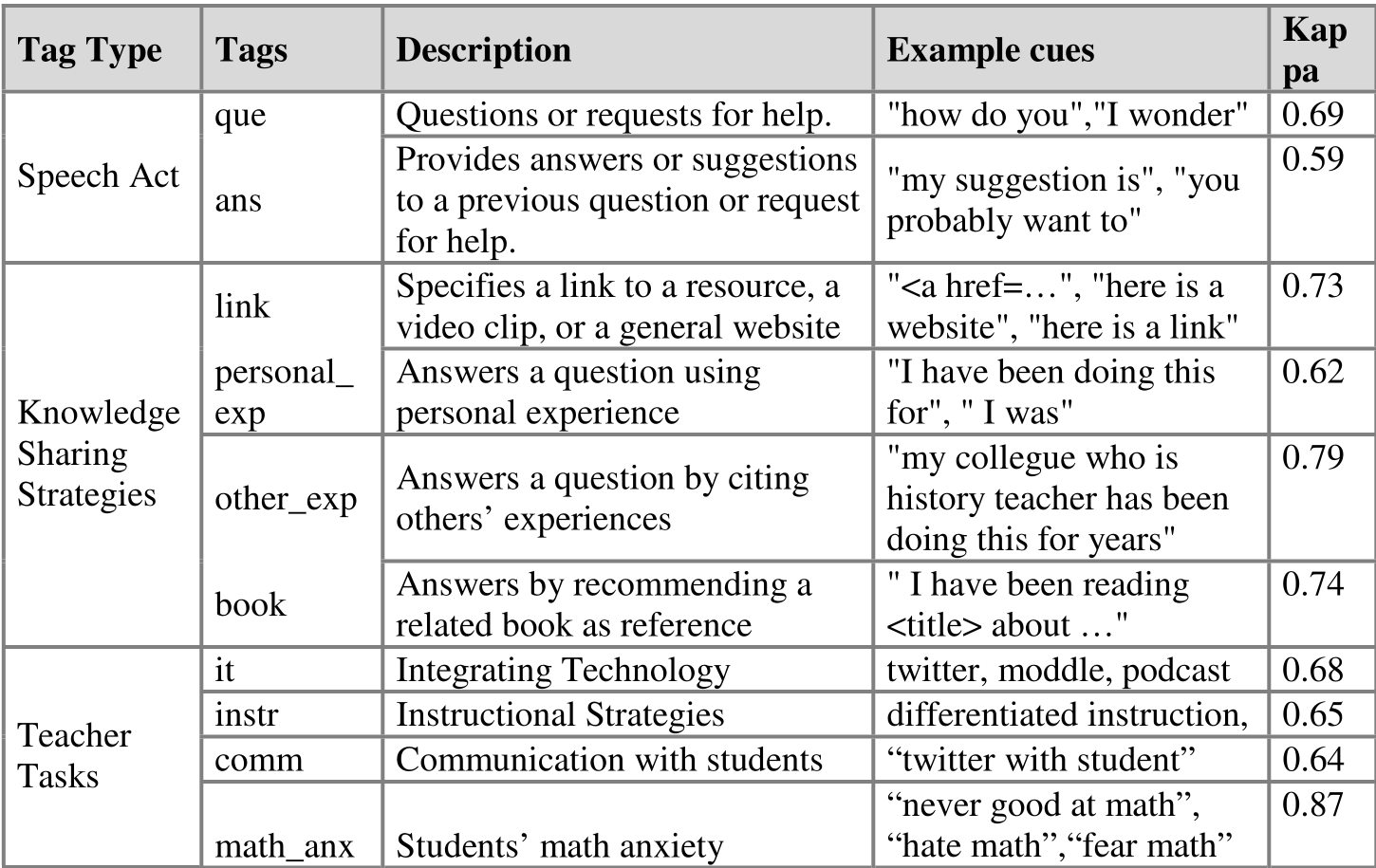 Table 1: The annotation framework used to categorize teacher interactions, showing high agreement (Kappa) in resource linking and math anxiety topics.
Key Insights: Success Recipes for Mentoring
The study analyzed what differentiates "Long Discussions" (top quartile of engagement) from "Short Discussions."
- Personal Experience is King: Sharing "how I did it in my classroom" was far more effective at sustaining a thread than simply providing a link.
- The Power of the First Responder: While the initial post should be short, the first answer needs to be meaty. In successful threads, the first response was significantly longer and more substantive than in failing threads.
- Tech is the Top Topic: Issues surrounding "Integrating Technology" (IT) were the most frequent drivers of long-form collaboration, highlighting a major area where teachers feel the need for peer-led mentoring.
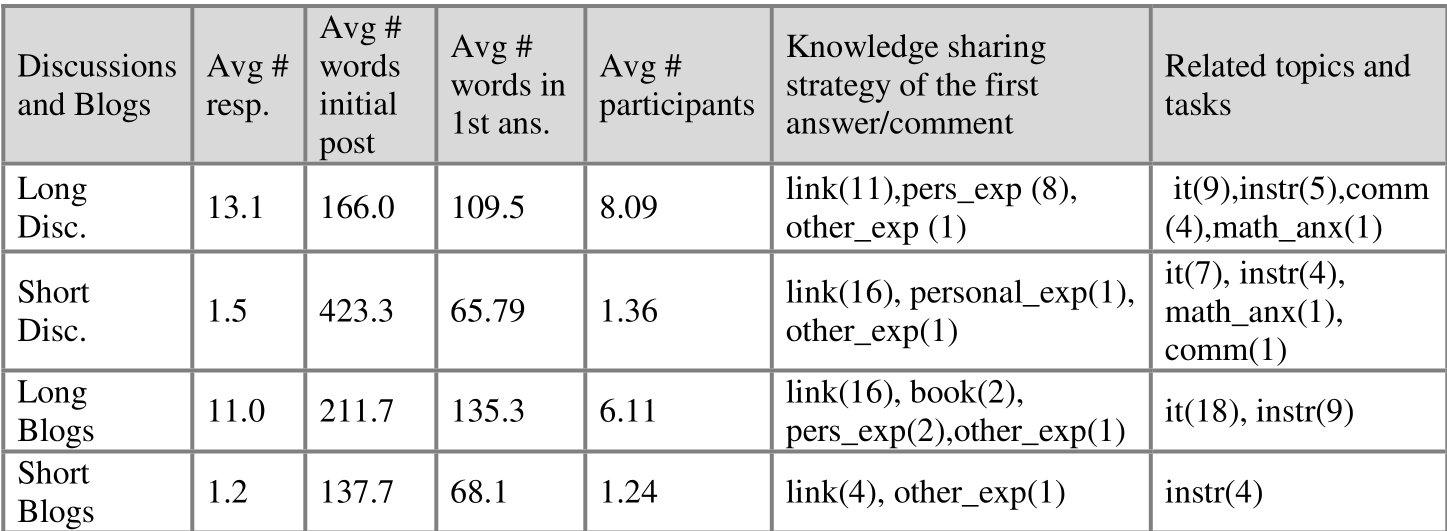 Table 2: Comparison of engagement metrics shows that first-answer word count and knowledge-sharing type are critical predictors of thread longevity.
Critical Analysis & Future Outlook
While this work is a "first step," its implications for UI/UX design in educational platforms are profound. If we know that personal experience drives engagement, platform designers should create prompts like "Have you faced this in your classroom? Share your story."
Limitations: The study relies on a relatively small sample (27 threads for deep analysis) and manual annotation. The next logical step—which the authors hint at—is using these findings to train Automated Classifiers. Imagine an AI moderator that can detect a "fading" thread and nudge a known expert to chime in with a personal anecdote to revive the mentoring process.
Summary
The value of a teacher's social network isn't just in the repository of links, but in the narrative exchange of professional wisdom. By keeping requests concise and answers rich with experience, educators can build a more resilient and interactive digital community.