
From Chaos to Randomness: Redefining Microblogging Dynamics via Random Dynamical Systems
Modeling of Microblogging Social Networks: Dynamical System vs. Random Dynamical System
This paper proposes a one-dimensional nonlinear Random Dynamical System (RDS) to model microblogging social networks like Twitter. By comparing fractal analysis and probability density functions (PDF) of empirical time series with theoretical models, the authors demonstrate that an RDS with q-exponential distribution is superior to the previously suggested three-dimensional Lorenz-Haken deterministic chaotic system.
TL;DR
Is the ebb and flow of Twitter (X) a predictable clockwork of chaos, or a roll of the dice in a complex system? This paper shifts the paradigm of microblogging modeling from 3D deterministic chaos to a one-dimensional nonlinear Random Dynamical System (RDS). By leveraging fractal analysis and Tsallis entropy, the researchers prove that social networks function as non-equilibrium systems where the "fine structure" of user activity follows a q-exponential distribution.
Background: The Limits of Deterministic Chaos
For years, researchers treated social networks as physical systems, often applying the Lorenz-Haken model—originally designed for lasers and fluid dynamics. While these models captured the "fractality" (the self-similarity) of tweet flows, they struggled with dimensionality. If a system is truly 3D chaotic, its correlation dimension should reflect that. However, empirical data from Twitter suggests a simpler, yet more "noisy" reality.
The Problem: The Dimensionality Gap
The authors identified a critical flaw in existing SOTA models. When analyzing real Twitter Time Series (TTS), the correlation dimension () reaches a saturation point at .
- Mismatch: The Lorenz-Haken model assumes three independent dynamic variables.
- Reality: Twitter data shows the phase space dimension is effectively 1.
- The Need: A transition from a deterministic 3D system to a stochastic (random) 1D system that can account for external data flows and biological-like randomness.
Methodology: The Power of Random Dynamical Systems
The researchers proposed a model defined by a Stochastic Differential Equation (SDE):
Where represents a Wiener process (noise). To find the specific form of this equation, they looked at the Probability Density Function (PDF) of tweet counts.
1. Fractal Fingerprinting
They calculated the Hurst Exponent () and Correlation Dimension () for four distinct datasets. The results (Table 1) consistently showed:
- : Saturation at one dimension.
- : Persistence (positive memory), meaning an increase in tweets today likely leads to an increase tomorrow.

2. Tsallis Entropy and the q-Exponential Law
Unlike standard Boltzmann-Gibbs entropy, Tsallis entropy is non-additive. This is perfect for social networks because a user doesn't just interact with their neighbor; they interact with the entire network. This leads to a q-exponential distribution:
Experiments & Results
The researchers tested their 1D RDS model against empirical data. By applying the Sturges rule to group Twitter data, they found that the q-exponential distribution fit the empirical observations almost perfectly, passing the statistical test at high confidence levels.
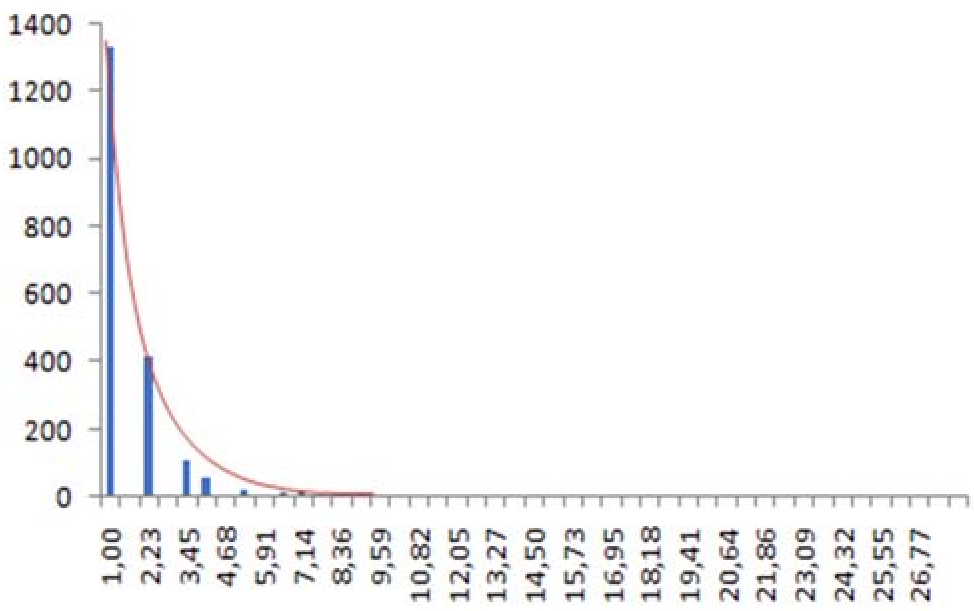 Figure: The histogram of observed tweet frequencies (bars) vs. the theoretical q-exponential curve (solid line).
Key Findings:
- Forecast Window: Using the largest Lyapunov exponent, they determined the "horizon of predictability" to be between 2 and 27 hours. This is the golden window for marketing teams to react to a trend before it becomes purely stochastic.
- Pink/Brown Noise: Most TTS exhibited noise, characteristic of complex, self-organizing systems.
Critical Insight: Self-Organized Criticality (SOC)
The most striking takeaway is the presence of Self-Organized Criticality. Because social networks operate near a "critical point," they are susceptible to catastrophic events. In this state, a single retweet (a small fluctuation) has the potential to trigger a massive, network-wide "avalanche" of information.
Conclusion & Future Outlook
This work successfully debunks the necessity of complex 3D chaotic models for microblogs, favoring a 1D Random Dynamical System that incorporates noise as a fundamental feature rather than a bug.
Limitations: While the math holds, the "physical meaning" of the specific parameters in the RDS equation (e.g., the exact nature of the multiplicative noise) remains abstract. Future research should map these mathematical coefficients to real-world sociological metrics like "user fatigue" or "algorithmic amplification."
Takeaway for Industry: If you are building a predictive model for social media, stop looking for deterministic patterns. Embrace the q-distribution; it better captures the long-tail risks and the non-additive nature of human influence.